Drilling Holes and Tightening Nuts... Hyundai Motor's 'Atlas' Hands Evolve
- Input
- 2026-10-02 08:44:19
- Updated
- 2026-10-02 08:44:19

On the 1st local time, Boston Dynamics released a video showing a next-generation robotic hand based on four fingers, along with Atlas, its humanoid robot equipped with the hand.
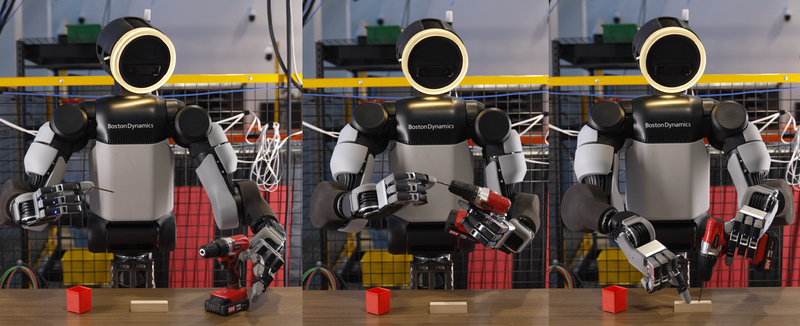
The key feature of the new robotic hand is its 13 degrees of freedom (DOF). This represents a significant expansion from the seven degrees of freedom in the previous generation. The thumb has four degrees of freedom, while each of the other three fingers has three. The hand was designed not only to grasp objects but also to precisely manipulate them by changing their position and orientation within the hand.
In the video, Atlas picked up a drill bit, inserted it into a power drill, gripped the handle, and pressed the button to drill a hole directly into a piece of wood. Rather than simply lifting a tool, the robot demonstrated how to use an actual tool while independently controlling the force and position of each finger.
Atlas also rotated a small nut with its fingertips to fasten it onto a bolt. The video additionally showed the robot rotating a drumstick in its hand and moving two golf balls simultaneously. These demonstrations were designed to showcase technology that adjusts gripping force and finger movements in real time to accommodate objects of different sizes and surface friction.
The hand's human-like size was also part of a design aimed at industrial applications. Instead of creating tools exclusively for humanoid robots, the design allows Atlas to use drills and other work tools made for humans. Boston Dynamics explained that it had also ensured the hand was strong enough to withstand the repeated impacts and demanding conditions found in industrial settings.
One notable feature is that the hand has four fingers rather than five, unlike a human hand. Boston Dynamics determined that the added design complexity, power consumption, costs resulting from the increased number of components, and maintenance burden would outweigh the manipulation performance gained by adding another finger.
Alberto Rodriguez, who leads the development of Atlas's behavior-manipulation technology, explained, "We considered a wide range of designs, from how many thumbs to include to whether a pinky finger was necessary. We conducted simulations and 3D-printed mock-ups, as well as an experiment in which members of the development team spent an entire day with their pinky fingers immobilized."
He added, "In the end, we concluded that there was no need to add a pinky finger at the cost of additional degrees of freedom and complexity."
The next-generation robotic hand also features enhanced tactile capabilities. Pressure-based tactile sensors are densely placed on the fingertips and palm to detect even subtle changes in force that occur when the hand comes into contact with an object. This enables the robot to determine not only whether it has grasped an object but also where and how much force is being applied, which it uses for precise control.
During development of the next-generation hand, Boston Dynamics also used Sim-to-Real technology, in which robots are trained in a virtual environment before the results are applied to real robots. The company simulates various conditions, including motor force and friction, object shapes, and external impacts, and uses reinforcement learning to teach the robot manipulation skills that can be applied in actual work environments.
The development effort is aimed beyond research prototypes and toward mass production. The hand was designed with a simplified structure and modularized key components to facilitate repairs when failures occur while making large-scale production feasible. The strategy treats the robotic hand itself as a system closer to a small robot, balancing not only performance but also cost, durability, and maintainability.
Boston Dynamics recently opened the Robotics Metaplant Application Center (RMAC) at Hyundai Motor Group Metaplant America (HMGMA) in the U.S. state of Georgia. At RMAC, Atlas is undergoing field trials in which it collects and learns from work data in an environment modeled on Hyundai Motor Group's actual manufacturing operations. With the addition of the next-generation robotic hand, Atlas's training for deployment in manufacturing is expected to expand beyond simple movement to precision assembly, tool use, and other tasks.
[email protected] Kim Dong-ho Reporter