Korean Interests at Stake in U.S. Midterms: Visas, Shipbuilding and U.S. Forces Korea Among the Issues [U.S. Midterms Through the Battlegrounds (6)]
- Input
- 2026-10-07 13:50:28
- Updated
- 2026-10-07 13:50:28
【Byung-cheol Lee, Financial News correspondent in New York】The U.S. midterm elections this November are not someone else’s election for South Korea, either. Many issues—from Korean companies’ investments in the United States and tariffs to visas for skilled workers, shipbuilding and semiconductor cooperation, U.S. forces stationed in South Korea, and North Korea—are tied to Congress’s legislative, budgetary and oversight powers. Depending on who is elected, the congressional channels for conveying South Korea’s voice in Washington could also change.
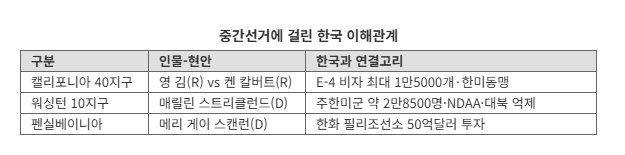
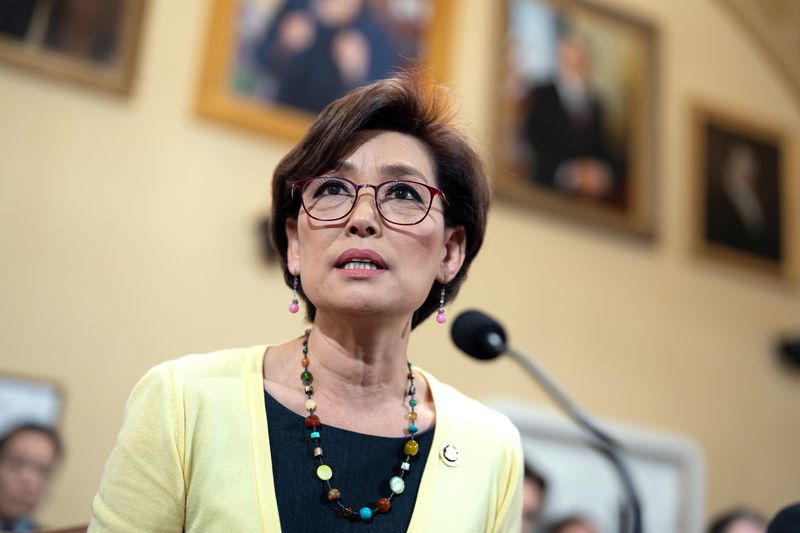
The figure drawing the most attention is Young Kim, a Korean American Republican member of the House. Kim chairs the House Committee on Foreign Affairs’ Subcommittee on East Asia and the Pacific and is one of the key Republican channels for handling U.S.-South Korea relations. This year, however, redistricting has put Kim in a fight for political survival against a longtime incumbent from the same party.■Young Kim’s Fight for Political Survival—‘Korean Visas’ Also at StakeThe November general election in California’s 40th District is unusual in that two Republican incumbents are facing off. Redistricting placed Kim and Rep. Ken Calvert, first elected in 1992, in the same district. Both advanced to the general election after finishing first and second in the June 2 primary. Calvert placed first with 35%, and Kim came second with 21%.
Calvert is a longtime incumbent who has served in Congress for more than 30 years. More than half of the new district consists of areas he previously represented. He is a formidable opponent for Kim, who was first elected in 2020 and is seeking a fourth term. In an early September Grassroots Targeting poll commissioned by a Republican-aligned group, Kim had 43% and Calvert 34%. The fact that the poll was commissioned by a particular group should be taken into account. In two polls released earlier, in July and August, Calvert led by one percentage point in each.
The reason Kim’s fight for survival is drawing attention in South Korea is not simply that Kim is Korean American. Kim chairs the House Foreign Affairs Committee’s Subcommittee on East Asia and the Pacific, co-chairs the ‘Korea Study Group in Congress,’ and has also served as co-chair of the Korea-U.S. Congressional Exchange.
The Partner with Korea Act, which has drawn the attention of Korean companies, was introduced by Kim and Democratic Rep. Sydney Kamlager-Dove last July. Its key provision is to set aside up to 15,000 E-4 visas for skilled workers each year for South Koreans with specialized training or expertise. The bill has been introduced repeatedly in previous Congresses but has not passed.
The visa issue has become more important as investment by Korean companies in the United States has surged. Even when semiconductor and battery plants are built, there are not enough suitable visa pathways to send Korean specialists for extended periods to handle the initial installation and operation.
About 475 people were arrested last year during a U.S. immigration enforcement raid at the construction site of a Hyundai Motor-LG Energy Solution battery plant in Georgia; at least 300 of them were South Korean. Since 2012, the South Korean government has asked the U.S. government and Congress for a separate visa quota. The raid gave that request greater weight. The Congressional Research Service (CRS) also cited the Partner with Korea Act as a relevant bill while analyzing the issue following the Georgia raid.■From Shipyards to U.S. Forces Korea: Korean Interests at StakeYoung Kim is not the only link to South Korea. As investment by Korean companies expands, U.S.-South Korea relations are moving beyond foreign policy in Washington and into issues of jobs and industry in U.S. congressional districts.
Korean American Democratic Rep. Marilyn Strickland is seeking a fourth term in Washington state’s 10th District. A member of the House Armed Services Committee, Strickland referred to the approximately 28,500 U.S. troops stationed in South Korea at an Indo-Pacific military posture hearing in April and asked about the readiness of the U.S.-South Korean combined forces to deter North Korea. If Strickland remains on the committee in the next Congress, the lawmaker could continue serving as a Korean American voice on U.S. Forces Korea, the National Defense Authorization Act (NDAA), and deterrence on the Korean Peninsula.
In shipbuilding, Pennsylvania has a direct connection to South Korea. The state is home to Hanwha Philly Shipyard, which Hanwha acquired in 2024. Hanwha plans to invest $5 billion there and increase annual production capacity from fewer than two ships to as many as 20. Democratic Rep. Mary Gay Scanlon, who represents the district, has also highlighted Hanwha’s investment and its impact on local jobs.
Although Andy Kim, a Korean American senator from New Jersey, is not on the ballot in this election, he is also a key figure in the next Congress. Kim is the top Democrat on the Senate Banking Committee’s Subcommittee on National Security, International Trade and Finance and a member of the Senate Committee on Commerce, Science, and Transportation. Kim works on economic security issues including international trade, advanced technology and advanced manufacturing.
Tariffs are also within Congress’s purview. In February, the U.S. Supreme Court ruled that the International Emergency Economic Powers Act (IEEPA) does not grant the president authority to impose tariffs. The Court emphasized that the Constitution gives Congress the power to tax, including the power to impose tariffs. However, tariffs imposed under laws that Congress has separately authorized, such as Section 232 of the Trade Expansion Act and Section 301 of the Trade Act, were not covered by the ruling.
The United States House Committee on Ways and Means handles tariffs and trade policy. If control of Congress changes in the midterms, the committee chair and legislative agenda will change as well. From visas to shipbuilding and semiconductors, and from U.S. forces in South Korea to tariffs, these are the reasons South Korea should pay attention to this year’s midterm elections.
[email protected] Correspondent Byung-cheol Lee Reporter