After 'OUT,' now comes 'Han Dong-hoon file'... Han Dong-hoon calls the camera-captured notebook note an "exposed political operation"
- Input
- 2026-10-02 06:40:36
- Updated
- 2026-10-02 06:40:36
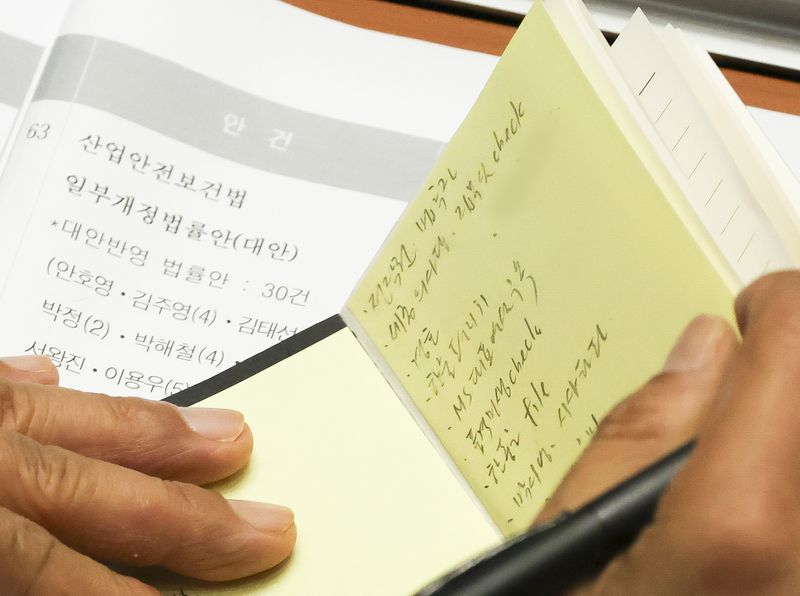
[Financial News] Tensions between the ruling and opposition parties are escalating after media cameras captured notes in a notebook that Democratic Party of Korea leader Kim Min-seok examined in the National Assembly chamber. The notes included party policy issues and phrases seemingly aimed at independent lawmaker Han Dong-hoon, drawing attention from political circles.
According to political circles on the 2nd, cameras operated by reporters captured Kim examining a notebook with yellow Post-it notes attached during the 10th plenary session of the National Assembly held the previous day.
The disclosed notes included the phrases "pushing for an OPCON law," "Sejong National Assembly Building office check," "security," "One-Line Letter TF," "Dignified Livelihood check," "Han Dong-hoon file," and "Park Si-young Sisa Tapa."
The references to "OPCON" and "pushing for an OPCON law" at the top of the page were interpreted as tasks related to the transfer of Wartime Operational Control (OPCON), which the Democratic Party of Korea is accelerating. At a launch ceremony for a task force promoting the recovery of OPCON on the 22nd of last month, Kim said, "The time has come to examine this in earnest and meticulously." The notes also included checks on the construction of the Sejong National Assembly Building and The President's Sejong Office, as well as "Dignified Livelihood check," referring to the Committee for Promoting a Dignified Society and Livelihood Stability and Reducing Disparities in the AI Era, which Kim chairs, and "One-Line Letter TF," a task force for banner messages. They covered many of the party's key policy issues currently being pursued.
The phrase "Park Si-young Sisa Tapa" was also interpreted as relating to efforts to review issues involving a pro-Democratic Party YouTuber who was referred for a party ethics investigation over allegations that the person encouraged the distortion of opinion polls during the last party convention.
The phrase that caused the biggest stir was "Han Dong-hoon file." The appearance of Han's name in Kim's notebook marked the second such incident, following last month's camera capture of a note reading "Lee Jin-sook–Han Dong-hoon OUT." Some in political circles speculated that it could refer to materials discussed during the vetting of former Justice Minister nominee Kim Seung-won or to a response strategy document targeting Han.
Han immediately pushed back. In a social media post, he described Kim's note as "an exposed political operation" and criticized him, saying, "The ruling party leader who cannot even properly speak about Rep. Kim Seung-won and North Korean mine attacks is plotting operations behind the scenes." He continued, "Are you trying to carry out a political operation directly against me? Do politics a little more 'jwa-ahage.'"
The term "jwa-a," mentioned by Han, originally refers to a Sino-Korean expression meaning that a government official goes to the government office and attends to official duties. Recently, however, it has been used online and among progressive supporters as a neologism created by replacing the "u" in "u-ahada," meaning "elegant," with "jwa," meaning "left." Earlier, President Lee Jae Myung drew attention by using the expression "Let's say it 'jwa-ahage'" while sharing government achievements on social media.
Meanwhile, the Democratic Party of Korea cautioned against excessive political overinterpretation. Lee Ji-hye, a former deputy spokesperson for the Democratic Party of Korea, dismissed the matter, saying, "It is a stretch to read excessive political intent into the appearance of one person's name in a single line of a memo," and adding, "The notebook mainly contains issues involving people's livelihoods and national security, as well as tasks the party needs to attend to."
[email protected] Moon Young-jin Reporter