"I'd Rather Open a Café Than Take Home 2.6 Million Won a Month"—55-Year-Old Retiree Puts Startup Plans on Hold After Running the Numbers [Money Planning Office]
- Input
- 2026-10-03 15:00:00
- Updated
- 2026-10-03 15:00:00

"If I'm Only Going to Get Half My Salary, I'd Rather Start a Business"
Kim Do-hyeon, 55, a pseudonym, took voluntary retirement four months ago after working in sales management at a mid-sized manufacturing company for 27 years. Recently, an acquaintance from a business partner asked whether he was interested in reemployment. He was not immediately inclined to accept when he heard the salary would be 2.6 million won a month. His take-home pay before retirement had been 5.2 million won a month.Kim thought it would be better to run his own store instead. He made plans to open a toast-and-coffee franchise near his home, occupying 33 square meters of dedicated floor space—about 10 pyeong. He believed it would be a profitable business because the couple could run it themselves and save on labor costs.
His wife, Park Seon-yeong, 53, also a pseudonym, saw things differently. Park earns 2.3 million won a month handling reception and payments at a neighborhood clinic, and she was hesitant to quit her job and jump into a startup. Their daughter had moved out, but their son still had two years left before graduating from college.
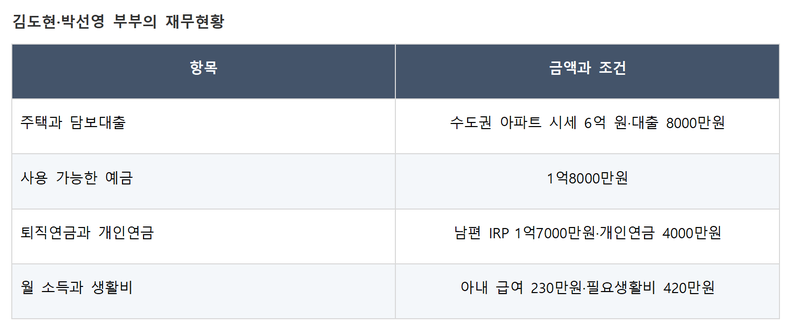
Even after opening a café, it takes time to build a stable customer base and sales. During that period, the couple must cover their fixed monthly expenses. Their monthly spending totals 4.2 million won: 2.1 million won for basic living expenses, 600,000 won for housing-loan principal and interest, 900,000 won for their son's tuition and living expenses, 300,000 won for insurance, and 300,000 won set aside for irregular expenses. At present, the wife's 2.3 million-won salary leaves them with a monthly deficit of 1.9 million won. If this continues for a year, they would have to withdraw 22.8 million won from their savings.
By contrast, if Kim finds a new job while Park keeps working, the couple's combined monthly take-home pay would be 4.9 million won, enough to cover their living expenses.
Trying to Save on Labor Costs Means Losing the Wife's Salary Too
A business does not automatically become profitable simply because a couple works together and saves on labor costs. Although they may avoid paying an employee, they would also lose the wife's salary. 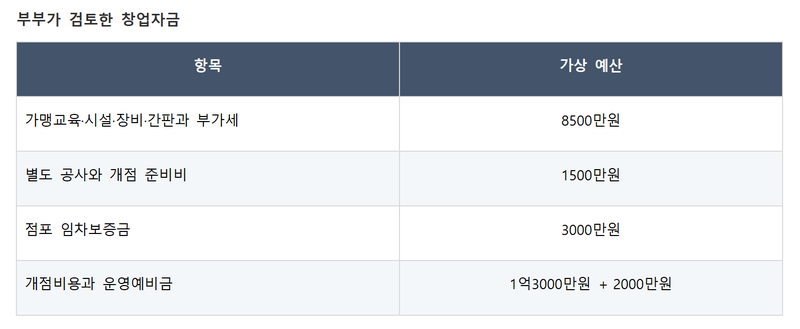
Financial planner Cho Hyeong-geun (AFPK) said, "The total startup cost should not be assessed based solely on the store-opening expenses," adding, "Additional costs may arise for items such as value-added tax and electrical-capacity upgrades." He also stressed, "Before signing a contract, you should review the information disclosure statement, franchise agreement and itemized estimates to check whether any costs have been left out."
Sales are not the same as the couple's income. After deducting ingredient and packaging costs, rent, fees, labor, utilities and taxes, they must also set aside money for the following month's operations before they can take anything home for living expenses. If the wife keeps her job, the café must generate at least 1.9 million won a month for the couple to withdraw. If she also retires, the café must generate the full 4.2 million won in monthly living expenses.
If the café operates 26 days a month—taking one day off each weekend—and stays open for 10 hours a day, its monthly operating hours alone would total 260 hours. The couple must also account for food preparation and closing duties, as well as staff to cover days off and peak business hours.
Carefully Assess the Business Prospects Before Starting Up
What they need is "one step back for two steps forward." Rather than becoming café owners immediately, they should secure their living expenses through salaries and first determine whether the store can support the couple's livelihood.If they decide to start the business, the couple plans to calculate profits and losses at three monthly sales levels: 15 million, 20 million and 25 million won. The key question is whether they can cover their living expenses and still retain operating funds even at the lower sales level.
Cho said, "You should request data from the franchisor on sales by region and store size, ingredient supply prices, royalties and advertising fees." He added, "You should ask existing franchisees about their actual working hours, number of employees and seasonal sales fluctuations. You should also examine restoration costs when closing the store and the resale value of the equipment."
The couple decided not to use their IRP, worth 170 million won, or their personal pension, worth 40 million won, for the startup. They also agreed to set aside their son's education costs and emergency medical expenses first from their savings. They established a rule that if sales fail to reach the target during the first six months after opening, or if half of their operating reserve is used, they will stop investing additional funds and reconsider whether to continue the business.
Kim will review the terms of the reemployment offer again, while Park will keep her job for the time being. They plan to decide whether to start the business after using their salaries to cover living expenses and verifying the store's profitability. The year Kim spends working after reemployment is not a delay in starting a business. It is a period for protecting their retirement assets while assessing the business's prospects.
Cho emphasized, "Starting a business after retirement can be a way to create new work and income," but added, "Even if the store does not perform as well as expected, you must leave enough money to support your daily life and retirement."
What the couple needs now is not merely enough money to start a business. They need to secure enough flexibility to make another choice even if the venture fails.
Earning, spending and saving money are lifelong routines, yet financial planning is often pushed aside. Money also has a timeline and will not wait. If we fail to make decisions at the right time, our finances are neglected; if we do not set a direction, money slips away. That is why we need to map out the flow of money across our entire lives.[Money Planning Office]supports life planning together with the Korea Financial Planning Association (IFPK), an AFPK certification institution.
[email protected] Lee Hyeon-jeong, Kim Tae-il Reporter