Even the Middle Class Lives in Rentals? Spacious Homes Near Subway Stations... Overhauling the Public Housing Paradigm [Come Out, House, Dduk-ddak!]
- Input
- 2026-10-02 07:00:00
- Updated
- 2026-10-02 07:00:00

■ Ministry of Land, Infrastructure and Transport (MOLIT)'s 'Housing Stability Plan' and the Seoul Metropolitan Government's 'Housing Welfare Measures' Launch Simultaneously
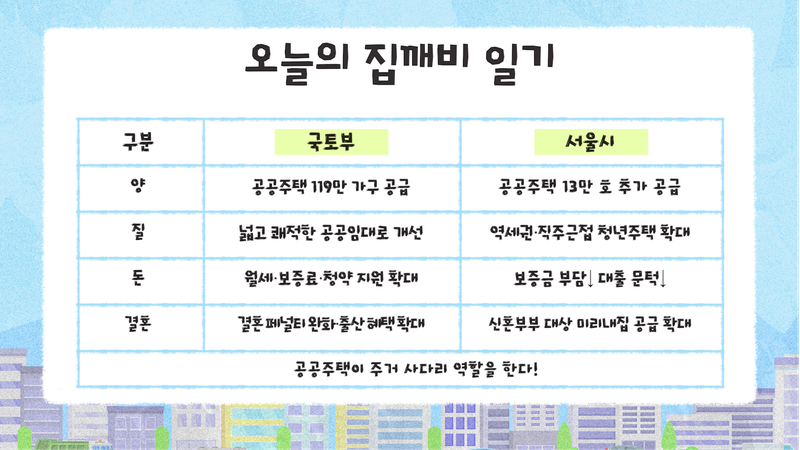
According to relevant ministries on the 2nd, the Ministry of Land, Infrastructure and Transport (MOLIT) announced the 'Housing Stability Plan' on September 21, outlining the supply of a total of 1.19 million public housing units by 2030. Of these, 920,000 units, or 77%, are planned for the Seoul metropolitan area, where demand is concentrated. If realized, the proportion of public rental housing in the Republic of Korea's total housing stock will surpass 10% by 2030. In addition, 240,000 public housing units for sale, which will provide opportunities for homeownership, will be supplied, primarily in the Third New Towns.
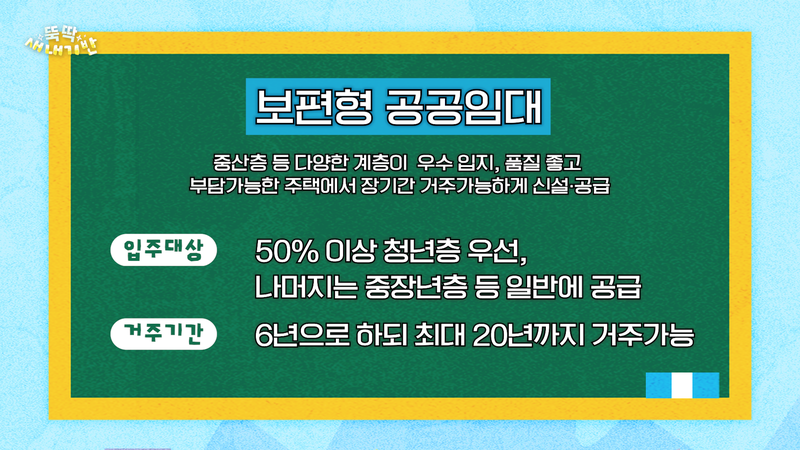
'Universal public rental housing' is also being newly introduced to break stereotypes about public rental housing. Designed to allow young people and the middle class to reside for up to 20 years, 190,000 units of universal rental housing will be supplied by 2030.
Newly constructed public rental housing will increase the proportion of medium-sized units and apply specialized floor structures designed to reduce inter-floor noise. In particular, balcony-extended floor plans will be introduced even in small homes for single-person households to significantly expand usable living space. Aging rental housing will undergo a major transformation through reconstruction and remodeling. Along with this, the plan explains that 'childcare-specialized housing' for newlyweds will be expanded and that the housing ladder will be strengthened so residents can easily move to larger homes as their families grow.
Criteria for financial support aimed at alleviating young people's housing costs will also be significantly relaxed. Starting in the first half of next year, the income threshold for monthly rent support for young people will be substantially raised from the current 1.54 million won or less to 2.74 million won or less. The eligible age will also be lowered from 19 to 18. By extending the upper age limit by up to three years, equivalent to the duration of military service, the number of beneficiaries is expected to increase approximately 2.6-fold, from the current 93,000 to 240,000. The income requirement for support for jeonse deposit return guarantee premiums, set at 65.67 million won or less, and the eligibility threshold for the Youth Dream Housing Subscription Savings Account, set at 70 million won or less, have also been raised.
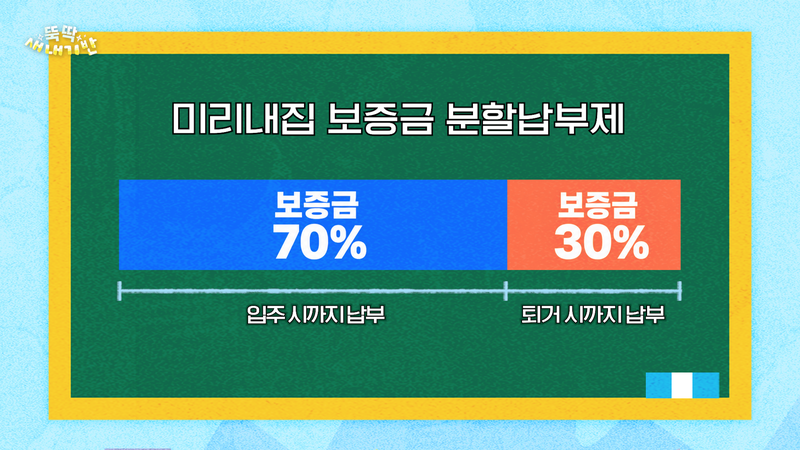
The Seoul Metropolitan Government's innovative systems also stand out. The 'deposit installment payment system,' first introduced at Jamsil Le El's 'Mirae Naejip,' allows tenants to pay only part of the deposit upon moving in and pay the remainder in installments over a certain period, providing practical relief to young people and newlyweds who find it burdensome to raise a large lump sum.
In addition, new systems are being applied to public housing for sale, which provides a realistic pathway to homeownership. The government announced the introduction of 'equity accumulation' and 'profit-sharing' schemes to enable people to purchase a home even with insufficient initial capital. The 'equity accumulation' scheme involves acquiring a small initial stake and gradually increasing one's ownership while residing in the property. The 'profit-sharing' scheme involves sharing part of the housing cost with the public and subsequently sharing any profits or losses arising from the sale of the home.
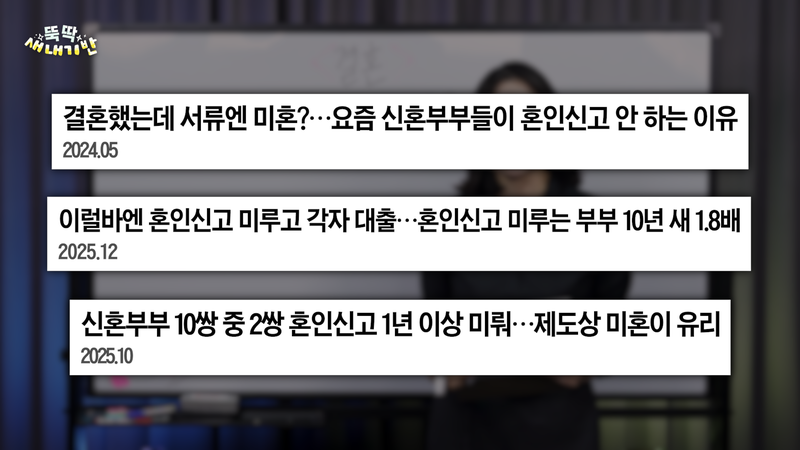
The 'marriage penalty,' which had caused young people to hesitate to register their marriages, has also been put on the operating table. The government is raising the income threshold for public rental housing for newlyweds from '1.6 times the standard for unmarried single-person households' to '2 times.' This is intended to eliminate the unfairness of dual-income couples being evicted from public housing because they exceed income limits. Furthermore, even if a young person living in public rental housing exceeds the income and asset criteria after marriage, a one-time contract renewal will be permitted, allowing them to register their marriage with peace of mind.
In addition, the eligibility threshold for housing support loans such as the Didimdol Loan and Buteumok Jeonse Loan has been lowered so that a loan can be obtained even if only one member of the couple meets the income criteria. The priority supply ratio for newlyweds within integrated public rental housing will be expanded from the current 8% to 13%. As public rental housing, like public housing for sale, serves as a reliable housing ladder, attention is focused on whether these measures can provide a practical foundation for housing stability among young people and help overcome the low birth rate.

[email protected] Jeon Min-kyung Reporter