"Crypto, RWA and STO on a Single Exchange... Next-Generation Exchange Rules Must Be Overhauled" [KBW2026]
- Input
- 2026-10-01 16:45:24
- Updated
- 2026-10-01 16:45:24
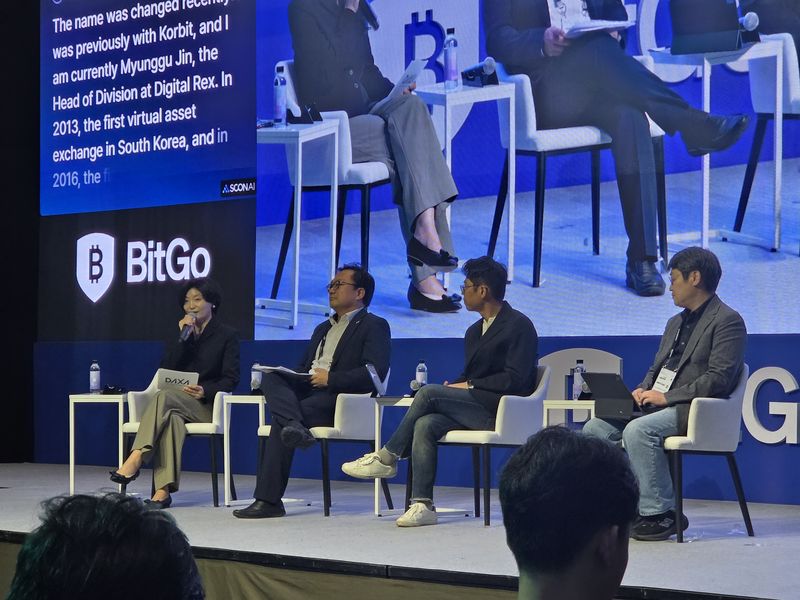
[Financial News] As the boundary between traditional finance and virtual assets rapidly breaks down, experts have called for domestic virtual asset exchanges to evolve beyond simple trading platforms into comprehensive trading infrastructure. They also said that reforms to network-separation rules, custody regulations and the overall structure of the trading market must come first.
A panel discussion on next-generation virtual asset exchanges was held on the 1st at WALKERHILL HOTELS & RESORTS in Gwangjin-gu, Seoul, as part of Korea Blockchain Week 2026 (KBW2026), Asia's largest blockchain event. Kim Jae-jin, standing vice chairman of DAXA, chaired the discussion, which was joined by Jin Myeong-gu, head of external policy at Digital X; Hwang Seon-ho, head of external relations at Dunamu; and Kang Min-gyu, director of external relations at Coinone.
Jin presented three tasks for integrating virtual assets with traditional finance: easing network-separation regulations, improving the custody system and building integrated trading infrastructure. "Under current regulations, it is difficult to use public blockchains," he said. "The United States uses public blockchains for everything from stablecoin issuance and custody to settlement. If we do not move quickly, our infrastructure could become dependent on overseas providers." He added that the Trust Act should be amended to include virtual assets in trust property and allow virtual asset service providers to take on secondary custody through sub-custody arrangements.
He also identified the market's division between security token offerings (STOs) and virtual assets as a problem. "When exchanges are fragmented, liquidity declines, making efficient price discovery difficult," Jin said. "I propose establishing an integrated-market exchange operating under a single license, where crypto, real-world asset tokenization (RWA), stablecoins and STOs can all be traded."
Hwang highlighted the pace of change in overseas markets. "Stocks such as NVIDIA and Tesla, as well as exchange-traded funds (ETFs), gold and crude oil, are being tokenized and traded, with substantial trading volumes," he said. "Ten of the top 15 perpetual futures products on overseas exchanges are linked to traditional assets." He added that the stablecoin market has grown to $300 billion and is spreading as a means of payment. "Korea's market is focused on individual brokerage, and the longer we delay our response, the harder it may become to close the gap in operational know-how," he warned.
Kang identified the lack of clear standards governing the scope of business as the biggest challenge. "There are many things we want to do, but without clear standards on what is permitted, it is difficult to decide whether to invest," he said. "We are not asking for user protection or internal controls to be relaxed. We want the areas in which we can take on challenges to be clearly defined." He also pointed out that domestic investors can use overseas exchanges, while foreign investors do not have access to domestic exchanges. Regarding the corporate market, he said, "Users should be able to choose from a variety of banks," and proposed limited-scope pilot tests as an alternative.
[email protected] Lim Sang-hyuk Reporter