Human Tissue-Derived Skin ECM: Safety and Clinical Evidence Discussed Beyond the 'Cadaver Injections' Controversy
- Input
- 2026-10-01 16:16:41
- Updated
- 2026-10-01 16:16:41
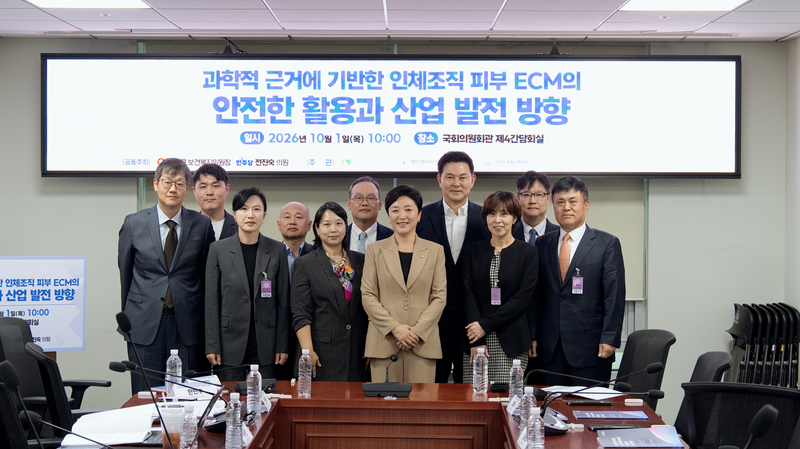
At the forum "Safe Use of Human Tissue-Derived Skin ECM Based on Scientific Evidence and Directions for Industrial Development," held at the National Assembly Members’ Office Building on the 1st, organizers unveiled a public and medical professional perception survey, real-world clinical data from multiple institutions, and examples of human tissue use in Korea and abroad. The ensuing discussion brought together medical, legal and regulatory experts to exchange views on the legal classification of skin ECM and applicable management standards.
Jeon Jeong-ae, head of the Embrain Research Center, delivered the first presentation, announcing the results of a survey on perceptions of human tissue-derived skin ECM involving 1503 consumers and 380 medical professionals.
In the survey, 80.4% of consumers said they viewed human tissue-derived skin ECM positively. Among those who had undergone related procedures, 91.5% knew that the material was derived from human skin tissue. Regarding safety, 99.2% of consumers and 99.4% of medical professionals were found to hold positive views.
Regarding the permissible use of donated tissue, 21.6% of respondents said they agreed to its use "only for treatment and reconstruction," while 63.1% agreed to its use "for legitimate medical purposes, including cosmetic procedures." Among medical professionals, 98.4% agreed to cosmetic use provided that sufficient explanations were given.
Bon-Cheol Ku, education director of the Korean Association of Dermatologists, presented retrospective real-world clinical data analyzing 433 patients and a total of 732 procedures at 16 medical institutions. The most common treatment purpose was improvement of age-related skin conditions, at 62.12%, followed by disease-related improvement at 21.48% and purely cosmetic purposes at 12.24%. Of the 433 patients, 185, or 42.73%, underwent two or more procedures. The presentation materials stated that no clear association was identified between repeated procedures and adverse reactions.
Lee Won-jae, chairman of the Korean Society of Plastic and Reconstructive Surgeons and a professor at Yonsei University, explained examples of human tissue ECM use in reconstructive medicine, as well as a traceability and follow-up management system spanning donation, processing and distribution through the post-transplantation period.
Some participants argued that legal classification should be determined through a comprehensive review of the raw materials, processing methods, final form, intended use and mechanism of action. Heo Su-jin, a lawyer at Bae, Kim & Lee, explained that under the Human Tissue Act, whether a material qualifies as human tissue is not determined solely by its processing or manufacturing method. She added that ECM products should likewise be classified legally after considering the characteristics of each individual product as a whole.
Suk-ho Moon, a professor of plastic surgery at The Catholic University of Korea Seoul St. Mary’s Hospital, emphasized the biocompatibility of human tissue in reconstructive settings. He explained that human tissue can be used to treat tissue defects or adverse effects caused by other injectable materials, and that advances in tissue-processing technology are leading to the development of forms that can be used even for small skin defects.
Noseong Kwak, co-head of the Good Regulation Citizens’ Forum and a visiting professor at Yonsei University, argued that regulatory changes should be based on confirmed safety and quality issues as well as scientific evidence. Rather than changing the regulatory system solely because of consumer perceptions or social controversy, he said authorities should first verify whether there are problems with the current management system and risks that cannot be addressed through existing measures.
Meanwhile, companies participating in Korea’s ECM market include L&C BIO, HANS BIOMED and GC Wellbeing, while related companies continue to enter the market. Accordingly, calls are growing for discussions surrounding skin ECM to move away from debates over terminology or for and against positions and instead focus on product-specific characteristics, clinical data and safety management systems.
[email protected] Jung Sang-hee Reporter