Japanese Media: "Alaska LNG Project's Economic Viability in Doubt ... Explanations from South Korea and the U.S. Diverge"
- Input
- 2026-10-01 18:44:52
- Updated
- 2026-10-01 18:44:52
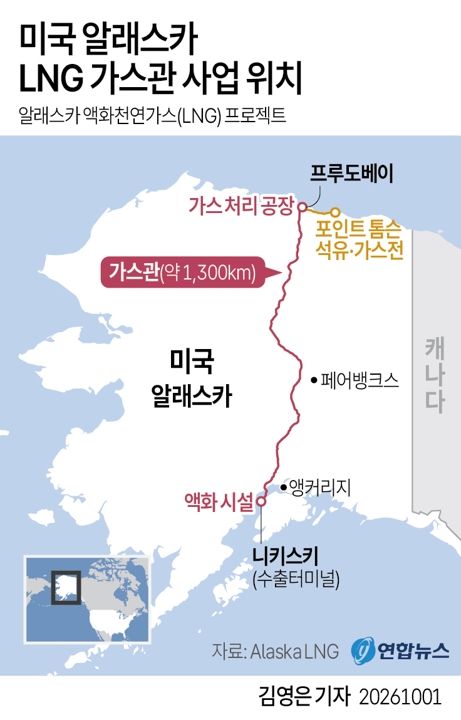
【Financial News, Tokyo—Correspondent Seo Hye-jin】Japanese media have raised questions about the economic viability of the Alaska LNG Project, for which the United States announced South Korea's investment plans. Concerns have also been raised in Japan over the cost of building a long-distance gas pipeline and the project's competitiveness in LNG pricing.
Nihon Keizai Shimbun (Nikkei) reported on the 1st that South Korean and U.S. explanations of the Alaska LNG Project differ.
U.S. Secretary of Commerce Howard Lutnick said on the 30th of last month (local time), while explaining South Korea's investment plans in the United States, that the country would invest more than $50 billion (approximately 81.8 trillion won) in the Alaska LNG pipeline. South Korean government materials, however, explicitly state that a decision on whether to proceed with the project will be made only after its commercial viability and the conditions required under relevant domestic laws have been confirmed.
Nikkei explained that, if realized, the project could become an LNG export hub to Japan, but that its long-term economic viability has long been questioned. NHK also reported, "The South Korean government has not yet decided to invest in the pipeline and plans to review it as a matter for future negotiations."
Sankei Shimbun introduced South Korean President Lee Jae Myung's statement that "confirming the project's viability is a prerequisite" for the Alaska LNG and nuclear power projects. It also reported the position that profits from the investment project should be divided 50-50 until the principal and interest are recovered, interpreting it as a check on the unilateral U.S. announcement.
■ Massive construction costs ... Burdens of securing selling prices and buyers
According to Nikkei's past reports, infrastructure costs are a major factor behind concerns over the project's economic viability. The Alaska LNG Project involves transporting natural gas from northern gas fields approximately 1,300 kilometers to the south, liquefying it, and exporting it. Both a long-distance gas pipeline and liquefaction facilities would have to be built.
An estimate reported by Nikkei last July put the total project cost at $44 billion (approximately 72 trillion won), including $11 billion (approximately 18 trillion won) for the gas pipeline alone. Nikkei Business explained that the pipeline would have to cross three mountain ranges and hundreds of rivers, while the construction season in the Arctic Circle is also limited.
Takafumi Yanagisawa, a senior researcher at the Institute of Energy Economics, Japan, pointed out at the time that project costs were highly likely to increase after taking inflation and tariff impacts into account.
High costs could also put pressure on LNG selling prices. Citing an executive at a Japanese general trading company last August, Nikkei reported that the selling price could be higher than that of conventional LNG when the use of a long-distance gas pipeline is taken into account, making it difficult to secure buyers.
Japanese companies have also remained cautious about investing. Katsuya Nakanishi, president of Mitsubishi, said last April that the project had been discussed several times and would be highly challenging because it would require a 1,300-kilometer gas pipeline. Daisuke Yamada, a director at INPEX, also questioned in May of the same year whether it was a project that private companies could pursue while expecting it to be economically viable.
■ Coal-fired power plant plans could become a headwind for the LNG project
The U.S. plan to build coal-fired power plants in Alaska is another variable. Nikkei reported on the 8th of last month that a plan to build coal-fired power plants with a combined output of 1.25 million kW and carbon capture and storage facilities around Anchorage could become a headwind for the Alaska LNG Project.
The first phase of the Alaska LNG Project calls for building a pipeline from northern gas fields to the south and selling the gas to the Anchorage metropolitan area, which is experiencing gas shortages. Once the pipeline's commercial prospects become clear, liquefaction facilities would be built in the second phase. Nikkei pointed out, however, that if the coal-fired power plants eliminate the local gas shortage, the profitability of the first-phase pipeline project would become uncertain, potentially making investment more difficult.
Its location close to Asia is an advantage. LNG could be transported from southern Alaska to Tokyo Bay in approximately eight days, making it more favorable for supplying Asia than the U.S. Gulf Coast.
Japanese media also discussed the political background of the announcement. A Republican senator from Alaska, where the outcome of the November midterm elections is attracting attention, attended the event. President Donald Trump emphasized, "A tremendous victory for the people of Alaska."
Nikkei analyzed that "there is an intention to highlight economic policy achievements through investment in a closely contested area," while Sankei described the announcement of some projects before final agreements as "a hasty move."
[email protected] Seo Hye-jin Reporter