Korean Display Industry Faces Growing Competition from China... "Tax and Infrastructure Support Urgently Needed"
- Input
- 2026-10-01 16:17:29
- Updated
- 2026-10-01 16:17:29
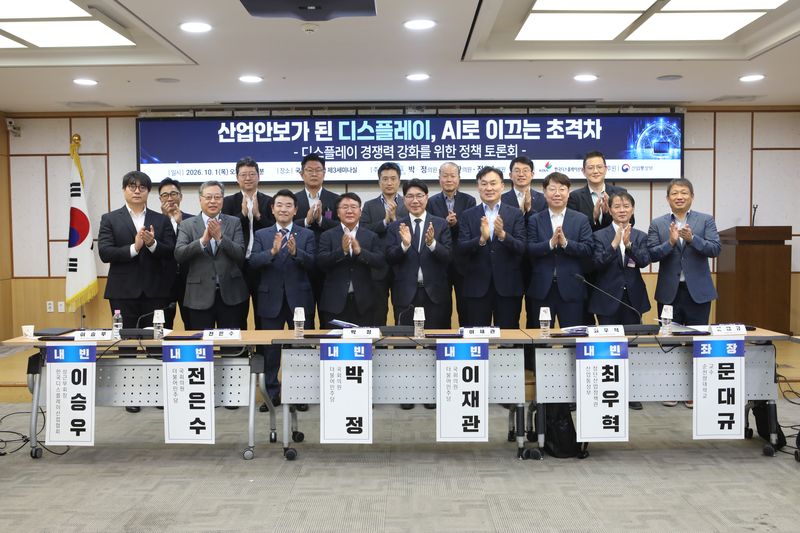
[Financial News] The domestic display industry called in one voice for expanded tax and infrastructure support to maintain its technological lead over China. Speakers said the system should be improved so companies can receive tax credits for large-scale investments on time, while production infrastructure such as power and water supplies must be expanded as needed.
■ Samsung Display and LG Display: "Tax and Infrastructure Support Needed to Maintain Technological Lead"Chul Heo, a vice president at Samsung Display, attended a policy discussion held at the National Assembly Members' Office Building in Yeouido, Seoul, on the 1st and said, "Along with extending the carryforward period for tax credits for national strategic technologies and abolishing their sunset clause, the government needs to provide timely infrastructure support for power and water supplies. It must also strengthen policy support so that small and midsize companies and research institutes can continue developing meaningful new technologies."
The industry is preparing for markets involving new forms of displays, such as foldable and slidable displays, as well as next-generation microdisplay technologies. However, maintaining its technological edge will require continued support at the national level alongside corporate investment.
Lee Han-gu, a group leader at LG Display, identified a direct-refund system for investment tax credits as a policy priority. Because the industry is capital-intensive, with large-scale facility investments and R&D expenses, companies that post losses have no corporate taxes due immediately, making it difficult to use tax credit benefits on time.
Lee emphasized, "For companies' efforts to bear fruit, bold policy support must be provided, including the introduction of a 'direct refund system' that offers tangible benefits in the year an investment is made and improvements to the 'local preference index' to reflect the unique circumstances of border areas."
The need to support border areas such as Paju was also raised. The point was that assessing regional conditions solely based on physical distance from Seoul does not sufficiently reflect the difficulties faced by companies and partner firms in border areas.
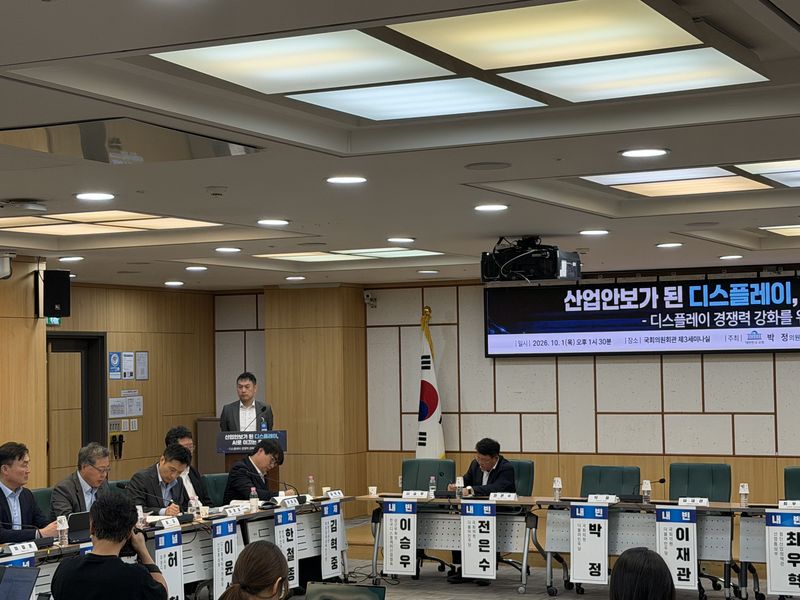
Han Cheol-jong, a center director at the Korea Electronics Technology Institute (KETI), said, "As Chinese companies are mounting an offensive by fully adopting AI across the entire manufacturing process, we must build a government-led AI data-sharing system and infrastructure and launch a speed-driven race to maintain a decisive technological lead."
Speakers also called for self-driving laboratories, where AI repeatedly runs experiments from design through evaluation to accelerate materials development, as well as shared infrastructure available to small and midsize companies.
There were also calls to spread the results of large companies' AI adoption to materials, parts, and equipment companies. Lee Sang-jin, an executive director at the Korea Display Industry Association (KDIA), said, "It is urgent to provide funding and consulting to small and midsize materials, parts, and equipment companies that lack AI and data infrastructure, along with mutually supportive assistance for artificial intelligence transformation (AX) through the spread of AI models from large companies." He added, "Government support must follow to underpin the development of next-generation technologies and the expansion into new markets such as defense and mobility."
An analysis was also presented that the display supply chain should be managed from the standpoint of industrial security. Kim Hyeok-jung, an associate research fellow at the Korea Institute for International Economic Policy (KIEP), explained that security concerns over dependence on Chinese-made displays have been raised, particularly by the U.S. government and major think tanks.
Ahn Sang-nam, a director at the Korea Defense Industry Association, emphasized, "Demand for next-generation displays is rising as the defense sector advances technologically, including through drones and unmanned systems. Measures must be prepared together to secure a military display ecosystem that remains resilient even in emergencies and to ensure the stability of the domestic supply chain."
[email protected] Ji-yeon Park Reporter