Climate Minister Kim Seong-hwan: "Renewable Energy to Increase by More Than 10 GW Annually Starting Next Year"
- Input
- 2026-10-01 16:00:00
- Updated
- 2026-10-01 16:00:00
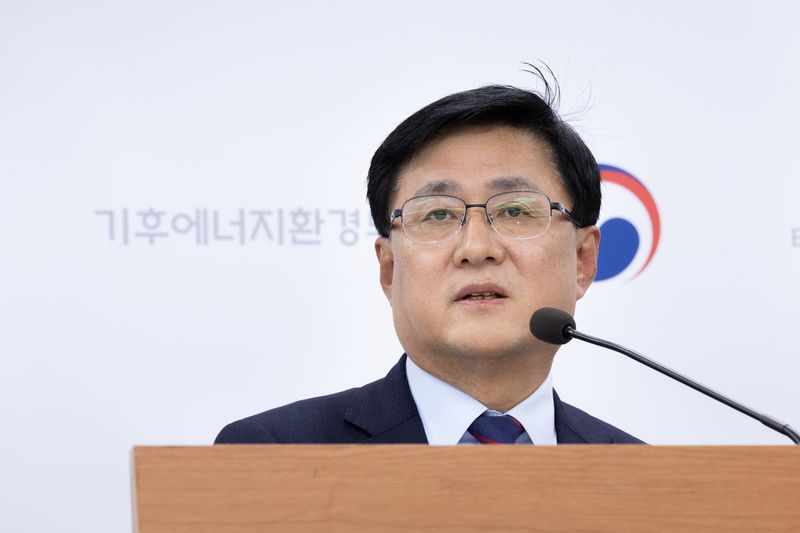
[Financial News] Kim Seong-hwan, minister of the Ministry of Climate, Energy and Environment, said renewable energy deployment would increase by more than 10 GW annually starting next year. However, he acknowledged that the government had made virtually no progress on measures to address algal blooms or reduce greenhouse gas emissions.
At a press briefing on the first anniversary of the Ministry of Climate, Energy and Environment, Kim said the 2030 target of 100 GW of renewable energy would be "a difficult task, as we are currently just short of 40 GW and need to add 60 GW over the remaining period." He explained that over the past year, the ministry had focused on laying the institutional groundwork, including improving distance regulations, reforming the Renewable Portfolio Standard (RPS), revising laws to expand Sunlight Income Village projects, and introducing power-grid innovation measures that use the existing grid. He added, "At least in solar power, more than 10 GW will be possible starting next year," stressing, "It is difficult for a plane to take off, but once it is airborne, it can travel far. We are at that stage now."
Electrification on the demand side was cited as a visible change. The share of electric vehicles among new vehicles has risen to 23%, helped by the introduction of conversion subsidies for replacing internal-combustion vehicles with electric cars. Kim projected that the figure would surpass 30% next year, saying, "They say that once a product exceeds a 30% share of purchases, it becomes the psychological mainstream." The government also plans to accelerate decarbonization in the building sector next year by constructing apartments without gas pipelines.
Regarding the sluggish reduction in greenhouse gas emissions, Kim apologized, saying, "There is an aspect in which we failed to reduce carbon as much as targeted, and I am sorry." He explained that gas prices rose amid the war in the Middle East this year, leading to a short-term reversal in which coal-fired power plants slated for closure were operated more and gas-fired generation was reduced. He added that some of the apparent effect was attributable to an optical illusion created by standardizing reduction criteria around net emissions and changing statistical guidelines. Kim predicted that reductions in the power sector could be delayed further because of demand from AI and semiconductors. Regarding overseas emissions reductions, he said, "We need a process of distinguishing what we can actually do from what we cannot do, and acknowledging what we need to acknowledge." The Ministry of Climate, Energy and Environment plans to compile and announce the status of emissions-reduction implementation early next year.
Kim also outlined the direction of electricity-rate reform. The government is designing a dedicated rate plan for AI data centers, which have so far been covered by the general-use electricity tariff. He stressed, "If tofu is supplied at a lower price than soybeans, someone has to bear the cost, but at least we do not intend to do that," adding, "There will be no increase in KEPCO's cost burden or in the electricity-bill burden on the general public." Criticizing the previous administration, he said, "There is an aspect in which raising only industrial electricity rates by more than 10% significantly weakened the competitiveness of domestic industry." He added that the government would soon finalize regional electricity rates for industrial users to ease the burden on businesses.
In water management, Kim admitted, "Personally, the most disappointing part was the response to algal blooms." The seasonal algal-bloom management program implemented this year had little effect because insufficient preparations coincided with a drought. The ministry plans to introduce measures next year to fundamentally reduce nonpoint pollution sources flowing into rivers and increase water flow. A research project on measures for the Four Major Rivers weirs will be completed in October, with the results released sequentially for each river. Kim explained that the plan for Dongbok Dam, which supplies water to a semiconductor complex in the southwestern region, had been changed because adding concrete to the existing dam, built with soil and gravel, could create safety problems. Instead, a taller dam will be built behind the existing one.
The organizational integration has now been completed physically. The energy division that had remained in the Trade and Industry Ministry building recently moved to the Ministry of Climate, Energy and Environment building. Regarding the substantive integration of employees from the former Environment Ministry and the Ministry of Trade, Industry and Energy, Kim said, "The most important thing is fairness in the personnel process," adding, "There has not been much friction for an integrated department."
Regarding the construction of eight nuclear power units in the United States agreed upon by South Korea and the United States, Kim said the matter falls under MOTIE's jurisdiction but added, "I do not think it will have a major impact on South Korea's nuclear power industry." The Ministry of Climate, Energy and Environment plans to establish a nuclear power public deliberation committee soon and begin gathering opinions in earnest. Responding to criticism that discussions on the 12th Basic Plan for Electricity Supply and Demand were merely an exercise in building a pretext, he said, "It is very different from the past," comparing the process with that of the 11th plan, when even the committee members had not been disclosed.
[email protected] Lee Yu-beom Reporter