Tiny pump takes over for the heart as Severance Hospital successfully completes high-risk procedure with Impella
- Input
- 2026-10-01 15:40:48
- Updated
- 2026-10-01 15:40:48
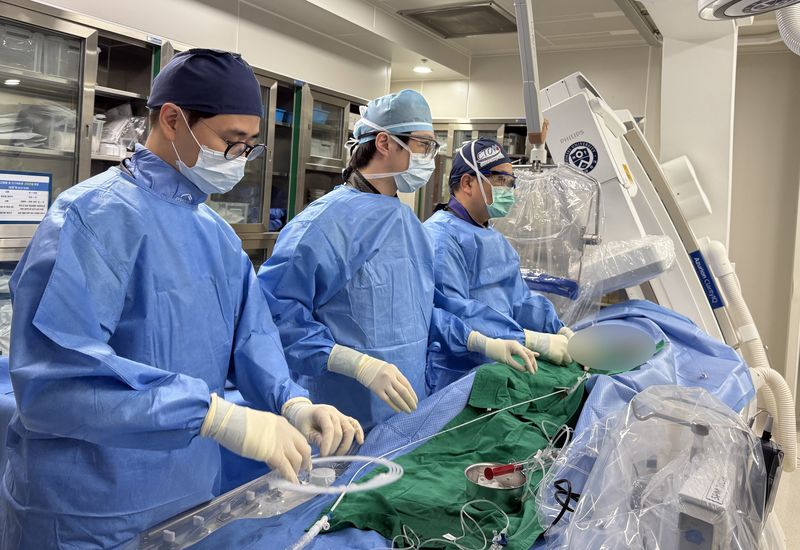
[Financial News] A tiny pump called Impella, which pumps blood in place of the heart, has made it possible to perform a coronary intervention on an elderly patient who underwent transcatheter aortic valve implantation (TAVI).
The team led by Professors Ahn Chul-min and Lee Sang-hyeop of the Department of Cardiology at Severance Hospital announced that it had successfully performed high-risk percutaneous coronary intervention (PCI) on an 86-year-old patient identified only by the surname Kim on the 14th of last month, with Impella inserted. This was the first high-risk coronary intervention using Impella in a TAVI patient in South Korea.
Mr. Kim underwent coronary artery bypass grafting (CABG) in 2010, followed by TAVI in July this year. CABG is a surgery that creates a bypass using another blood vessel in place of a narrowed or blocked coronary artery. TAVI treats a narrowed aortic valve by inserting an artificial valve through a blood vessel without opening the chest.
The patient was elderly, had already undergone two heart treatments, and had reduced cardiac function. As a result, conventional PCI carried a substantial risk of death from cardiogenic shock during the procedure. Severe vascular calcification also raised concerns that blood flow might not be maintained adequately during the intervention.
The medical team inserted Impella first to prevent cardiogenic shock during the procedure and maintain stable blood circulation. Impella is a slender pump device inserted into the heart through the femoral artery. It draws blood from the left ventricle and sends it directly to the aorta, taking over the heart's pumping function. This helps maintain blood flow to vital organs, including the coronary arteries, brain, and kidneys, even during shock. Because it is less burdensome to insert than extracorporeal membrane oxygenation (ECMO), it is an advanced device that can be used for patients with cardiogenic shock or coronary artery disease facing high procedural risks.
With the assistance of Impella, Mr. Kim completed the procedure. After being monitored in the intensive care unit, he was transferred to a general ward the following day and was discharged on the 18th of last month after recovering.
This is the only reported case in South Korea in which high-risk PCI was performed on a TAVI patient among domestic cases involving Impella. Its significance lies in offering a new treatment option for elderly, high-risk patients who have undergone both heart surgery and aortic valve intervention.
Professor Ahn Chul-min said, "Given the patient's cardiac function and coronary artery condition, the risk of unstable blood pressure and systemic circulation during the procedure was extremely high. Thanks to Impella, we were able to reduce the burden on the heart and maintain blood circulation, allowing us to safely treat the severely calcified lesion."
Professor Lee Sang-hyeop said, "Impella enables active coronary treatment for patients whose conditions made treatment difficult using conventional methods alone in a state of cardiogenic shock. We will closely assess each patient's condition, select appropriate candidates, and continue building a safe treatment system."
[email protected] Jung Myung-jin, medical correspondent Reporter