Jeju Seeks National Grid Connection for 2.4GW Chuja Offshore Wind Power Project, Appeals to National Assembly of the Republic of Korea for 40MW AI Data Center
- Input
- 2026-10-01 15:21:53
- Updated
- 2026-10-01 15:21:53
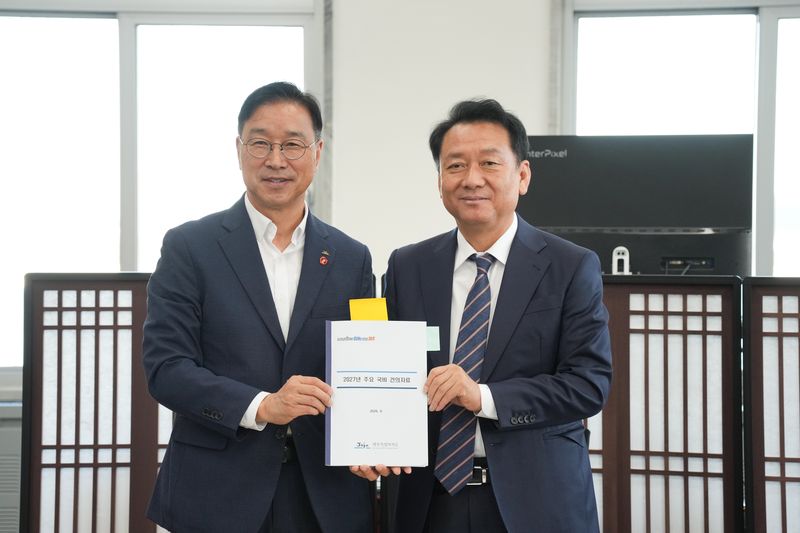
【Financial News | Jeju—Jung Yong-bok, reporter】 Jeju Province has begun lobbying the National Assembly to connect the 2.4GW Chuja Offshore Wind Power Project to the national power grid and build a 40MW AI data center powered by renewable energy. After holding a budget policy consultation with the Democratic Party's leadership the previous day, the province on the first visited the chairs and secretaries of National Assembly standing committees responsible for the budget, climate and energy, and science and technology to request national funding and institutional improvements.
Wi Seong-gon, governor of Jeju Special Self-Governing Province, met in succession at the National Assembly with Park Ji-hye, secretary of the Special Committee on Climate Crisis; Lee Kwang-jae, chair of the Special Committee on Budget and Accounts; Choi Ki-sang, secretary of the Committee on Climate, Energy, Environment and Labor; Han Jun-ho, secretary of the Science, ICT, Broadcasting and Communications Committee; and Song Ki-heon, chair of the same committee.
The meetings were follow-up events held before the National Assembly's budget review began in earnest, allowing Jeju to explain the need for individual projects directly to the relevant standing committees.
The first issue raised was connecting Jeju's offshore wind power to the national grid. Jeju Province asked that the 12th Basic Plan for Electricity Supply and Demand include national-grid access for the Chuja Offshore Wind Power Project and infrastructure for demonstrating floating offshore wind power.
The Chuja Offshore Wind Power Project described by Jeju Province has a capacity of 2.4GW. The province estimates that Jeju can absorb no more than about 1GW of electricity on its own, meaning that local consumption alone would not be sufficient if power generation increases.
National-grid access would establish the infrastructure needed to transmit electricity generated in Jeju to other regions instead of consuming it only on the island. Jeju argued that expanding renewable-energy generation facilities alone is not enough; the grid must also be secured to transmit and consume the electricity produced.
Jeju Province also explained its "Wind Pension" initiative, under which residents share in the profits from power-generation projects. Citing the Suwon-ri offshore wind power project, in which 1,070 residents formed a cooperative, invested 300 eok won (30 billion won), and shared the profits, the province emphasized that sharing the economic benefits of power generation with local communities could increase public acceptance.
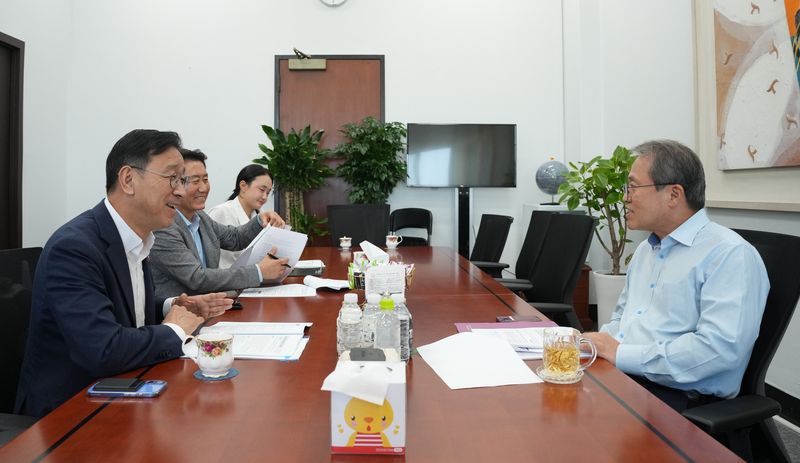
Jeju Province also called for improvements to the electricity tariff system. It argued that Jeju bears higher transmission-use charges from Korea Electric Power (KEPCO) than the Seoul metropolitan area and said the system should be revised so that the costs of high-voltage direct current transmission (HVDC) facilities linking Jeju and the mainland do not fall on the region.
The province also proposed measures to address local-government finances affected by the expansion of electric-vehicle adoption. Jeju Province said that more than 50,000 electric vehicles are registered on the island, accounting for 12.2% of the national total, but tax exemptions are reducing local tax revenue while increasing the burden of matching local funds. It requested a compensation mechanism using the Climate Response Fund and other resources.
In science and technology, Jeju bundled renewable energy and AI into a single project. The province explained its Jeju-region AI transformation (AX) project and plan to build a 40MW renewable-energy-based AI data center to Song Ki-heon, chair of the Science, ICT, Broadcasting and Communications Committee, and Han Jun-ho, the committee's secretary.
The project received 5 eok won (500 million won) in planning research funds during last year's National Assembly budget review. Jeju Province requested follow-up funding so that, once the research service is completed, the project can move to the proof-of-concept (PoC) stage to verify whether its technology and business model work in real-world conditions.
The plan combines wind and solar power with an Energy Storage System (ESS) to supply the electricity needed by the data center from renewable sources.
AI data centers are facilities that continuously consume large amounts of electricity. Jeju Province is pairing renewable-energy generation with a data center to link power production and consumption within the region, reduce the burden of power curtailment, and create new electricity demand.
Jeju Province also asked the Science, ICT, Broadcasting and Communications Committee to support efforts to attract Global AI Hub Jeju. It cited four international schools, a visa-free entry system, and an international airport as advantages for attracting the hub. The province also explained that Jeju had not achieved sufficient success in attracting international organizations since being designated an International Free City in 2002, emphasizing the need to establish an international base for AI on the island.
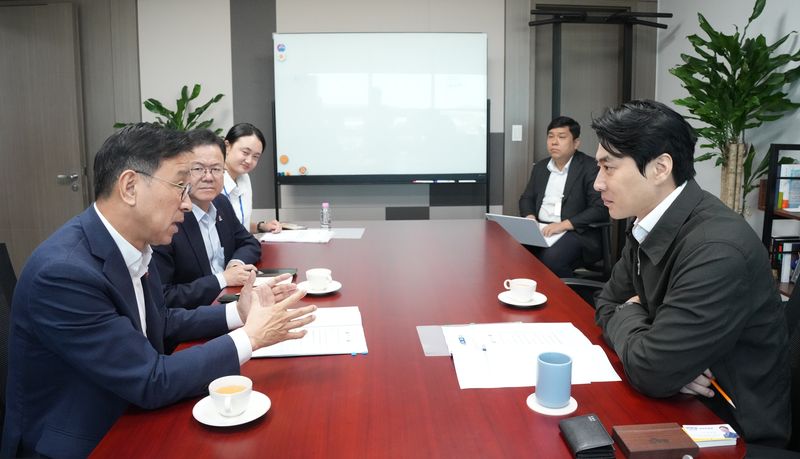
Alongside its national budget-funded projects, Jeju Province also put the second phase of public-institution relocations back on the agenda. It cited Jeju's share of domestic racehorse production as a reason to relocate the Korea Racing Authority (KRA), and the fact that Jeju International Airport is connected to major airports nationwide as a reason to relocate Korea Airports (KAC).
Jeju Province also requested support for hosting the 2028 Group of Twenty (G20) summit in Jeju. It explained that the island has the accommodation and conference infrastructure needed for a summit-level international event, including 20 five-star hotels.
The province also brought up the issue of air-service capacity. Jeju Province explained that Jeju International Airport received 2,800 eok won (280 billion won) in investment for facilities capable of handling up to 40 operations per hour, but actual operations remain at about 35 per hour. It said a study is needed to verify the effects of expanding the infrastructure and the potential to increase the supply of air seats.
Jeju Province also proposed introducing a "distance-equivalence scheme" under which the government would cover the additional travel costs incurred by residents of island regions. Citing similar systems in Greece, Spain, Portugal, and France, the province argued that transportation-cost gaps arising from the geographic conditions of islands should be addressed as a matter of national policy.
The lawmakers who attended the meetings said they would review budget and institutional-improvement issues in their respective areas of responsibility.
Governor Wi Seong-gon requested, "Please review Jeju's national budget-funded projects and major pending issues for next year during the standing committee review process so that they can be reflected in the government budget and policies."
The National Assembly visit was notable for targeting both budget allocations and institutional improvements. Securing national funding is the priority for the AI data center and AX project, while connecting the Chuja Offshore Wind Power Project to the national grid, revising the electricity tariff system, and introducing the distance-equivalence scheme require changes to government plans or existing systems.
[email protected] Jung Yong-bok Reporter