5% operating-profit surcharge for multiple, repeated industrial accidents... Occupational Safety and Health Act amendment passes National Assembly
- Input
- 2026-10-01 15:59:16
- Updated
- 2026-10-01 15:59:16
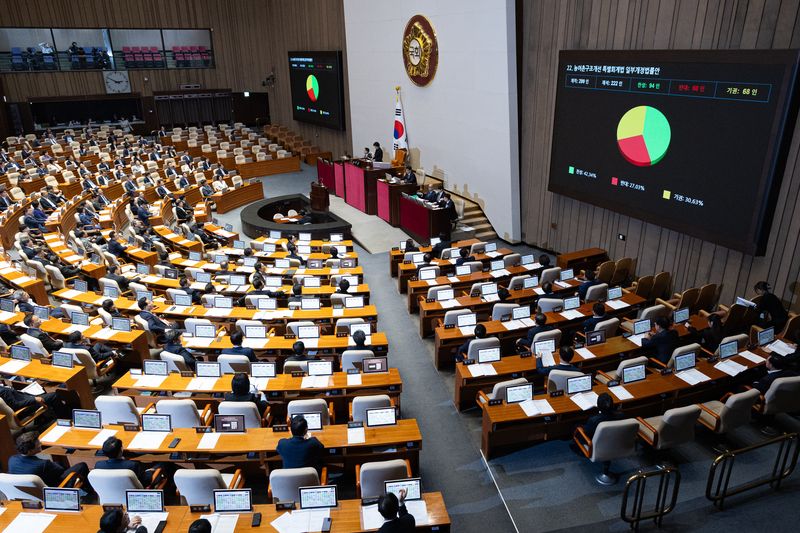
The National Assembly of the Republic of Korea considered 63 bills during the session and passed 62 of them. In particular, the amendment to the Occupational Safety and Health Act, pushed through by the pro-government bloc, cleared the legislative hurdle despite major differences between the ruling and opposition parties. The Democratic Party of Korea and the broader pro-government bloc have emphasized the need for the amendment, saying it would impose a surcharge in the nature of punitive damages of up to 5% of operating profits on employers responsible for multiple and repeated industrial accidents, thereby creating an incentive to improve safety at industrial sites.
The People Power Party, however, argued that a surcharge of up to 5% of operating profits, as proposed by the Democratic Party of Korea and the broader pro-government bloc, was excessive. It proposed setting a KRW 5 billion cap on the surcharge, but the proposal was ultimately rejected.
Kim Wi-sang, a People Power Party lawmaker who took part in the opposition debate, said, "I—and the People Power Party—agree 100% that industrial accidents must be reduced," but added, "We must carefully consider whether our society can withstand the economic side effects that could arise from taking an unreasonable approach." His argument was ultimately unable to overcome the pro-government bloc's overwhelming number of seats.
The remaining 61 bills were also processed during the plenary session, including an amendment to the Animal Protection Act introducing an "animal-keeping prohibition order" system that would allow people at risk of repeating animal abuse to be prohibited from keeping animals.
Meanwhile, an amendment to the Act on Special Accounts for Structural Improvement of Agricultural and Fishing Villages, introduced by Democratic Party of Korea lawmaker Lee Gae-ho, ultimately failed to clear the National Assembly of the Republic of Korea. The amendment's key provision was to expand the scope of transfers from the account for projects funded by the Special Tax for Rural Areas to the entire Special Account for Balanced Regional Development. Kim Young-hwan, a Democratic Party of Korea lawmaker who took part in the opposition debate, criticized the bill as legislation that would retroactively legitimize transfers made over the past three years without a legal basis. He urged lawmakers to oppose it, saying that using funds intended to support farmers and fishers for projects that should be funded by the general account would undermine the purpose of establishing the special account. The amendment was ultimately rejected, with 94 votes in favor, 60 against and 68 abstentions among 222 members present.
The amendment to the Urban Improvement Act, which had initially been expected to be placed on the plenary session's agenda, was also not tabled. Its key provision was to grant an incentive allowing developers of public redevelopment projects to build up to 1.3 times the statutory maximum floor area ratio. The People Power Party had argued that the incentive should also be extended to private-sector developers, revealing its differences with the Democratic Party of Korea.
The government and ruling party, which face an urgent need to increase housing supply, had expressed their determination through the previous day to push the bill through. However, with newly appointed Ministry of Land, Infrastructure and Transport (MOLIT) Minister Hong Ji-sun and Seoul Mayor Oh Se-hoon scheduled to discuss housing supply, they withdrew their intention to force the bill through and decided to monitor the situation first. The People Power Party consequently shelved its filibuster option—a limitless debate legally permitted under the National Assembly Act to obstruct legislative proceedings. The Democratic Party of Korea said it would pursue passage of the bill while monitoring discussions between the government and Seoul.
[email protected] Kim Hyeong-gu Reporter