Even as Gains Slow, September DRAM and NAND Prices Hit Record Highs Again
- Input
- 2026-10-01 19:59:00
- Updated
- 2026-10-01 19:59:00
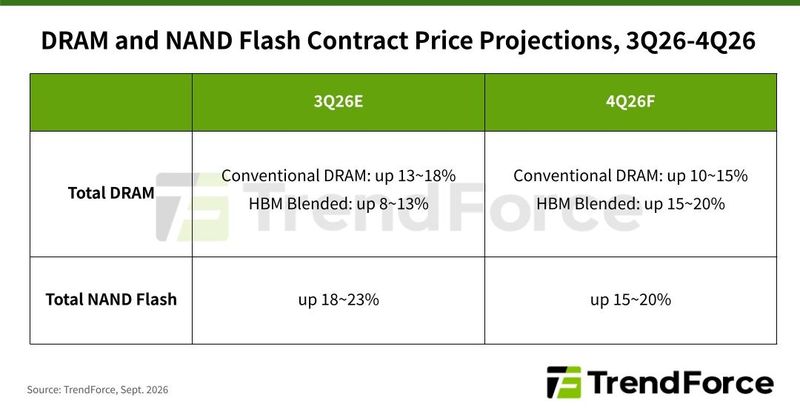
[Financial News] The monthly average prices of DRAM and NAND flash hit record highs last month. Memory demand has surged amid the artificial intelligence (AI) boom, while a worsening shortage of memory supplies continues to drive up prices for general-purpose DRAM. TrendForce expects DRAM prices to rise further in the fourth quarter as PC DRAM supplies decline. It also forecasts that memory semiconductor companies will continue to post record-breaking results through the end of the year.
According to market research firm DRAMeXchange on the 1st, the average fixed transaction price of the general-purpose PC DRAM product DDR4 8Gb 1Gx8 was $26 in September, up 4.0% from $25 the previous month.
TrendForce expects PC DRAM supplies to decline as suppliers shift production capacity to server DRAM. As a result, it sharply raised its forecast for PC DRAM price increases in the fourth quarter from 3–8% to 13–18%.
The average fixed transaction price of the general-purpose NAND product used in memory cards and USB devices, 128Gb 16Gx8 MLC, was $30.6 in September, up 0.4% from $30.5 the previous month. Prices have risen for 21 consecutive months.
TrendForce analyzed that MLC prices have already reached high levels and that buyers are facing a growing cost burden, significantly reducing their ability to accept further price increases. It added that prices are expected to remain high in the fourth quarter, with the market likely to follow a trend close to flat.
There are also optimistic forecasts that strong prices and earnings growth for general-purpose DRAM and NAND flash could continue beyond next year.
Sanjay Mehrotra, CEO and chairman of Micron Technology, which posted record quarterly and annual results on the same day, responded to a question about concerns that the memory industry may have peaked during the company's fiscal 2026 fourth-quarter earnings call covering June through August. "We expect demand to exceed supply in 2027 and 2028, and we believe supply and demand will be tighter than this year," he said. "It is difficult to gauge when supply and demand will return to balance."
Micron Technology expects the memory semiconductor supply shortage to persist because of the structure of HBM production. Compared with general-purpose DRAM of the same capacity, HBM requires more wafers to produce. As the share of HBM grows and products become more complex, less production capacity can be allocated to general-purpose DRAM.
Micron Technology's fourth-quarter revenue for June through August was effectively driven by its Core Data Center business, where demand for AI servers and HBM is concentrated. The business posted a record $18 billion, more than 11 times higher than a year earlier.
Expectations are also mounting for Samsung Electronics and SK hynix to report strong third-quarter results as expanded HBM sales coincide with higher prices for general-purpose DRAM and NAND.
According to financial information provider FnGuide on the same day, Samsung Electronics' third-quarter operating profit is forecast at 108.6786 trillion won. If the forecast proves accurate, Samsung Electronics will surpass 100 trillion won in quarterly operating profit for the first time. SK hynix's third-quarter operating profit is projected at 77.2214 trillion won, bringing the two companies' combined estimated operating profit to 185.9 trillion won.
[email protected] Park So-hyun Reporter