NAVER and Kakao Unions Form First United Front, Speak with One Voice for "Integrated Bargaining"
- Input
- 2026-10-01 16:37:27
- Updated
- 2026-10-01 16:37:27
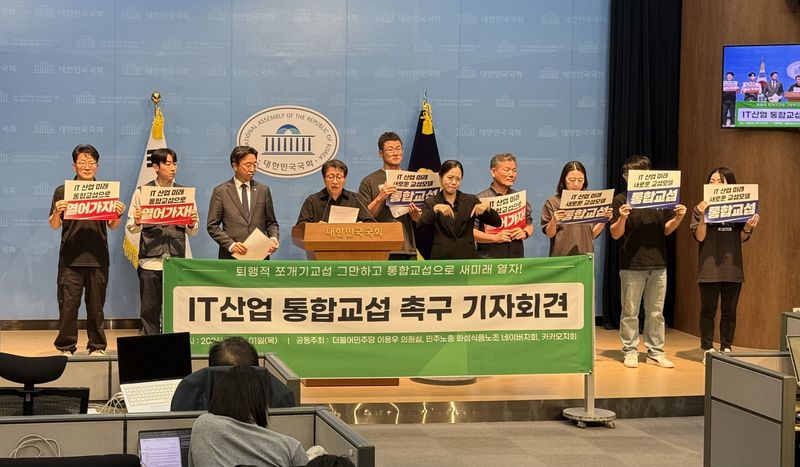
[Financial News] The NAVER and Kakao labor unions have formed a united front for the first time to change the bargaining structure divided among affiliates. The Kakao union has moved to unify its existing "joint bargaining" with the NAVER union's "integrated bargaining" and has also placed employment measures related to the planned corporate demerger on the integrated bargaining agenda.
The NAVER branch and Kakao branch of the National Chemical, Textile, and Food Industry Labor Union held a press conference calling for integrated bargaining in the IT industry with the office of Democratic Party of Korea lawmaker Lee Yong-woo at the National Assembly Communication Center on the 1st. They each called on their respective companies to conduct integrated bargaining encompassing their affiliates. This is the first time the two unions have jointly responded on a bargaining issue.
Joint bargaining maintains separate negotiations by corporation while addressing common demands together. Integrated bargaining, by contrast, is a plan to discuss issues shared by multiple affiliates with the parent company at a single bargaining table.
NAVER Union to File Corrective Petition for Integrated Bargaining with Labor Commission on the 2nd
The NAVER branch cited the repeated negotiations conducted separately by affiliates as grounds for its demand for integrated bargaining. According to the union, individual wage negotiations are currently being held at 16 corporations, resulting in more than 150 rounds of bargaining each year. The union said that affiliates cannot present management proposals before NAVER headquarters concludes its wage negotiations, but wrap up their own negotiations with similar terms within a month after an agreement is reached at headquarters. Oh Se-yoon, chair of the NAVER branch, argued, "There is a history of NAVER's decisions being applied to affiliates' working conditions, of NAVER's bargaining results being applied to affiliates in the same way, and of NAVER directly participating in affiliate bargaining and reaching agreements." He added, "NAVER has already acted as the employer of affiliate workers."
According to the union, NAVER did not post a notice of the bargaining request involving its affiliates, saying that it is not in a position to "substantially and specifically control or determine" the working conditions of affiliate workers. The NAVER branch plans to file a petition for corrective action regarding the failure to announce the request for integrated bargaining with the Gyeonggi Regional Labor Relations Commission on the 2nd.
Labor-management tensions are also continuing at NAVER Z, a NAVER affiliate. The NAVER Z union planned an additional strike on the 19th after staging a walkout before the Chuseok holiday, but it is adjusting the schedule because it overlaps with building maintenance plans and other activities. The union will decide on the date of the additional strike after reviewing management's position on the wage freeze and the company's business conditions.
Kakao Union Switches to Integrated Bargaining and Puts Corporate Demerger on the Table
Taking the joint action as an opportunity, the Kakao branch changed the name of its existing "joint bargaining" to "integrated bargaining." Seo Seung-wook, chair of the Kakao branch, explained, "Because the scope of the corporate group is broader than NAVER's, we used the term joint bargaining to give it a different meaning, but we have now unified the name as integrated bargaining."
In particular, the planned corporate demerger at Kakao has been placed on the integrated bargaining agenda as a key issue. With supplementary negotiations following this year's wage talks still pending, the union maintains that the bargaining structure and employment measures after the demerger must also be discussed at the group level. Seo said, "News broke that the company would be split while the wage negotiations had not been fully completed." He added, "The company must present how it plans to structure bargaining going forward." He continued, "Employment insecurity is becoming a reality during the demerger process. Since this cannot be resolved through bargaining by a single corporation, employment stability measures are needed across the entire group."
The union also cited a case from the restructuring of Kakao Enterprise in which some employees were redeployed internally in connection with hiring at affiliates. Seo explained, "If the company is sold or a business is shut down, employment measures should be discussed at the same time. If the organization is reorganized, its impact on workers must be assessed in advance." He added, "We are proposing that the group jointly seek alternatives such as internal transfers and retraining."
Kakao likewise conveyed to the union that it is not in a position to substantially and specifically determine the working conditions of its affiliates. The two sides are continuing discussions over whether to conduct integrated bargaining.
The key issue is how far the parent company's employer status will be recognized under the revised Trade Union Act. The amended law recognizes an entity as an employer within the relevant scope when it can substantially and specifically control or determine working conditions, even if it is not a party to the employment contract. The unions at both companies claim that the parent companies exercise substantial influence over business restructuring and compensation. The companies, however, maintain that they have no authority to directly determine the working conditions of individual affiliates.
[email protected] Choi Hye-rim Reporter