Even When AI Is Used for Welfare and Permits, 'People' Retain Final Responsibility... "Remedies for Harm If Problems Arise"
- Input
- 2026-10-01 19:00:00
- Updated
- 2026-10-01 19:00:00
[Financial News] Even when the government uses artificial intelligence (AI) to select welfare beneficiaries, process permits and approvals, or predict risks, people will retain final responsibility and control. The government will ensure that people can review and intervene in AI judgments and decisions, while also establishing systems for follow-up management and redress if problems arise.
On the 1st, MOIS finalized the Ethical Standards for Artificial Intelligence in the Public Sector, which contain these provisions.
The move comes amid growing concerns about biased decisions and privacy violations as AI use expands in public administration. It is intended to promote administrative innovation through AI while protecting citizens' fundamental rights and securing public trust.
Discussions on AI ethics have continued both in South Korea and abroad. Major countries and international organizations have issued AI ethics guidelines, while the Ministry of Science and ICT established the Artificial Intelligence Ethics Principles for application across all areas of society. After analyzing domestic and international AI ethics standards and consulting experts, MOIS prepared a draft in early November last year. It finalized the standards after reviews and consultations with relevant agencies and academic experts.
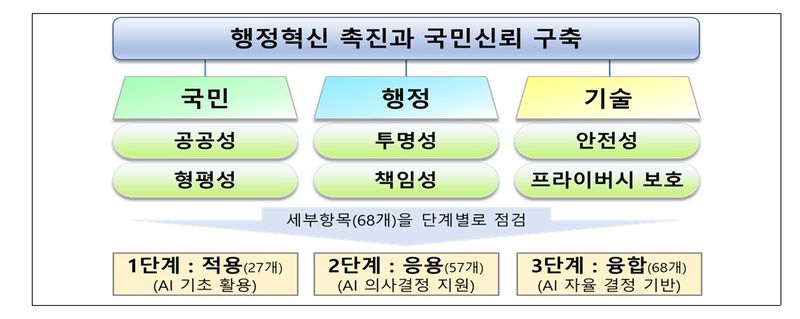
The standards encompass six core values: public interest, equity, transparency, accountability, safety, and privacy protection. These values have been broken down into 68 detailed items that can be assessed in actual work.
The items to be assessed vary according to the level of AI use. At the "application" stage, which involves basic use of AI, 27 items are assessed. The "augmentation" stage, in which AI supports human decision-making, involves 57 items, while the "convergence" stage, based on autonomous AI decisions, involves 68 items.
The standards specifically clarify human responsibility and control when AI is used for tasks that directly affect citizens' rights and daily lives, such as selecting welfare beneficiaries, issuing permits and approvals, and predicting risks. They require clear designation of the parties responsible for AI services, from planning through delivery, as well as a human oversight system that allows people to review and intervene in AI judgments and decisions. They also call for systems for follow-up management and redress in the event of problems.
AI is to be provided fairly and without discrimination to all citizens, while the processes for its introduction and use must be disclosed transparently. Safeguards will also be established to ensure safe operation without causing harm to citizens or violating their personal information and privacy.
MOIS plans to operate training programs for public-sector workers so that the ethical standards can be applied in actual work. It will also continue to improve the standards by incorporating newly emerging AI ethics issues into the assessment items.
MOIS Minister Yun Ho-jung said, "As artificial intelligence technology is becoming a key driver of administrative innovation, an ethical foundation to protect citizens' fundamental rights and secure their trust is essential. Through the ethical standards established this time and the 68 self-assessment items, we will ensure that AI ethics takes root naturally across the public sector and create an administrative environment in which artificial intelligence can be used fairly and safely."
[email protected] Lee Bo-mi Reporter