As Pharmaceutical and Bio R&D and Technology Transfers Increase, Accounting Calculations Become 'More Complex'... Samjong KPMG Presents Response Strategies
- Input
- 2026-10-01 14:34:21
- Updated
- 2026-10-01 14:34:21
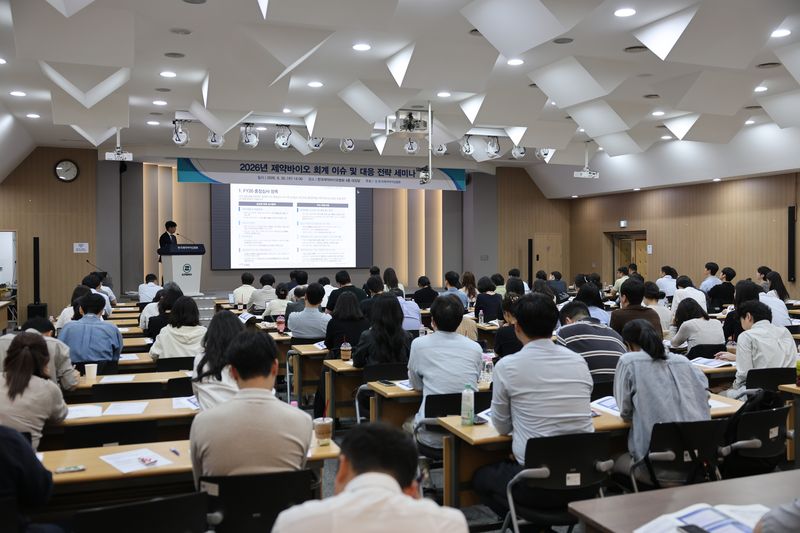
According to Samjong KPMG and the Korea Pharmaceutical and Bio-Pharma Manufacturers Association on Oct. 1, the two organizations jointly held the '2026 Seminar on Accounting Issues and Response Strategies for the Pharmaceutical and Bio Industry' on Sept. 30 at the association's main auditorium in Seocho District, Seoul, for employees of member companies.
The seminar focused on newly emerging accounting and tax risks arising from the diversification of pharmaceutical and bio companies' business structures. As large-scale R&D investments, technology transfers, licensing agreements and overseas entity formations increase, the importance of determining how to recognize individual transactions and reflect them in financial statements is also growing.
Park Sang-hoon, an executive vice president at Samjong KPMG, and Noh Young-il, a managing director at Samjong KPMG, explained how recently revised or forthcoming accounting standards could affect financial reporting by pharmaceutical and bio companies. They highlighted key judgments required in accounting treatments, focusing on transactions frequently seen in the industry, including R&D, technology transfers and licensing.
Tax issues arising from expanded overseas operations were also presented as a major concern. Executive vice presidents Choi Eun-young and Kang Sung-won explained the application framework and filing obligations of the global minimum tax. They stressed that companies with overseas entities and business establishments need to identify the tax implications of their business structures in advance and establish appropriate reporting systems.
The new risks associated with the rapid adoption of AI in accounting and finance operations were also discussed. Generative AI can improve the efficiency of data analysis and repetitive tasks, but companies must also establish systems for ensuring data reliability, maintaining internal controls and managing business processes.
The seminar also analyzed major recent tax rulings and court precedents in the pharmaceutical and bio industry. It examined tax issues that may arise in industry-specific transactions, such as R&D, technology transfers and pharmaceutical transactions, using real-world cases and presented standards that could be applied to similar transactions.
Park Sang-hoon, leader of Samjong KPMG's pharmaceutical and bio sector, said, "The pharmaceutical and bio industry requires a wide range of judgments and reviews from accounting and tax perspectives because of its industry characteristics, including large-scale R&D investments, technology transfers and global business expansion." He added, "Rather than responding piecemeal to individual regulatory changes, it is important to identify key accounting and tax issues in advance based on the business structure and characteristics of each transaction and establish a response system."
[email protected] Kim Hyun-jung Reporter