"Station-area access alone isn't enough"—Developments with both transportation and daily-life infrastructure are gaining popularity
- Input
- 2026-10-01 14:27:19
- Updated
- 2026-10-01 14:27:19
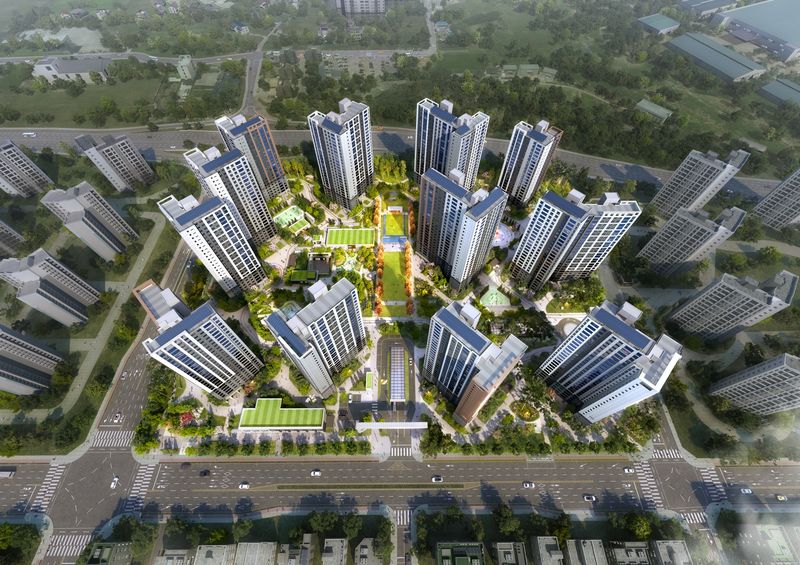
[Financial News] In the housing market, accessibility to daily-life infrastructure, including shopping, healthcare and education, is emerging as a key criterion for choosing a home.
According to the 2026 Real Estate Trends study jointly conducted by Heerim Architects & Planners, R2Korea Real Estate Investment Advisory and Gallup Korea Research Institute, accessibility to daily-life amenities was the most important detailed location factor considered when choosing a home in the future, cited by 60% of respondents. Transportation convenience followed at 56%.
As an ideal housing location, residential areas within major cities were selected by 59.4% of respondents, while central districts within major cities were chosen by 28.2%. Combined, the two categories accounted for 87.6%. Preference for central districts in major cities rose by 3.2 percentage points from the previous year, while preference for new towns near major cities fell by 3.0 percentage points.
The trend is believed to be driven by the spread of time-efficiency consumption, or the tendency to treat time like a cost. A survey of 2,318 adults nationwide conducted by Kiwi Survey, operated by Korea Research International, in June and July 2025 found that 61.8% of respondents cited "pursuing an efficient lifestyle" as a reason for time-efficiency consumption. Meals and food ranked first among the areas where respondents wanted to save time, at 51.4%, followed by transportation and travel at 44.9% and shopping and payments at 40.3%.
In the housing subscription market, developments equipped with both transportation networks and established daily-life infrastructure are also recording relatively high competition rates.
Anyang Station Central IPARK Sujain, supplied in Anyang, Gyeonggi Province, in February this year, received 1,904 applications for 185 general-allocation units, recording an average first-priority competition rate of 10.29 to 1. The development offers access to Anyang Station on Seoul Metropolitan Subway Line 1, as well as established downtown amenities such as Emart, Homeplus, Enter-6 Mall, Anyang 1st Street and Anyang Central Market.
The Sharp Bundang Tier One, sold last year in Jeongja-dong, Bundang-gu, Seongnam, Gyeonggi Province, also recorded an average first-priority competition rate of 100.4 to 1, with 4,721 applicants for 47 general-sale units. The development offers access to Jeongja Station, served by the Shinbundang Line and Suin–Bundang Line, as well as the commercial district around the station, large supermarkets and medical facilities.
Mangpo Station Prugio Le Mark, supplied in Yeongtong-gu, Suwon, Gyeonggi Province, the same year, drew 5,644 applicants for 393 units and recorded an average competition rate of 14.36 to 1. Its key advantage is access to the station area around Mangpo Station on the Suin–Bundang Line, along with the existing Yeongtong living area.
Meanwhile, new housing supply is planned around PyeongtaekJije Station in Gyeonggi Province. Hanwha E&C Division plans to launch Hanwha Forena Jije Station for sale this month.
The development offers access to PyeongtaekJije Station, with Emart Pyeongtaek Store and The Mart Pyeongtaek Store nearby. Large retail facilities, including Costco Pyeongtaek, Traders Wholesale Club and STARFIELD ANSEONG, are also accessible.
The central commercial district of Bijeon-dong and medical facilities such as Pyeongtaek St. Mary's Hospital are within the neighborhood. Educational facilities, including Jije Elementary School, Segyo Middle School and the academy district in Bijeon-dong, are also nearby. The Pyeongtaek Jije Station Integrated Transfer Center is slated to be developed, along with an expansion of the surrounding commercial district.
[email protected] Choi A-young Reporter