"Institutional Blockchain Investment Requires Reliable Data and Credit Ratings" [KBW2026 Korea Blockchain Week]
- Input
- 2026-10-01 14:31:52
- Updated
- 2026-10-01 14:31:52
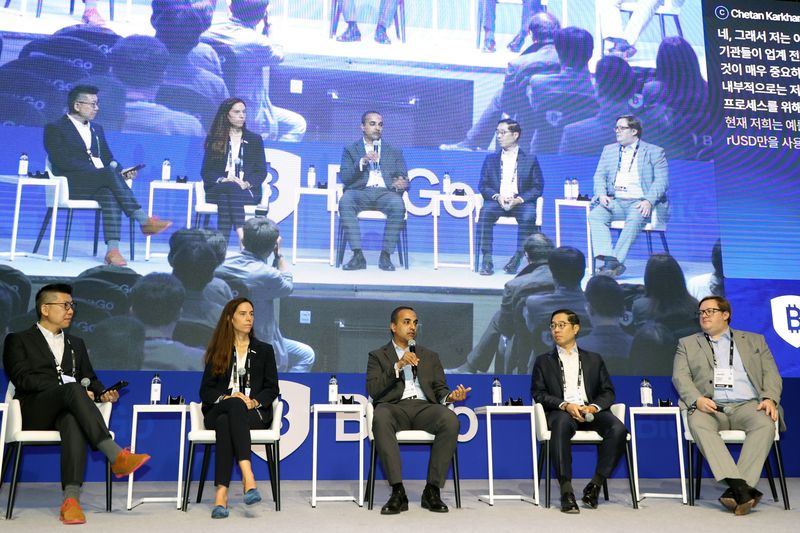
[Financial News] Reliable market data and credit-rating systems were identified as key infrastructure supporting institutional entry into the digital-asset market. Panelists said that beyond making transaction information public on the blockchain, the market needs standards for pricing financial products and comparing repayment risks.
A panel discussion titled "What Blockchain Infrastructure Do Institutions Need?" was held at the main conference of Korea Blockchain Week 2026 (KBW2026), Asia’s largest blockchain event, at WALKERHILL HOTELS & RESORTS in Seoul’s Gwangjin District on the 1st. Chetan Karkhanis, Senior Vice President for Asia-Pacific Digital Asset Partnerships at Franklin Templeton Investments; Jin Fang, an executive at Moody’s Ratings; Ambre Soubiran, CEO of Kaiko; and Charles Jansen, Managing Director at S&P Global, discussed data standards and risk-management measures needed for institutional investment.
Soubiran, Kaiko’s CEO, highlighted the role of data in the changing crypto-asset market. As institutions enter a market that was previously fragmented and dominated by retail investors, standards for pricing financial products and comparing performance have become more important than simply collecting prices and trading volumes. "Kaiko has been collecting crypto-asset data for 12 years," she said. "With regulated benchmarks in place and credit ratings being conducted for digital assets, data has become extremely important."
Public access to data does not automatically make it useful as investment information. Even when anyone can review transaction records, additional processing and verification are needed to use them to assess an asset’s value. Soubiran said, "Looking at what is happening on-chain is completely different from looking at prices. We are working with Franklin Templeton Investments to provide net asset values (NAVs)."
Fang identified an issuer’s ability to repay as the key factor in stablecoin credit ratings. The main criterion, Fang explained, is whether holders can receive the full amount of fiat currency back from the issuer. "What we are assessing is the probability that a stablecoin holder will not receive 100% of the fiat currency they are owed," Fang said. "It can be viewed similarly to a bank deposit and should be a comparable measure."
Fang also said that a distinction must be made between depegging, in which a price moves away from its reference value, and credit risk. "We are not directly addressing the depegging phenomenon itself," Fang said. "Depegging can be a market signal indicating signs of stress, but credit ratings are related to default."
Karkhanis emphasized that established investment and risk-management principles should also apply to digital-asset investing. "The investment process itself does not change," Karkhanis said. "The same investment team should manage the same liquidity solutions."
Karkhanis also highlighted the importance of standards used by data providers and institutions. "We use relevant data for internal risk management," Karkhanis said. "What matters is how operational and technology risks are assessed." The way the blockchain being used connects to external services was also identified as a key area for review.
The growing use of artificial intelligence (AI) in trading has also increased the importance of data analysis and security. "Rather than separating out AI trading, we are focusing on the market’s price-formation process," Soubiran said. "Our role is to make data easy to consume and understand." Fang emphasized the need to strengthen risk analysis when AI is involved, saying, "The important thing is to reduce AI-related cyber risks."Special Reporting Team [email protected] Choi Do-sun Reporter