South Korea, India Resume Talks on $3 Billion-Scale 'K30 Biho-complex' Air-Defense System
- Input
- 2026-10-01 13:21:39
- Updated
- 2026-10-01 13:21:39
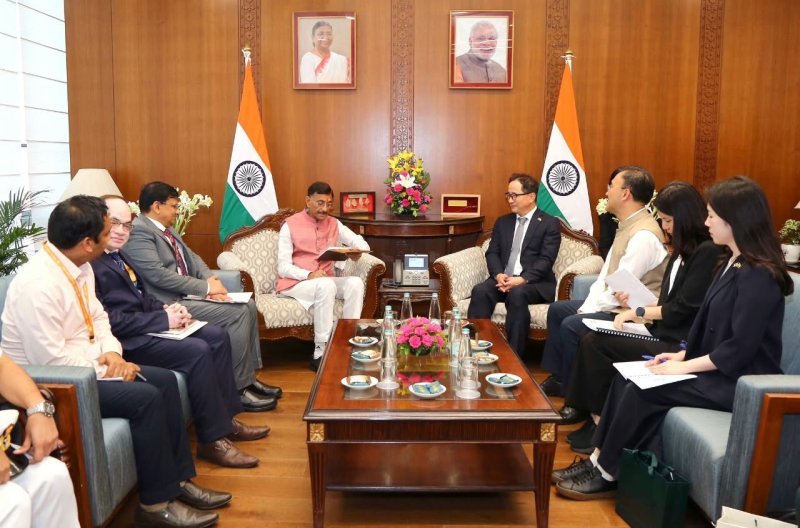
【New Delhi, India—Pragya Awasati, Correspondent】South Korea and India have resumed discussions on the export of the K30 Biho-complex short-range air-defense system, estimated to be worth approximately $2.5 billion (about 3 trillion won). The Biho-complex project, which had remained stalled, returned to the forefront following the Korea-India Joint Committee on Defense and Military Logistics held in New Delhi on Sept. 29.
According to local media reports on the 1st, officials from DAPA and India's Ministry of Defence held a meeting of the Korea-India Joint Committee on Defense and Military Logistics in New Delhi on the 29th of last month. They reviewed the progress of defense-industry cooperation between the two countries and discussed plans for advancing major defense projects. The agenda reportedly included the K30 Biho-complex project produced by Hanwha Aerospace.
The K30 Biho-complex is a tracked short-range air-defense system designed to protect armored and mechanized units from low-altitude aerial threats. It combines twin-barrel 30mm autocannons with surface-to-air missiles, enabling it to engage a range of targets, including helicopters, low-flying aircraft, cruise missiles, drones and loitering munitions. The system detects and tracks targets using radar and electro-optical sensors. Its tracked chassis allows it to maneuver alongside tanks, infantry fighting vehicles and artillery units while carrying out air-defense missions.
During testing for India's acquisition of the K30 Biho-complex in 2021, the system received a more favorable assessment than the Russian-made Tunguska-M1 and Pantsir-family systems. India's Defence Acquisition Council approved the project, but it did not subsequently lead to the signing of a final contract. The lack of progress over an extended period has been attributed to India's demands for domestic production and technology transfer, as well as operational and procurement issues involving existing Russian-made air-defense equipment. The resumption of negotiations comes amid growing operational requirements for the Indian military and the need to secure short-range mobile air-defense capabilities.
The Biho-complex can engage various aerial targets by operating 30mm autocannons and missiles together, while helping reduce the cost problem of using expensive missiles against low-cost drones. Analysts have also suggested that interest in the system has recently grown again in India as the importance of counter-drone and air-defense capabilities came to the fore during Operation Sindoor.
The governments of the two countries have not yet officially announced a final purchase decision, a contract schedule or the number of systems to be acquired. Some Indian media outlets and reports estimate that India may require approximately 104 Biho-complex systems and that the project could be worth $2.5 billion to $2.6 billion (about 3 trillion won). However, these are estimates at the current stage, and local media report that the project's scale and terms could change depending on India's required operational specifications, the share of local production and the scope of locally made components.
The meeting also covered the K9 self-propelled howitzer, which is already operated by the Indian Army, in addition to the Biho-complex. The K9 Vajra-T, India's variant of the K9 self-propelled howitzer, is produced locally through cooperation between Hanwha Aerospace and Indian company Larsen & Toubro. It is regarded as a leading example of defense cooperation and technology transfer between the two countries.
South Korea and India discussed ways to reactivate the defense cooperation road map established in 2020. They also exchanged views on expanding exchanges between the defense industry and academia, as well as areas for future joint development. The South Korean side emphasized the need to strengthen cooperation so that major defense projects can proceed steadily and receive long-term operational support. If a Biho-complex contract is concluded, defense cooperation between South Korea and India could expand further. However, coordination between India's localization demands and South Korea's protection of core technologies, along with technology-transfer and local-production terms and the Indian Army's air-defense requirements, are expected to be key variables in the final contract.
[email protected] Pragya Awasati, Correspondent Reporter