Court: "Han Duck-soo's Donation to '1,000-won Restaurant' Did Not Violate Election Law... Acquitted at First Trial"
- Input
- 2026-10-01 14:56:13
- Updated
- 2026-10-01 14:56:13
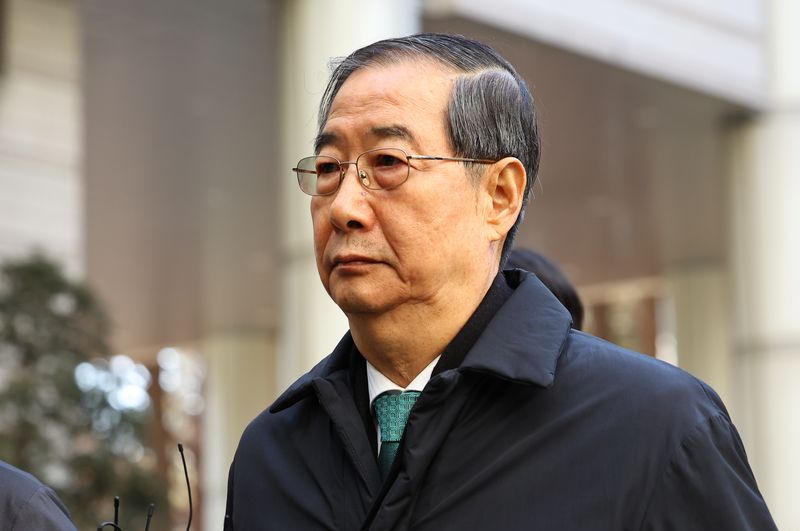
[Financial News] A court has ruled that former Prime Minister Han Duck-soo did not violate the Public Official Election Act by donating approximately 1.5 million won to a restaurant in Gwangju shortly before declaring his candidacy in the presidential election. The court explained that Han did not qualify as "a person seeking to become a candidate" under the election law at the time, and that the donation was closer to ordinary public welfare outreach that an acting president or prime minister could undertake.
Presiding Judge Cho Hyung-woo of the 22nd Criminal Division of the Seoul Central District Court acquitted Han Duck-soo at his first trial on charges of violating the Public Official Election Act on the 1st.
After former President Yoon Suk Yeol's removal from office was finalized following the Dec. 3 emergency martial law declaration, South Korea entered an early presidential election phase. Han Duck-soo, who was serving as acting president at the time, emerged as a leading presidential candidate. In April 2025, as part of public welfare outreach responding to then-imposed U.S. tariffs, Han visited an automobile industrial complex in Gwangju and personally donated 1.5 million won to a restaurant with a charitable mission known as the "1,000-won restaurant."
Although Han did not visit the restaurant himself, 1.5 million won in ingredient costs was paid through the Prime Minister's Office as a donation. Seventeen days later, on May 2, Han Duck-soo announced his candidacy for president.
The Rebuilding Korea Party (RKP) filed a complaint, alleging that Han had violated the Public Official Election Act, which prohibits donations by prospective election candidates. Prosecutors likewise argued, based on the circumstances at the time, that Han qualified as "a person seeking to become a candidate" and that the donation was effectively an illegal election activity.
The court explained, "The fact that the defendant later declared his candidacy cannot be used to make assumptions retroactively about the donation at the time it was made; the act must be judged based on the circumstances at that time." It added, "The defendant never personally expressed an intention to run, and there were no indications that people around him knew of his candidacy in advance."
The court also determined that the interpretation of the disputed term "a person seeking to become a candidate" must be based on the circumstances at the time. It stated, "The term must be limited to people whose intention to run has been expressed externally or whose intention to stand for election can be objectively recognized in light of their words, actions and status." The court added, "Otherwise, the scope of punishable conduct would become excessively broad, causing even ordinary performance of duties or social etiquette to be punished."
The court went on to rule, "The purpose of Han's visit to Gwangju on the day of the donation was a meeting at a Kia Corporation factory to respond to U.S. tariff measures, while the visit to and support for the restaurant were planned by the Public Relations Office as part of public welfare outreach." It added, "It is difficult to find any special indication of an election purpose that distinguishes the visit and support from the ordinary public welfare outreach previously conducted by public officials."
[email protected] Lee Chang-hoon Reporter