Humanity Faces 'the Alps Laid Bare' as Swiss Glaciers Melt Away by 20% in Five Years
- Input
- 2026-10-01 11:38:48
- Updated
- 2026-10-01 11:38:48
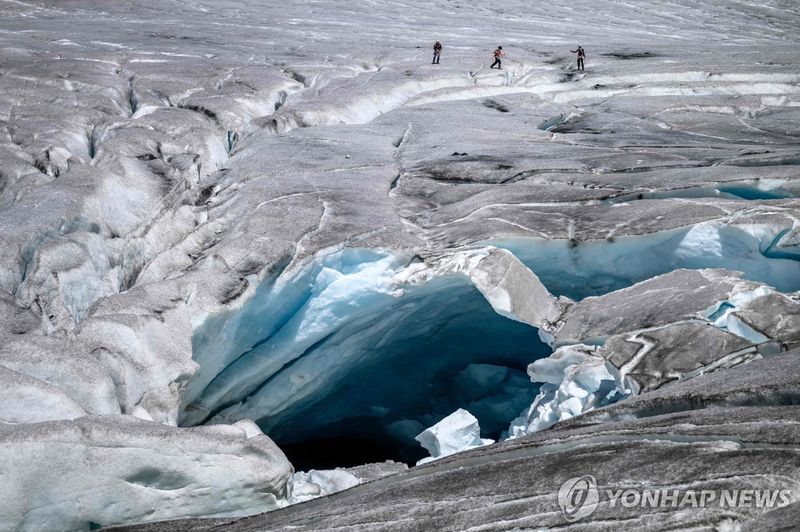
[Financial News] Swiss glaciers have lost 20% in five years, a study has found. This year, in particular, saw the second-largest amount of glacial melt since records began.
AFP reported on the 30th, local time, citing a report from the Swiss Glacier Monitoring Network (GLAMOS), that a record heat wave this year caused 5.5% of Switzerland's glacier volume to disappear.
According to the Swiss Federal Office of Meteorology and Climatology, June, July, and August were each the hottest such months in Switzerland since observations began in 1864.
GLAMOS team leader Matthias Huss described 2026 as "a catastrophic year."
Swiss glaciers have been shrinking for a long time, but the rate of melting has accelerated sharply in recent years.
According to the report, the rate of glacial melt over the five years from 2022 through this year was more than twice as fast as during any previous period. Glaciers melted by 10% between 1990 and 2000, but declined by 27% over the past decade.
Some of the glaciers surveyed by GLAMOS lost 2.5 to 4 meters in average ice thickness, while their more exposed terminus sections shrank by up to 10 meters.
Huss said, "It is truly hard to believe to see mountains where all the snow has melted away, leaving only rock and black glaciers."
GLAMOS warned, "Under these conditions, the Alps' glaciers have no chance of surviving in the long term."
GLAMOS estimated the overall decline by applying the results of a survey of 23 glaciers last month to the roughly 1,300 remaining glaciers in Switzerland.
2022 was the year with the greatest glacial melt on record.
The report explained that less dust blown in from the Sahara Desert this year allowed the glaciers to reflect more sunlight.
Concerns are also growing about securing water resources in the future. As glaciers melted from July through September, about 2.2 trillion liters of water disappeared.
Huss explained, "That is more than four times the amount of fresh water used by Swiss households in a year."
[email protected] Lee Seok-woo, International Affairs Specialist Reporter