RICON Marks Its 20th Anniversary, Presents Future Vision Through AI and Smart Construction
- Input
- 2026-10-01 16:39:52
- Updated
- 2026-10-01 16:39:52
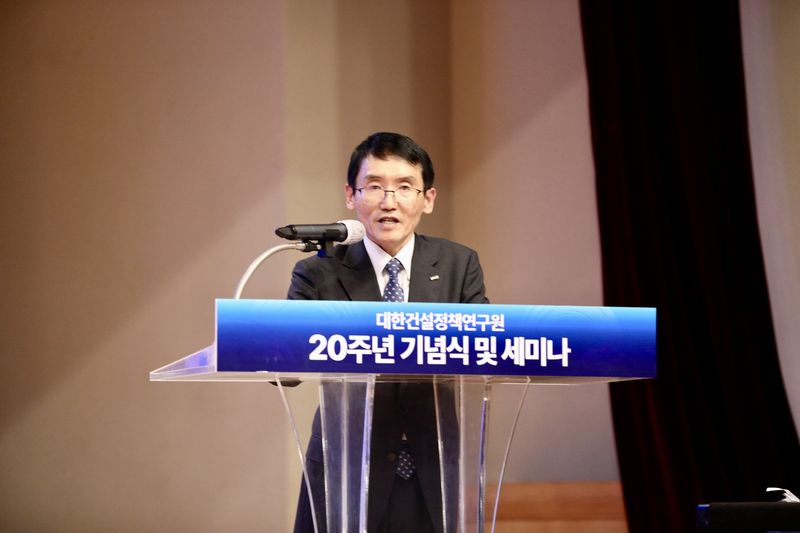
On the 1st, RICON held a ceremony marking its 20th anniversary at Specialty Construction Hall in Dongjak District, Seoul, under the slogan "RICON 20 Years, Drawing a Bigger Future." The event was themed "An Era of Transformation: The Future Vision and Innovation Strategies of the Specialty Contracting Industry."
RICON was authorized to establish and opened in August 2006 with the goal of promoting the sustainable development of the construction industry and strengthening the competitiveness of the specialty contracting industry. Since then, it has conducted research on construction-market policies, institutional improvements, labor and safety, and future policies. Over the past 20 years, it has carried out 599 studies, including 501 basic and commissioned studies and 98 studies involving construction market analysis, indicator-based issue analysis, and specialty construction market monitoring.
In his opening remarks, Kim Hee-soo said, "Looking back over the past 20 years, the environment surrounding the construction industry has changed constantly." He explained, "The changes we will face—from digital transformation centered on AI and Smart Construction, to changes in the industrial structure aimed at carbon neutrality and the reorganization of construction production systems resulting from demographic shifts—will be faster and more fundamental than those of the past two decades." He continued, "We will read these currents of change one step ahead," adding, "Based on field-rooted expertise and objective, systematic research capabilities, we will become a trusted policy leader that proactively presents the direction in which the construction industry should move."
Yoon Hak-soo, chairman of the Korea Specialty Contractors Association, said in his welcoming remarks, "The institute is a major guide for our construction industry." He added, "Rather than resting on the achievements of the past 20 years, I hope it will take another leap forward as a research institution that leads the future of the specialty contracting industry and become our policy partner."
The ceremony also featured a presentation titled "RICON 20 Years: Footprints and Achievements," which covered the institute's research activities and major accomplishments. RICON described the past five years as a "period of advancing future policies," during which it took the lead on digital transformation (DX), serious industrial accidents, workforce supply and demand, carbon neutrality, and regional and global agendas.
Among its institutional reform achievements, RICON cited the restriction of exemptions from payment guarantees to construction contracts worth 10 million won or less through an amendment to the Act on the Fair Transactions in Subcontracting, as well as the invalidation under civil law of unfair special clauses. Other major achievements included revising unfair special clauses and review guidelines concerning the prohibition of retainage, introducing a system linking construction-sector delivery prices to costs, expanding areas reserved for specialty construction, and raising the minimum winning-bid rate in eligibility reviews for public works. RICON also explained that it had responded to construction disputes and site risks, as well as workforce, safety, and technology-transition issues.
The keynote address was delivered by former Minister of Land, Infrastructure and Transport Park Sang-woo, who served as RICON's fourth president. Under the theme "Let's Give the Construction Industry Wings with AI," Park analyzed the changes, opportunities, and risks that AI development will bring to the construction industry and proposed response strategies.
He identified three tasks for preparing for the future: analyzing the impact of AI development on human life and living spaces, assessing and communicating changes in construction demand, and disseminating the latest AI trends throughout the industry. Park said, "I ask you to take the lead in monitoring changes in the new world related to AI and the aforementioned aspects of DX." He added, "You need to serve as the future radar of the information and communications industry, regularly informing the industry about how the world is changing."
The subsequent thematic presentations addressed the market and technological changes facing the specialty contracting industry and ways to respond to them.
Park Sun-gu, head of RICON's Economic and Finance Research Division, assessed the industry's environment, including prolonged low growth, rising construction costs, uncertainty surrounding project financing (PF), and the contraction of regional construction markets. He also presented five innovation strategies for the sustainable growth of the specialty contracting industry: institutional and market-structure reform, technology and productivity, workforce structure, finance and management, and market diversification.
Kim Tae-jun, head of RICON's New Growth Strategy Research Division, forecast the changes that emerging technologies such as physical AI and digital twins will bring to construction sites. He also proposed ways for the specialty contracting industry to move beyond simply adopting new technologies and become a driving force that creates new added value.
[email protected] Choi Ga-young Reporter