Korea Rural Community Corporation President Kim In-jung: "Floating solar revenue should be shared with residents and operators to solve rural problems"
- Input
- 2026-10-01 11:07:27
- Updated
- 2026-10-01 11:07:27
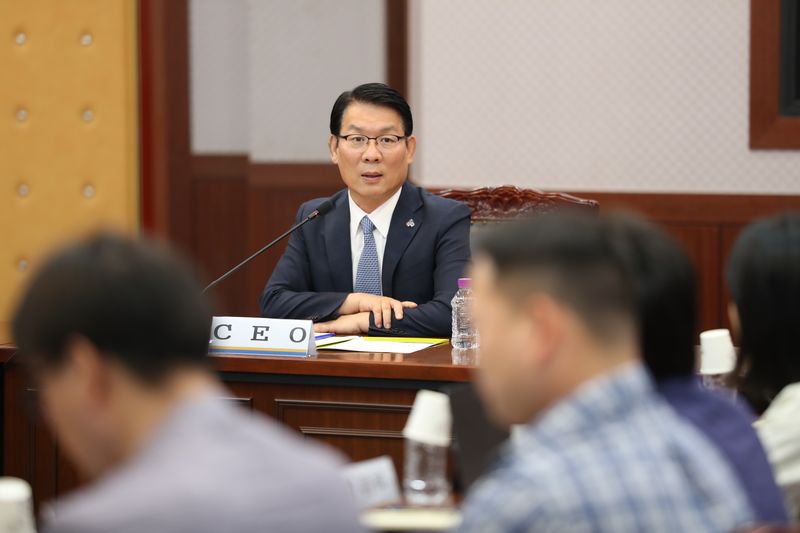
[Financial News] Kim In-jung, president of the Korea Rural Community Corporation, unveiled plans to eliminate the annual 200 billion won deficit in agricultural water supply through floating solar PV projects and secure funding to improve rural infrastructure. The corporation plans to develop 3 GW by 2030, promoting a win-win model under which the corporation, power-generation companies and local residents each receive one-third of the revenue. However, reconciling differences with the Ministry of Climate, Energy and Environment over the project structure and legal regulations has emerged as a challenge. Floating solar PV refers to an environmentally friendly power-generation facility that produces electricity by floating solar modules on reservoirs and other bodies of water.
At a press briefing held on the 30th of last month at the Saemangeum 33 Center in Gimje-si, North Jeolla Province, President Kim said, "The corporation's floating solar PV projects are intended to generate funds that will be invested in sustaining rural communities," adding, "We aim to overcome the national energy crisis while addressing agricultural and rural issues." He continued, "The issues farmers raise most frequently involve the maintenance of irrigation and drainage facilities and pumping stations." He also said, "If we develop 3 GW across 28 districts by 2030, we can secure profits of around 200 billion won. This will enable us to improve aging rural infrastructure."
Annual funding of 650 billion won is needed to maintain agricultural infrastructure, but government budget support has remained around 150 billion won since 2007. Even though the corporation contributes 280 billion won from its own resources, it faces an annual deficit of 200 billion won. To cover the deficit, the corporation has been selling assets it already owns, including reservoirs. Last year, the corporation covered 312.4 billion won of its maintenance and management costs itself. Of that amount, 71% came from selling assets such as reservoirs, followed by site and water-surface leases (11%), renewable energy (9%) and water sales (9%).
President Kim's "2030 Floating Solar PV Development Plan" is expected to become a future source of funding for rural infrastructure services. The corporation is pursuing development of 3 GW across 28 districts by 2030. Of the 3 GW, private operators will account for 2.1 GW, while the corporation will develop 900 MW. The private sector's share is larger. If floating solar PV facilities are built in all 28 districts, the corporation could generate average annual revenue of approximately 227.7 billion won starting in 2030. This figure consists of 23.8 billion won in annual lease revenue from private operators and 203.9 billion won in annual revenue from the corporation's power plants.
A major obstacle is the difference of opinion with the Ministry of Climate, Energy and Environment, the ministry responsible for the Renewable Energy Act. The ministry argues that floating solar PV projects should be operated through special-purpose companies (SPCs) to reduce the risks borne by businesses. The corporation, by contrast, has proposed a transfer-and-acquisition model. Under the proposal, a private operator would build a power plant on a water surface owned by the corporation, after which the corporation would pay the operator the construction cost for 20% to 30% of the power-generation facilities, as agreed, and operate those facilities directly. The corporation would earn revenue from its own power generation and from leasing water surfaces to private operators.
The Ministry of Climate, Energy and Environment is also revising subordinate regulations under the Renewable Energy Act. The revisions include operating rules for the Renewable Portfolio Standard (RPS) system, with the aim of newly designating the Korea Rural Community Corporation as an obligated entity. Entities that own facilities above a certain scale, such as public power-generation companies, and public enterprises capable of conducting renewable-energy projects are subject to regulation once designated as obligated entities. The Ministry of Agriculture, Food and Rural Affairs (MAFRA) submitted an opinion stating, "If the Korea Rural Community Corporation is designated as an obligated entity, there is concern that its core public-interest functions for agriculture and rural communities could be seriously disrupted." It added, "The expansion of borrowing and equity investments resulting from the obligation to supply renewable energy, as well as substitute performance payments and fines for noncompliance, would inevitably weaken agricultural services."
President Kim said, "The corporation's principle is an interest-balancing model in which the corporation, power-generation companies and local residents each share one-third of the power-generation revenue. Even if the project is pursued through an SPC model, that principle must be upheld." He added, "Given the corporation's fundamental role, it is not an organization created for energy projects. Its core functions are maintaining agricultural production infrastructure and supplying water, and it is pursuing renewable-energy projects to faithfully carry out those functions. It is not appropriate to designate the corporation as an obligated entity."
[email protected] Choi Yong-jun, agriculture correspondent Reporter