KOSPI Composite Index Nearly Flat; KOSDAQ Jumps More Than 2% on Strength in Semiconductor Materials, Parts and Equipment Stocks [fn Morning Market Update]
- Input
- 2026-10-01 10:44:32
- Updated
- 2026-10-01 10:44:32
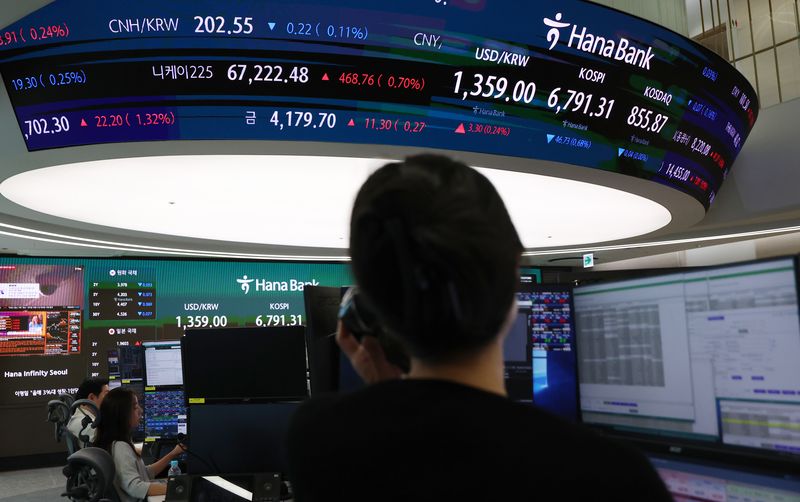
[Financial News] On Oct. 1, the first trading day of October, domestic stocks showed divergent trends, with the KOSPI Composite Index and KOSDAQ moving in opposite directions.
The KOSPI Composite Index was under pressure from selling by foreign investors and institutions, while KOSDAQ continued to gain more than 2%, led by semiconductor materials, parts and equipment stocks. Samsung Electronics and SK hynix, two large-cap semiconductor stocks, showed mixed performance.
According to the Korea Exchange (KRX), as of 10:30 a.m., the KOSPI Composite Index was trading at 6,822.25, down 15.79 points, or 0.23%, from the previous session. Retail investors were net buyers of 537.5 billion won, but foreign investors and institutions were net sellers of 726.3 billion won and 227.5 billion won, respectively, weighing on the index.
Large-cap stocks showed mixed performance. Samsung Electronics was trading at 268,000 won, down 0.19%, while SK hynix was nearly flat with a slight gain of 0.06% at 775,000 won. Samsung Electro-Mechanics rose 6.63%, Samsung Biologics 1.44%, Samsung Life Insurance 1.24%, KB Financial Group 1.84%, Hanwha Aerospace 1.59% and Celltrion 2.93%.
By sector, insurance stocks fell 1.33%, financial stocks 1.29%, chemical stocks 1.08%, construction stocks 0.77% and communications stocks 0.78%. Electrical and electronics stocks, down 0.19%, and manufacturing stocks, down 0.06%, also remained nearly flat.
By contrast, KOSDAQ stood at 875.98, up 20.07 points, or 2.34%, from the previous session. Although retail investors were net sellers of 142.6 billion won, foreign investors and institutions were net buyers of 138.2 billion won and 31.5 billion won, respectively, supporting the market's advance. Buying was particularly concentrated in semiconductor materials, parts and equipment stocks, driving KOSDAQ's strong performance.
Kim Joo-yeon, an analyst at Mirae Asset Securities, said, "In the semiconductor sector, Samsung Electronics has shown a differentiated performance despite Micron Technology's strong earnings, but equipment stocks expected to benefit from global industry competitiveness and Samsung Electronics' increased investment continue to rise."
The explanation is that buying is flowing primarily into equipment stocks whose benefits from expanded investment could become more concrete, unlike large-cap semiconductor stocks.
As KOSDAQ's upward trend continued on the first trading day of October, stock performance diverged between large-cap semiconductor stocks and small- and mid-cap semiconductor materials, parts and equipment stocks. The KOSPI Composite Index has been held back by selling pressure from foreign investors and institutions, while KOSDAQ has remained relatively resilient on the strength of stocks across the semiconductor value chain.
[email protected] Kang Jung-mo Reporter