Lee Chan-jin, Governor of the Financial Supervisory Service: "High Interest Rates Make Loans Harder to Obtain... Vulnerable Groups Are Being Driven into Illegal Private Lending"
- Input
- 2026-10-01 12:00:00
- Updated
- 2026-10-01 12:00:00
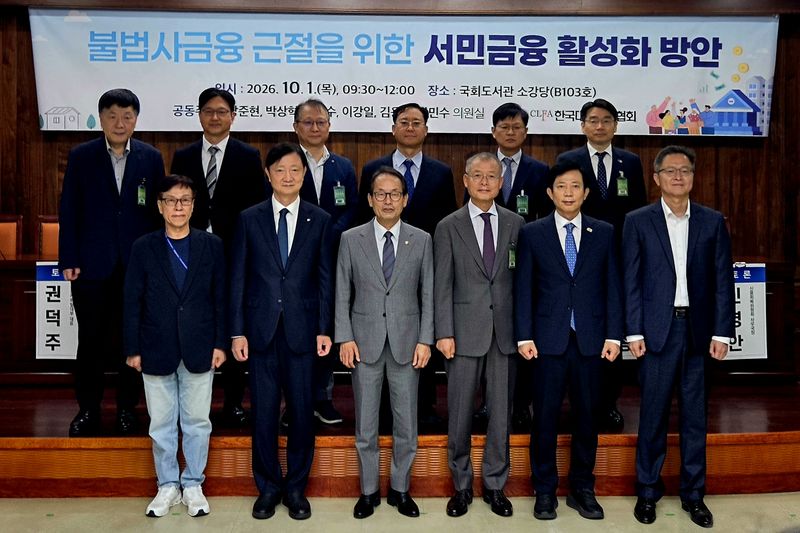
[Financial News] It was again pointed out that the statutory maximum interest rate, fixed at 20%, is driving financially vulnerable groups into the illegal private lending market. As funding costs rise while the interest rates moneylenders can charge remain capped, moneylenders have reduced loans to low-credit borrowers, leaving people in need of emergency funds to turn to illegal private lenders. Lee Chan-jin, Governor of the Financial Supervisory Service, said, "I am very interested in ideas that could expand credit supply to low-credit borrowers, such as a Japanese-style guarantee business model in which the moneylending industry provides screening and guarantees for low-credit borrowers seeking loans from the formal financial sector."
At the forum held at the small auditorium of the National Assembly Library of the Republic of Korea in Yeouido, Seoul, on the 1st, Lee Chan-jin said, "We are actively considering testing the Japanese-style model through a regulatory sandbox," referring to the same proposal.
In his congratulatory remarks, Lee Chan-jin said, "Although our economy has recently posted strong export performance, the difficulties facing ordinary people and vulnerable groups have worsened because of rising prices and a delayed recovery in domestic demand." He added, "As rising interest rates raise the barriers to obtaining loans, the reality is that vulnerable groups are being pushed outside the financial safety net and face a growing risk of being driven into illegal private lending."
Lee Chan-jin said, "The moneylending industry's role in supplying credit to low-credit borrowers also needs to be revitalized." He explained, "As the moneylending industry has shifted its business model toward collateral-backed loans, its role as a source of emergency funds for ordinary people has weakened, and many people are being driven into illegal private lending." In fact, the share of credit loans in the outstanding balance of moneylenders' loans fell from 84.8% at the end of 2015 to 41.0% at the end of last year. This resulted from moneylenders reducing loans to low-credit borrowers because lower statutory maximum interest rates made it difficult for them to generate operating profits.
Lee Chan-jin added, "Given the moneylending industry's extensive contact with financially vulnerable people, it should strive to fulfill its social responsibility by informing applicants whose loan applications have been rejected about loans designed to prevent illegal private lending and how to apply for welfare services." He continued, "A thorough culture of compliance-based management must be established throughout the moneylending industry."
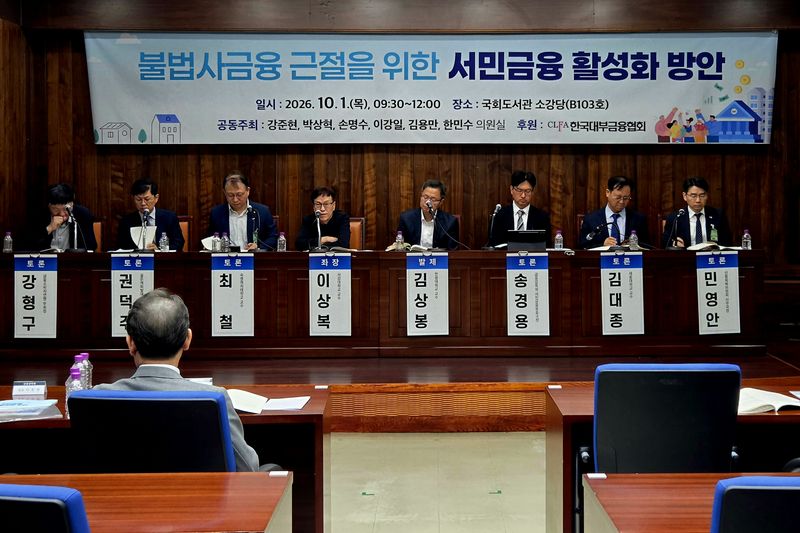
Song Kyung-yong, head of the Financial Supervisory Service's Consumer Finance Protection Bureau, said, "To prevent the spread of illegal private lending, the moneylending industry must increase the supply of funds to low-credit borrowers." He added, "Measures must be devised to reduce the moneylending industry's funding costs." Song Kyung-yong said, "Considering the business environment of moneylenders struggling to secure funding, the proposal to launch a credit guarantee business modeled on Japan's moneylending industry, which would provide guarantees to borrowers applying for loans from credit finance institutions, could help supply funds to low-credit borrowers." He continued, "The program could be piloted through a sandbox, and the law could then be amended once its effects have been confirmed."
The forum was jointly hosted by the offices of lawmakers Kang Jun-hyun, Park Sang-hyuk, Son Myeong-su, Lee Kang-il, Kim Yong-man, and Han Min-su, and sponsored by the Korea Loan Finance Association. The need to amend the Money Lending Business Act was raised several times during the event.
Lee Sang-bok, a professor at Sogang University who moderated the panel discussion, said, "Unlike other laws, such as the Banking Act, the Insurance Business Act, and the Specialized Credit Finance Business Act, which all include market-entry regulations, conduct regulations, and internal control and compliance requirements, the Money Lending Business Act merely consists of a list of provisions." He added, "The law is our face, so it must be overhauled in a way that will not embarrass us internationally."
There were also calls to change the term "moneylending business," amid concerns that the term itself creates a negative image because many people cannot distinguish between legitimate moneylending businesses and illegal private lending. Choi Chul, a professor at Sookmyung Women's University, said, "The government and legislature may not appear firmly committed to changing the name because they are concerned that, even if the name changes, the new term could become tainted in the same way as the current term." He added, "Because moneylending refers broadly to the provision of funds and loans, consideration should be given to granting exclusive business names based on factors such as asset size, whether a company is incorporated, or whether it belongs to an association, rather than applying the same name to all financial businesses engaged in moneylending."
Kim Dae Jong, a professor at Sejong University, argued, "Legitimate moneylending businesses should be renamed inclusive finance and brought into the formal sector." He said, "If the term 'inclusive finance' or 'everyday finance' is used and government-certified registered businesses are actively publicized, it can reduce the likelihood that ordinary people will turn to illegal private lending." He continued, "The statutory maximum interest rate system should be left to market forces." He added, "While excessive profiteering should be strictly regulated, a system is needed that recognizes normal risk costs." His proposal was to adjust the maximum interest rate flexibly by comprehensively considering financial market conditions, funding rates, inflation, and delinquency rates.
Jung Sung-woong, president of the Korea Loan Finance Association, said, "Even now, ordinary people are being driven to the brink by illegal loan sharks." He added, "When we look back at why they turned to illegal private lending, it was because registered moneylenders had closed their doors and they had nowhere else to go." He continued, "If even one registered moneylender is found to have violated the statutory maximum interest rate, the association will take responsibility." He emphasized, "We will track down any excess profits collected and return them to consumers."
Lawmaker Kang Jun-hyun said, "The higher the barriers to formal financial services become, the fewer options financially vulnerable people have, allowing illegal private lending to fill the void." He added, "Beyond crackdowns and punishment, we must expand access to inclusive finance so that the financial services people need are provided to those who need them in a timely manner."
[email protected] Park Moon-soo Reporter