Mixed-Use Developments in Commercial Areas 'Must Include at Least 10% Commercial Space'... A Barrier to Expanding Supply
- Input
- 2026-10-01 16:15:48
- Updated
- 2026-10-01 16:15:48
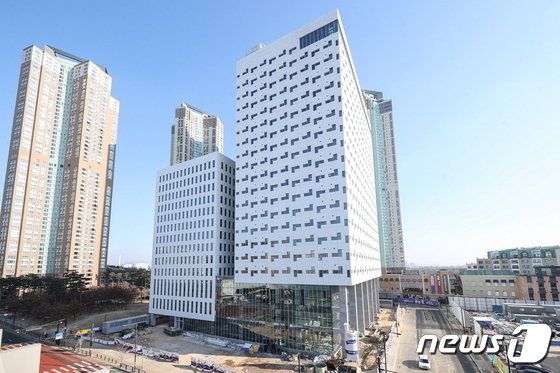
[Financial News] Seoul Metropolitan Government lowered the mandatory ratio of commercial space (non-residential facilities) for new mixed-use residential-commercial developments in commercial areas to 10% last year, as part of efforts to expand housing supply and address the oversupply of retail space. The problem is that the ratio cannot be lowered any further. This is because the higher-level National Land Planning and Utilization Act stipulates that commercial areas must consist of 90% residential space and 10% commercial space.
According to industry sources on the 1st, the government is moving to ease regulations on mixed-use residential-commercial developments in commercial areas to increase housing supply, but the 10% rule under the National Land Planning and Utilization Act is acting as an obstacle. "With relaxed floor-area-ratio regulations, floor-area ratios of more than 1,000% are possible in commercial areas," an industry official said. "Applying the mandatory 10% commercial-space ratio to a 1,000% floor-area ratio means the amount of commercial space supplied is by no means small."
The government is pursuing a plan to raise the threshold for new mixed-use residential-commercial developments in commercial areas that require building-permit approval from fewer than 300 households to fewer than 500 households. The aim is to enable housing to be supplied more quickly.
Separately, however, the 10% mandatory commercial-space ratio remains in place for mixed-use residential-commercial developments in commercial areas. The National Land Planning and Utilization Act stipulates that apartments and other multifamily housing may not account for more than 90% of the total floor area in commercial areas. In other words, non-residential facilities, including commercial space, must account for at least 10%.
Last year, Seoul Metropolitan Government amended its ordinance to lower the mandatory commercial-space ratio in commercial areas from 20% to 10%. Because the higher-level law sets the ratio at 10%, 10% is effectively the lowest level to which it can be reduced through an ordinance.
Meanwhile, the effect of reducing the ratio to 10% is also being blunted by the increase in floor-area ratios in commercial areas. "In the past, a floor-area ratio of 800% was typically applied to new mixed-use residential-commercial developments in commercial areas, but ratios of more than 1,000% are now possible," a construction company official said. "Lowering the mandatory commercial-space ratio is significant, but given the higher floor-area ratios, a 10% requirement remains a considerable burden."
Another industry official said, "We are pursuing a mixed-use residential-commercial development project in a commercial area of Seoul, but the 10% commercial-space rule is causing us considerable concern. Since large-scale unsold commercial space is all but inevitable, we have been unable to find a viable alternative."
Industry officials argue that the National Land Planning and Utilization Act should be amended so that the 10% commercial-space rule in commercial areas can be applied flexibly, helping expand housing supply, enable more flexible urban planning, and address the oversupply of commercial space.
Choi Won-cheol, a professor at Yonsei University, pointed out, "A rule that uniformly sets the ratio at 90% residential space and 10% commercial space, without distinguishing between areas that need more commercial space and those that need more housing, fails to reflect current conditions."
[email protected] Lee Jong-bae Reporter