Korea Expressway, Hyundai Motor Group Join Forces to Develop 'Physical AI' Robots for Highways
- Input
- 2026-10-01 10:45:43
- Updated
- 2026-10-01 10:45:43
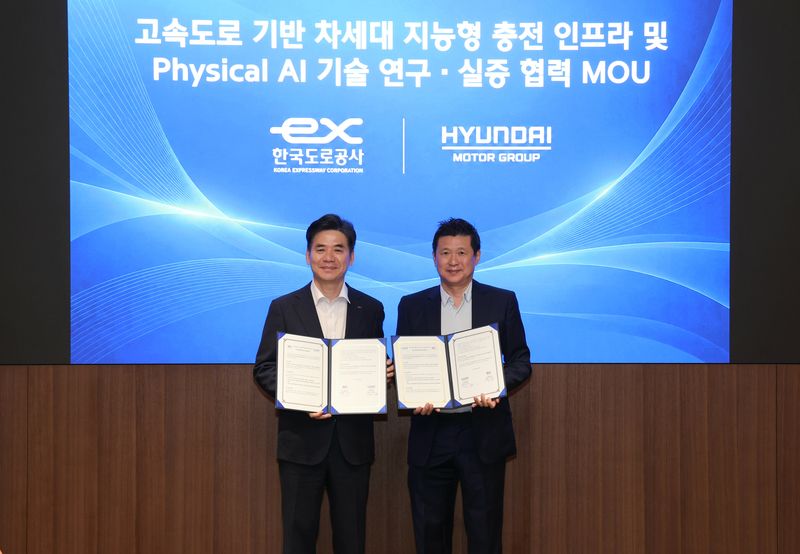
Korea Expressway said on the 1st that it had signed an MOU with Hyundai Motor Group at Hyundai Motor Company's headquarters in Seocho-gu, Seoul, on the 30th of last month for cooperation in the joint research, development and field demonstration of Physical AI-based robot technologies for highways.
Physical AI refers to technology that enables a physical entity, such as a robot, to use artificial intelligence to perceive and assess its real-world surroundings and perform tasks directly.
The two sides will jointly research and conduct field demonstrations of Physical AI-based highway safety and maintenance technologies. They will also consider building next-generation intelligent charging infrastructure, including charging robots and wireless charging systems, at highway rest areas. In addition, they will pursue the exchange of technology and information and joint research and development in the future road sector.
Korea Expressway will provide actual highway facilities, including bridges, tunnels and rest areas, as field demonstration sites. Hyundai Motor Group will draw on the technology and experience it has accumulated in developing and operating service robots and charging robots.
Following the signing ceremony, officials from both sides observed demonstrations of irrigation, security and delivery robots developed and operated by Hyundai Motor Group. They also discussed ways to apply the robots to highway operations.
Once the technology is introduced, robots could directly collect data in areas that are dangerous for workers to access, such as beneath bridges and inside tunnels. This would enable a shift to an inspection system in which people make precise assessments of facility conditions based on the data. In the long term, the two sides plan to advance the technology so that robots can perform on-site tasks as well as inspections.
Korea Expressway expects the use of robots to help reduce the risk of workplace accidents and secondary accidents, while enabling the early detection of damage to highway facilities.
Sung-min Cho, head of the Expressway and Traffic Research Institute at Korea Expressway, said, "Robot technology is a key field that can maximize both the efficiency of highway maintenance and worker safety. By combining the private sector's outstanding robot technology with Korea Expressway's field-based highway infrastructure, we will produce tangible results and create a highway environment that people can use more safely."
[email protected] Choi Ga-young Reporter