Seoul Metropolitan Government Officially Designates 'Human Town 2.0' Project Sites; Floor Area Ratio Relaxed by 1.2 Times
- Input
- 2026-10-01 11:15:00
- Updated
- 2026-10-01 11:15:00
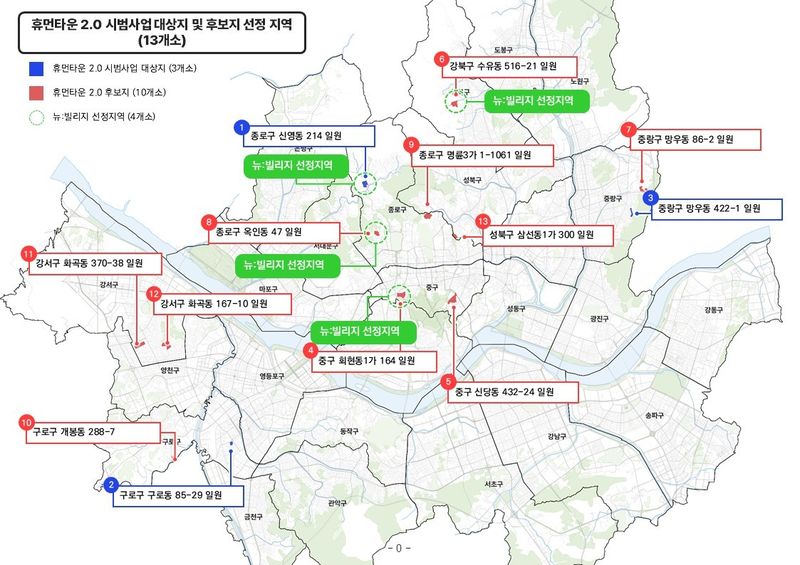
According to Seoul Metropolitan Government on the 1st, Human Town 2.0 is a method of improving housing through building agreements between individual lots or adjoining lots while preserving the characteristics of existing alleys and villages. Since establishing its implementation plan in September 2023, the city has selected 13 sites in seven autonomous districts as target areas and is working to formulate project plans.
The newly selected areas of Ogin-dong and Myeongnyun 3-ga have faced restrictions on individual housing improvements because their small lots, sloping terrain, and narrow alleys that are difficult for vehicles to access make it difficult to secure project feasibility for new construction.
If the application requirements, including the Human Town 2.0 design guidelines, are met, the floor area ratio may be relaxed to up to 1.2 times the level set by ordinance. In Type 1 general residential areas, it can be increased from 150% to a maximum of 180%. In Type 2 general residential areas with a seven-floor height limit in Ogin-dong and Myeongnyun 3-ga, it can be increased from 200% to a maximum of 240%. For example, on a 200-square-meter lot subject to a 150% floor area ratio, the maximum gross floor area counted toward the floor area ratio can increase from 300 square meters to 360 square meters.
Customized special provisions based on local characteristics, such as hilly terrain and height restrictions, will also apply. In Ogin-dong, the height limit for the relevant area within the natural landscape district can be relaxed from 16 meters to a maximum of 20 meters. In Myeongnyun 3-ga, it can be eased from 10 meters to a maximum of 14 meters.
When underground parking facilities or nonresidential uses are created in sloped areas, Ogin-dong and Myeongnyun 3-ga may receive a relaxation of the building coverage ratio from 60% to a maximum of 80% for the portions of underground floors that are exposed above ground.
While building standards are being relaxed, the residential environment and landscape of the villages will be managed together. Regional design guidelines will be applied to encourage building forms, exteriors, and outdoor spaces to harmonize with the surrounding village landscape.
Building owners seeking special provisions may apply for a building permit with their autonomous district by submitting a 'special-exception application plan' that explains the reasons for and expected effects of the special provisions. The Seoul Metropolitan Government Architectural Committee will determine whether the provisions apply and the scope of their application after deliberation.
The special architectural zones being designated this time will operate on a temporary basis for three years after designation. Buildings granted special provisions must begin construction within 12 months of receiving a building permit or filing a notification for the provisions to remain valid.
Following the designation of these three sites, Seoul Metropolitan Government plans to complete Architectural Committee deliberations this year for the designation of eight additional sites as special architectural zones. Myeong No-jun, Director General for Housing of the Seoul Metropolitan Government, said, "We will pursue regulatory easing and design management tailored to local conditions together so that they lead to improvements in the residential environment of aging low-rise residential areas."
[email protected] Kwon Jun-ho Reporter