AI Writes Medical Records and Supports Cancer Diagnosis... KT Unveils Standard Healthcare Model
- Input
- 2026-10-01 09:59:51
- Updated
- 2026-10-01 09:59:51
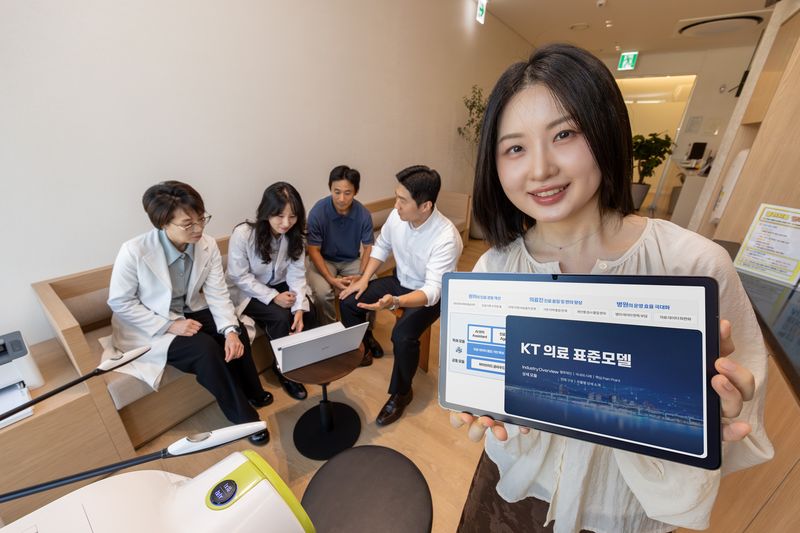
[Financial News] KT is applying artificial intelligence (AI) across hospital operations, from patient appointments and consultations to healthcare staff scheduling and medical record creation. The company is expanding cooperation with tertiary general hospitals and general hospitals nationwide based on a "healthcare standard model" that enables hospitals to adopt AI services tailored to their infrastructure and data environments.
KT said on the 1st that it had systematized a healthcare standard model to support the AI transformation (AX) of hospital operations.
KT is applying the "AI Patient Assistant" at patient touchpoints. An AI voice bot automatically responds to inquiries 24 hours a day and supports appointment registration through symptom classification, as well as post-discharge care guidance. In the first quarter of next year, KT also plans to add a retrieval-augmented generation (RAG) search function based on medical knowledge.
For healthcare professionals, KT is applying nursing and operating room scheduling agents. Its healthcare data platform collects and stores data from across hospitals, including electronic medical records (EMR), medical images, and testing and research data, and links them based on healthcare information exchange standards. The platform can also be used to search medical data, build datasets for AI training, and develop and validate medical AI.
AI will also automate clinical administrative tasks. The "clinical administration agent" recognizes and analyzes conversations between healthcare professionals and patients and drafts clinical notes using medical terminology and abbreviations. After review and approval by healthcare professionals, it links with electronic medical records and testing and prescription systems, supporting workflows from medical record creation through orders and billing.
Going forward, KT will combine solutions from healthcare technology companies with its healthcare data platform and hybrid cloud and graphics processing unit (GPU) computing infrastructure to expand the standard model into diagnosis, image interpretation, and clinical decision support. The targets include an "AI cancer-diagnosis clinical decision support system (CDSS)" that presents clinical guidelines and treatment evidence based on integrated patient clinical and imaging data, as well as "AI endoscopy image interpretation," which analyzes endoscopy images in real time.
KT also plans to participate in the AI-specialized hospital initiative under the government's "AI Basic Healthcare Strategy," validating its services in hospital environments and expanding their scope of application. The company will reorganize its healthcare AX organization and promote adoption, focusing on tertiary general hospitals nationwide. This month, it will hold a healthcare AX seminar for representatives of general hospitals.
Kim Bong-gyun, vice president and head of KT's Enterprise Division, said, "Since each hospital has different systems, data environments, and priorities for pursuing AX, we will combine KT's infrastructure and AX capabilities to provide a foundation that enables hospitals to adopt the services they need and expand them step by step."
[email protected] Choi Hye-rim Reporter