SFA CEO Kim Sang-kyung: "Semiconductor Equipment Performance Surpasses Display Equipment"
- Input
- 2026-10-01 08:23:43
- Updated
- 2026-10-01 08:23:43
[Asan, South Chungcheong Province—Kang Kyung-rae, reporter] "SFA is the company benefiting the most from the emergence of artificial intelligence (AI)."
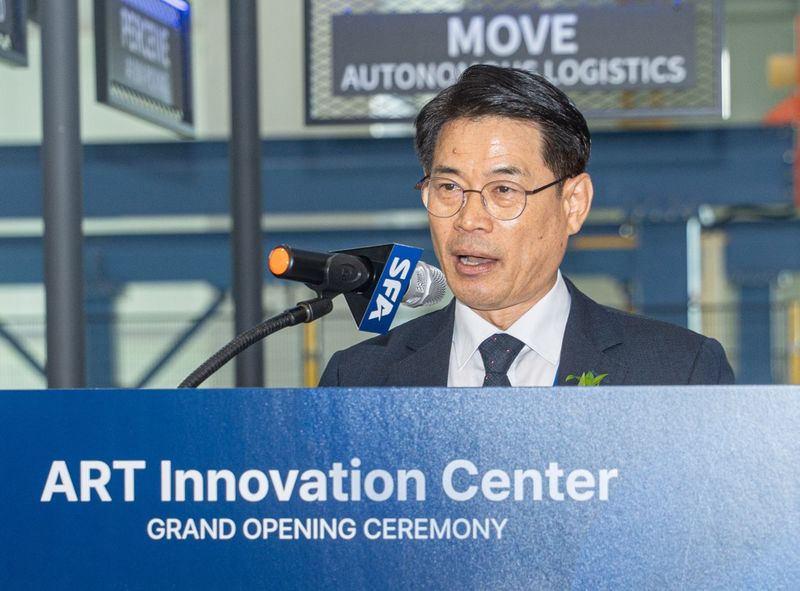
SFA CEO Kim Sang-kyung made the remarks at a press briefing held in Asan, South Chungcheong Province, on Sept. 30. "SFA has focused on the automation business for more than 40 years and accumulated robotics technology," he said, adding, "Because of AI, many of the technologies we developed in automation are now spreading into various fields, including semiconductors and logistics."
This was Kim's first press briefing. He became CEO last December and has worked at SFA for nearly 40 years. After graduating from the Department of Mechanical Engineering at Yeungnam University, he joined Samsung Techwin, now Hanwha Aerospace, in 1988. In 1998, he moved to SFA, which was newly established when Samsung Techwin's Process Automation Business Division was spun off.
Until 2013, Kim oversaw research and development (R&D) in process equipment, helping establish the company's technological foundation. He then headed the Process Equipment Division for 10 years. During that period, he was credited with helping SFA expand beyond display equipment into new businesses, including secondary-battery equipment.
Kim emphasized that, with the dawn of the AI era, performance in SFA's semiconductor business—which had previously contributed less than its secondary-battery and display equipment businesses—is increasing significantly.
"Semiconductors accounted for 26% of revenue in the first half of this year, surpassing display equipment at 22% and secondary-battery equipment at 17%," he said. "Semiconductor revenue is typically around ₩150 billion to ₩200 billion annually, but it will increase by at least twofold this year."
"In particular, we were able for the first time to expand our equipment business, which had until then been limited to semiconductor back-end processes, into the front-end segment," he added. "Semiconductor equipment revenue has begun to come from Stockers and Lifts as well, following Overhead Hoist Transport (OHT) and Automated Guided Vehicles (AGVs)."
Kim said SFA plans to strengthen its logistics automation business using robotics to keep pace with the AI era. On the same day, SFA held the opening ceremony for the ART Innovation Center (AI Robotic Technology Innovation Center), a demonstration hub for robotics-based autonomous manufacturing, alongside the press briefing.
Inside the ART Innovation Center, Autonomous Mobile Robots (AMRs), collaborative robots, and humanoid robots were working together. The collaborative and humanoid robots carried out tasks in their respective processes, while the AMRs transported items between them. The center covers 3,600 square meters and took one year to build.
In particular, SFA agreed to work with Rainbow Robotics to improve its logistics automation capabilities. SFA will develop AMRs and collaborative robots in-house, while introducing humanoid robots from Rainbow Robotics.
"Through the ART Innovation Center, we will present a new paradigm for transforming all industrial sites into fully autonomous manufacturing environments based on AI technology," Kim said. "By 2030, we will build solutions capable of 100% unmanned manufacturing," he emphasized.
[email protected] Kang Kyung-rae Reporter