"Apartments to Remain Core Housing in the Future... Simultaneous Expansion of Supply and Regional Decentralization" [Editorial Office News Analysis]
- Input
- 2026-09-30 18:33:32
- Updated
- 2026-09-30 18:33:32
Apartments have far exceeded half of all housing nationwide in the 60 years since their introduction. Recently, the younger generation's preference for apartments has reached a level bordering on obsession.
As the housing shortage intensified due to urban concentration in the 1960s, apartments emerged as the best alternative for rapid mass supply. Because they were mass-produced, costs could also be minimized. Although people initially avoided living in apartments, the supply targeting the middle class and above—such as the Hangang Mansion Apartments (1970) and Banpo Jugong Apartments (1972) in the early 1970s—led to them being regarded as an advanced residential culture, giving rise to terms like "Danji-jok" (complex dwellers) and "Banpo-jok" (Banpo dwellers). During the period of rapid economic growth, long working hours left people with no time to manage their homes themselves, and the living conditions were significantly better, featuring amenities such as parks, playgrounds, and parking lots. In a situation where frequent residential relocation occurred due to rapid industrialization, apartments offered high liquidity and adaptability to new residences, as well as superior security, privacy, and anonymity. Recently, they have even attained the status of luxury housing. While luxury housing abroad mostly consists of "gated communities" or detached houses, Korea possesses top-tier apartments like Nine One Hannam and Eterno Cheongdam, which hold high asset values. The younger generation, who have many things they want to do such as travel and hobbies, particularly prefer apartments that are easy to manage and do not have inconveniences regarding soundproofing or parking. This is also popular among young people in Japan these days.
You said, "As the number of apartment buildings increased, communities disintegrated."
Korean apartments lack sufficient community formation to be considered true multi-unit dwellings. Since privacy is a more important value, they are actually closer to the Japanese academic concept of "collective housing." Apartment residents do not know who lives next door, nor do they try to find out, so the "mutual aid in daily life" described by American urban planning theorist Jane Jacobs does not occur. The disintegration of communities in Korean cities is due to frequent mobility. During the period of rapid economic growth, the average length of residence was a mere three years. The frequent meetings and partings caused emotional exhaustion, leading to a lack of affection for one another.
Jane Jacobs believed that mutual aid, where neighbors know and help one another in daily life, creates urban safety and order rather than grandiose community organizations. In Greenwich Village, New York, where she lived, shop owners watched over the children, and everyday relationships had formed where neighbors lent umbrellas, money, and keys to one another. These relationships are what Jacobs called the "eyes on the street."
The surge in Seoul apartment prices is surprising, but there are also claims that they are not high compared to international cities.
Sales and rental prices in Seoul are at a low level. According to the survey results, the median price of a three-bedroom apartment is $4 million (approx. 5.4 billion won) in Manhattan and $1.2 million in the outskirts of Brooklyn, as well as 250 million yen (approx. 2.2 billion won) in Tokyo's six major wards and 120 million yen in the remaining 23 wards. In contrast, the median price in Seoul is 2.09 billion won in the four Gangnam districts (Gangnam, Seocho, Songpa, and Gangdong) and an overall average of 1.05 billion won (as of July 2026). Rental prices are much cheaper; according to the global statistics platform Numbio, Seoul ranks 139th among major cities. For a three-bedroom apartment, New York is 3.6 times more expensive than Korea, Singapore 2.3 times, London 2.2 times, and Los Angeles, Sydney, and Hong Kong twice as expensive, while Tokyo is similar. Nevertheless, the perceived cost of housing is high because prices have surged, centered on Seoul and the metropolitan area, since the COVID-19 pandemic. At that time, concentration in the capital area intensified as people realized the disparities in infrastructure, such as accessibility to large hospitals, as well as in education and culture.
Whether apartments will remain the core form of housing in the future.
That is highly likely. Seoul is expected to remain in a state of excess demand, making apartments inevitable for mass supply, and they hold an advantage in terms of residential convenience and unit costs. In global cities such as Manhattan in New York, Tokyo, and Singapore, downtown luxury apartments serve as the core housing type.
There is a saying that the Jeonse system developed only in Korea.
▲ It exists in six to seven countries around the world, including India, Bolivia, Peru, Colombia, and Morocco. Among OECD member countries, Korea is the only one. Its origins can be traced back to the Mesopotamian civilization of the 15th century BC, where a custom of providing labor by entrusting one's children in exchange for borrowed grain, and then bringing them back upon repaying the debt, was adopted into housing. Similar records can be found in the Annals of King Sejong. The oldest domestic record is a diary entry from the reign of King Jeongjo in which No Sang-chu, a military official, recounts the difficulties he faced in recovering the security deposit for a rented house belonging to a noble family in Seoul. Gasajendang and semae, the predecessors of Jeonse, were already commonplace during the Joseon Dynasty. Following the opening of ports in 1876, the Jeonse system expanded significantly as rural labor flocked to port cities, causing a surge in rental demand and increasing the demand for large lump sums among merchants.
In the rental market, the proportion of monthly rent has already surpassed that of Jeonse. From the tenant's perspective, which is more advantageous?
The number of semi-jeonse (partially paid lease) arrangements is increasing as risks such as Jeonse fraud and rising absolute Jeonse deposit amounts make it difficult to secure additional funds. Rising property taxes and the demand for living expenses due to the aging landlord population are also fueling landlords' preference for monthly rent. However, Jeonse is more advantageous when considering only the tenant's living expenses, as the interest on Jeonse loans is lower than that of monthly rent.
Views on Jeonse are divided between a positive view that it serves as a 'housing ladder' and a negative view that it encourages speculation through gap investment.
In Korea, in addition to Jeonse, there is also monthly rent with a deposit. Securing a home by gradually increasing the deposit while holding a Jeonse lease is essentially a legitimate demand—equivalent to utilizing loans—and is a typical method of asset formation for ordinary people. In this sense, "gap investment" is a distorted term that emphasizes only the negative aspects of Jeonse. However, the term "gap speculation" should only be used when multiple properties are purchased using this method. Due to the government's insufficient institutional improvements, the risk of Jeonse accidents and fraud has continued to rise. This issue can be resolved through measures such as mandating the registration of Jeonse rights, capping the Jeonse-to-price ratio, and ensuring the transparent provision of landlord and tenant information. It is regrettable that these measures are not being implemented, despite repeated suggestions made to policy authorities, due to reasons such as the protection of private property rights and personal information.
There are also opinions that it should disappear completely.
Such an argument is akin to saying we shouldn't drive cars just because they cause accidents. There was a study projecting that the total value of Jeonse deposits in Korea would reach 1,000 trillion won by 2024. If deposits for guaranteed monthly rent are included, the total would exceed 2,000 trillion won. If this system, which has been in place for at least 200 years, had fatal flaws, it would have already disappeared. Countries with only monthly rent systems faced a surge in cases during the pandemic where unemployed tenants were evicted for failing to pay rent, forcing them to implement eviction bans. Korea was able to avoid such a situation because the deposit, whether for Jeonse or monthly rent, was at least equivalent to 12 months' rent. To enhance housing stability, options such as Jeonse, guaranteed monthly rent, and monthly rent must be diversified so that landlords and tenants can choose according to their respective circumstances.
―What impact have the government's real estate policies had on the market? Both conservatives and progressives claim that the goal is housing stability, yet their actual policies differ significantly.
▲ The impact of measures to stabilize housing for ordinary citizens is immense. While efforts to stabilize the market through land supply, adjustments to housing regulations, and the expansion of supply such as public rental housing were positive, excessive tax, loan, and supply regulations distorted the market and increased volatility. Frankly speaking, the reason policy content differs by political camp is that real estate has a significant impact on approval ratings. As the original goal of national housing stability becomes intertwined with political interests such as votes, election victories, and maintaining or renewing the administration, policy measures vary depending on the support base. This is not a problem unique to Korea. In the United States and Europe as well, when conservative parties come to power, they sometimes even sell off public rental housing, which the previous administration had painstakingly established, entirely to the private sector.
Everyone agrees that supply is the key. What is the core of future supply policy?
▲ It is to abolish regulations on normal demand. The private sector, which accounts for more than 80% of the supply, scales back its housing business when the recovery of funds becomes unstable during presales and move-ins. While the role of the public sector is important, the total number of employees at the three major public housing supply agencies—the Korea Land and Housing Corporation (LH), the Seoul Housing and Urban Corporation (SH), and the Gyeonggi Housing and Urban Corporation (GH)—is only about 11,000, which is equivalent to the workforce of two or three large construction companies.
Do urban renewal projects, such as reconstruction, play a significant role in supply? Is the preference for super high-rise buildings desirable?
Urban renewal projects are necessary. If not carried out in a timely manner, the city declines and loses its vitality. However, there are regrettable aspects when creating new residential areas through these projects. While super-high-rise apartments are feasible on flat land or in core business districts, insisting on high-rise buildings even on hilly terrain is undesirable in terms of urban landscape and infrastructure efficiency. It is excessive that reconstruction is being considered for a representative Han River waterfront apartment complex to a height of 250 meters and 70 stories. The Han River waterfront landscape, which should be enjoyed by all citizens, must not be privatized. When viewed from a Han River cruise ship, with the exception of Yeouido, the area appears as if it is surrounded by a screen of apartments, which is vastly different from the scenery seen from a cruise ship on the Seine River in Paris.
There are also criticisms that the expansion of supply in the metropolitan area is fueling overcrowding.
▲ Both housing supply in the metropolitan area and national balance are necessary. My specific area of expertise is housing demand estimation, and if we estimate the actual demand in the metropolitan area, it amounts to 190,000 units annually, including 50,000 in Seoul. Since supplying this is virtually impossible, price increases are inevitable. Therefore, decentralization to regional areas is also a crucial task. The government has focused on creating jobs in the provinces, but that alone is insufficient. To revitalize the provinces, medical, educational, and cultural infrastructure must also be established. Residents in the provinces must be able to receive medical benefits comparable to those of major hospitals in Seoul, and there must be academy districts on par with Daechi-dong in Gangnam. I recently heard that top instructors from Daechi-dong are teaching in the academy district of Dongtan; only when there is that level of quality will the provinces become attractive residential areas.
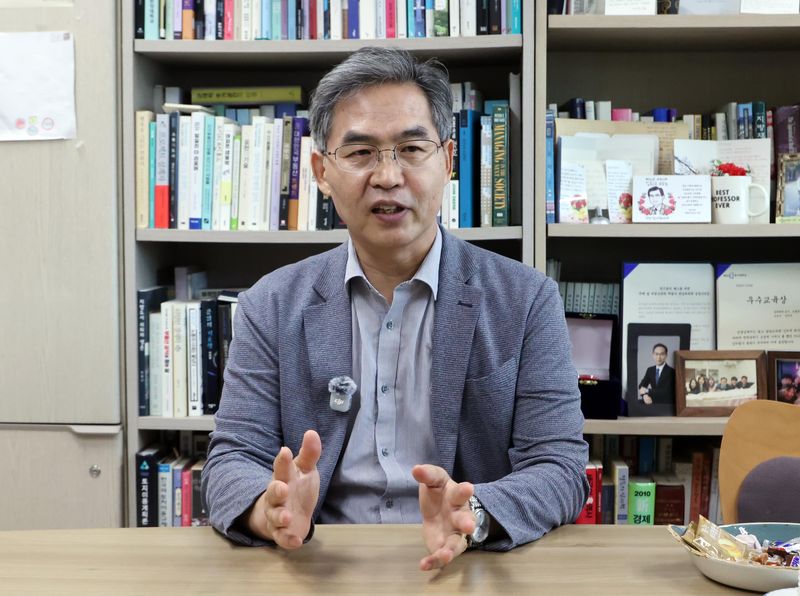
■ Professor Jin-Yu Kim’s Profile △ Ph.D. in Urban Engineering, Hanyang University △ Researcher at the Korea Appraisal Institute (currently the Korea Real Estate Institute) and the Korea Housing Corporation (currently the Korea Land and Housing Corporation) △ Professor, School of Smart City Engineering, Kyonggi University △ President, AsReal Estate Asia Society (AsRES) △ Member, Jeonse Damage Support Committee, Ministry of Land, Infrastructure and Transport △ Member, Seoul Metropolitan Government Urban Planning Committee △ President, Korea Real Estate Analysis Society △ President, Korea Housing Association △ Author of numerous books including *The Future of Cities* (co-authored, 2024) and *Jeonse* (2017).