Department Manager Kim, Laughing After Losing 3 Million Won in U.S. Stocks, Crumbles at the Diner Auntie's "1,000-Won Price Hike" [Grown-Ups' Wrong Answer Notes]
- Input
- 2026-10-01 19:30:00
- Updated
- 2026-10-01 19:30:00
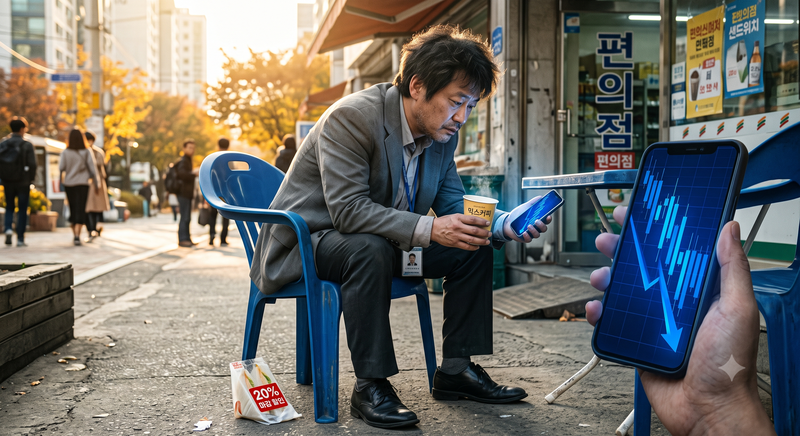
[Financial News] October 1, Thursday. It is the first day of the fourth quarter and a melancholy start to the month, when people must try to erase the traces of September's paycheck that have already slipped away.
At lunchtime, the brows of office workers in their 40s and 50s who stop by their regular Korean diner near work begin to furrow.
"Due to rising prices, the price of spicy stir-fried pork will unavoidably increase by 1,000 won."
Just 1,000 won. Yet this single 1,000-won increase fills middle-aged men who must get through the month on tight allowances with tremendous anger and a sense of loss.
In the end, they decide to save even on coffee, taking free instant coffee mix from the restaurant's vending machine as they leave. Without fail, each of them is also holding a smartphone.
They casually open their MTS, or stock-trading app. The screen is filled with deep-blue loss indicators. NVIDIA and Tesla have plunged on bad news from the United States overnight, wiping out 2 million to 3 million won—roughly a month's salary—in a single day. Surprisingly, however, their expressions are far calmer than they were at the diner.
◇ Big Shots in Front of Their Stock Screens, Cheapskates in Real Life
The financial mindset of Korean breadwinners in their 40s and 50s has a strange duality. Money in their stock accounts is treated as if it were cyber money that does not really exist. Even when losses of 20% or 30% wipe out millions of won, they proudly play the big-hearted investor, saying, "In stocks, the one who can sit tight is the one who wins," as if channeling Warren Buffett.
When prices fall, they even insist that they should average down, or buy more, miraculously finding emergency savings or room on their overdraft credit lines.
But when it comes to money in real life, they turn into ruthless cheapskates. When their wives add a decent cosmetic product to the shopping cart and hesitate over it, they make them feel guilty by saying, "There are so many things to spend money on these days." When they need to buy new shoes for a child who has suddenly outgrown the old ones, they stay up all night searching for the lowest online price. Where did the big spender who fearlessly pressed the "Buy" button on the stock screen go? All that remains is a stingy middle-aged man who trembles even before a 5,000-won cup of coffee.
◇ Why Have We Become So Generous Toward the Blue Numbers?
It is not simply a matter of stock addiction or a lack of financial sense. The reason breadwinners pretend to remain composed even in the face of enormous losses in their stock accounts is that those blue numbers contain a "melancholy hope" for their family's future.
This is an era when it is difficult to save only from one's salary and ever afford a decent home under Seoul's sky. We are pushed into the rough sea of the stock market by the deep anxiety that we cannot guarantee even our own retirement, let alone our children's college tuition. The losses shown in the account are not merely numbers. They are the "expensive tuition" paid by a breadwinner's heavy sense of responsibility—the price of wanting to turn a harsh reality around in one stroke and give the family a somewhat more comfortable life.
◇ In the First Week of October, Spend Cash on Yourself
October 1 marks the beginning of the fourth quarter. Even if the stocks painstakingly averaged down remain blue, the harsh daily life of October, beginning tomorrow, must go on.
For just today, take your eyes off the merciless numbers on the stock screen. The fact that millions of won have disappeared from the monitor does not mean your reality has collapsed. Instead, on your way home from work today, take out a few 10,000-won bills and buy a warm whole chicken or a bag of sweet fruit, either for yourself or for your beloved wife and children.
Rather than the cold smartphone screen whose signal could turn red at any moment, the smiling faces of your family over a simple snack bag held in your hands will be the best blue-chip stock in your life—one with no volatility.
[email protected] Jeon Sang-il Reporter