KAI Sets Sights on Becoming a Global Top-Four Aerospace Platform Company by 2040
- Input
- 2026-09-30 17:31:00
- Updated
- 2026-09-30 17:31:00
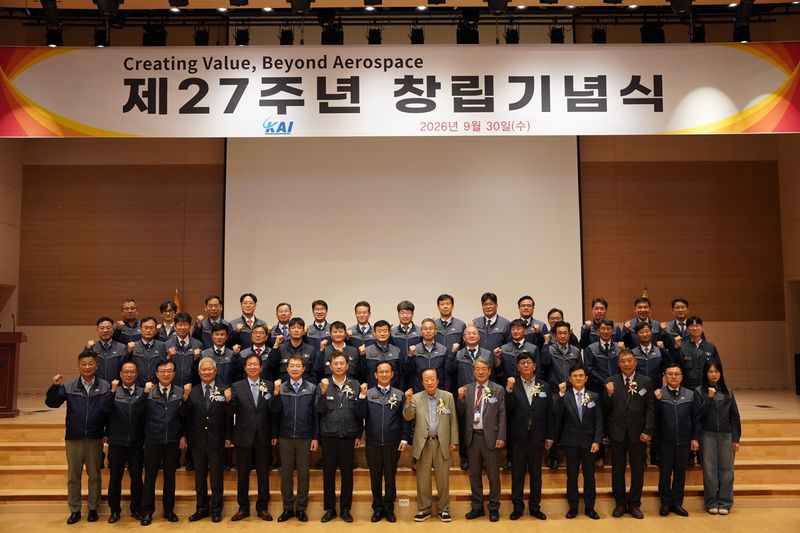
[Financial News] Korea Aerospace Industries (KAI) has unveiled a mid- to long-term vision to become one of the world's top four aerospace platform companies by 2040, as it marks its 27th anniversary. The company plans to transform its business structure, currently centered on defense, by expanding into commercial aviation, future mobility, manned-unmanned teaming systems, and space to become a global advanced platform company.
KAI said it held a ceremony marking its 27th anniversary at its headquarters in Sacheon on the 30th, with President Kim Jong-chul, employees, and former executives in attendance.
In his commemorative address, Kim said, "KAI will transform itself into a globally leading advanced platform company that goes beyond defense to encompass commercial aviation, future mobility, manned-unmanned teaming systems, and space. Building on this foundation, we will become one of the world's top four aerospace platform companies by 2040."
To achieve this goal, KAI will focus on strengthening quality competitiveness and expanding its commercial business. The company will ensure stable deliveries of the KAI KF-21 Boramae, which has entered full-scale production, and establish a preventive quality management system for the KAI LAH-1 Miron. At the same time, it plans to expand its commercial business through the international joint development of next-generation airliners and the independent development of a dual-use advanced air vehicle (AAV) model.
KAI will also work to strengthen the aerospace industry ecosystem by promoting shared growth with its partners. The company plans to establish a sustainable virtuous cycle of mutual growth so that KAI's expansion benefits the broader South Korean aerospace industry.
The company also plans to change how it operates. It will reduce unnecessary procedures and establish a system for swift decision-making based on data and artificial intelligence (AI). At the same time, KAI will redesign authority and responsibility around frontline operations and foster an organizational culture that is not afraid of failure.
KAI will expand its business portfolio around six key future businesses that will drive its mid- to long-term growth. These businesses are broadly organized into three pillars: commercial aviation and future mobility, next-generation defense platforms, and space solutions.
In commercial aviation and future mobility, KAI will pursue next-generation airliners and AAV projects. In defense, it will develop AI-based manned-unmanned teaming systems, sixth-generation fighter jets, and next-generation high-speed medium-lift utility helicopters. In space, the company will develop space-based infrastructure and services as a new growth pillar, including the in-house development of core payload technologies, the construction of satellite networks, and entry into service businesses.
[email protected] Jung Won-il Reporter