Alaska's North Slope, Rich in Untapped Natural Gas, Awaits South Korean Capital [Park Jong-won's Then and There]
- Input
- 2026-10-03 06:00:00
- Updated
- 2026-10-03 06:00:00
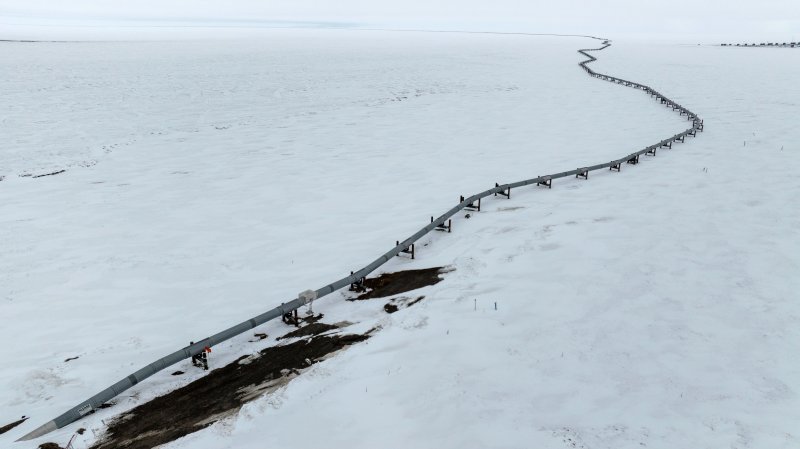
[Financial News] Traveling north over the Brooks Range, which runs east to west across Alaska, leads to gently sloping terrain and hills stretching toward the Arctic Ocean. The area is called the North Slope, quite literally. Administratively, it is designated as a borough, a unit similar to a county in the U.S. mainland, and covers 245,520 square kilometers—roughly the size of the entire Korean Peninsula. Most of the land is covered by permafrost, which briefly thaws during the summer to form wetlands. The vegetation consists mainly of alpine plants, including mosses and grasses. The area had only 11,031 residents as of 2020. Alaska Natives accounted for approximately 51.5% of the population, followed by whites at 27%. Alaska Natives made their living through coastal fishing and hunting until Western explorers mapped the coast in 1826. As the whaling industry expanded in the 1800s, more outsiders arrived, and epidemics also spread among the Native population.
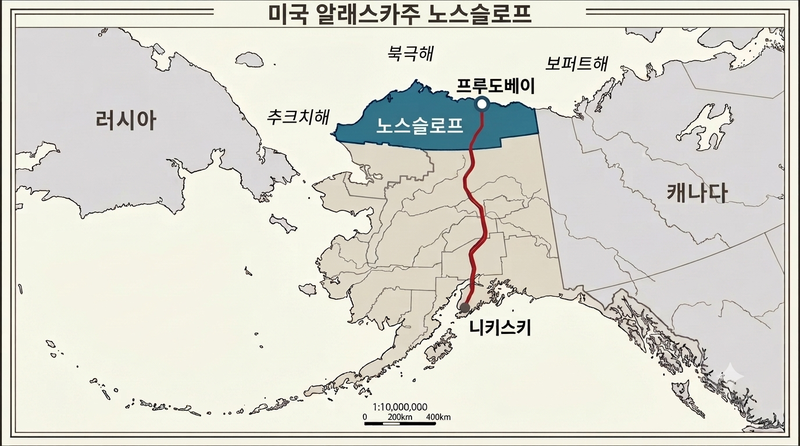
Today, however, the North Slope is a vital energy hub responsible for supplying the United States with oil, along with Texas. Geologists had suspected since the early 1900s that the area held oil and natural gas. After decades of exploration, crude oil production finally began at the Prudhoe Bay Oil Field in 1968. ExxonMobil and other U.S. energy companies formed a consortium and built the 1,287-kilometer Trans-Alaska Pipeline System between April 1974 and June 1977, connecting the Prudhoe Bay Oil Field with Valdez, a port in southern Alaska. At the time, the facility was the world's largest privately financed construction project, costing $8 billion.
According to the U.S. Energy Information Administration (EIA), Alaska produced an average of 421,000 barrels of crude oil per day in 2025. That was about 3% of total U.S. crude oil production, which averaged 13.58 million barrels per day in the same year. At its 1988 peak, however, Alaska produced 2 million barrels per day, accounting for roughly 20% of the nation's total output at the time, which averaged 9.81 million barrels per day. Alaska's crude oil production has rebounded sharply this year as numerous new oil fields have been developed. The North Slope accounts for 95% of Alaska's crude oil production.
Alaska is also rich in natural gas. Its natural gas production totaled 99.109 billion cubic meters in 2025, ranking sixth in the United States after Texas, Pennsylvania, New Mexico, Louisiana and West Virginia. The EIA noted that natural gas production in Alaska's North Slope exceeds local demand, but there are no facilities to transport it south. Currently, natural gas produced during crude oil extraction in the North Slope is reinjected underground to accelerate oil production.
As a result, major energy companies have sought to transport surplus natural gas from the North Slope to southern ports for sale. ExxonMobil, BP and ConocoPhillips devised a plan to transport natural gas extracted from the Prudhoe Bay Oil Field to Nikiski in southern Alaska, liquefy it and export it. The project would require a roughly 1,297-kilometer pipeline running north to south through Alaska, along with liquefaction terminals and other infrastructure. The energy companies began actively pursuing the project in 2014 but withdrew in 2017 because of its enormous costs and concerns over its economic feasibility. Controversies over environmental pollution and damage to ecosystems also continued.
The project was later taken over by the Alaska Gasline Development Corporation (AGDC). In March last year, U.S. energy company Glenfarne acquired a 75% stake in 8 Star Alaska, an AGDC subsidiary that holds assets related to the pipeline project, thereby joining the construction effort. AGDC retains the remaining 25%. AGDC maintains that construction would not be particularly difficult if the new pipeline were built alongside the existing TAPS and highway, but experts remain divided. The second Donald Trump administration, which took office in the United States last year, has revived the project and is working to sell Alaska LNG in Asia while calling for investment from South Korea and Japan.
[email protected] Park Jong-won Reporter