"The AI Bubble Will Burst Next Year... 'More Certain Than Ever': The Big Short's Burry"
- Input
- 2026-09-30 16:13:40
- Updated
- 2026-09-30 16:13:40
[Financial News] Michael Burry, the real-life protagonist of the film The Big Short, became famous after predicting the 2008 collapse of the U.S. mortgage market. He has moved up his forecast for when the AI bubble will burst and expanded his bearish bets on AI-related stocks, including NVIDIA and Micron Technology.
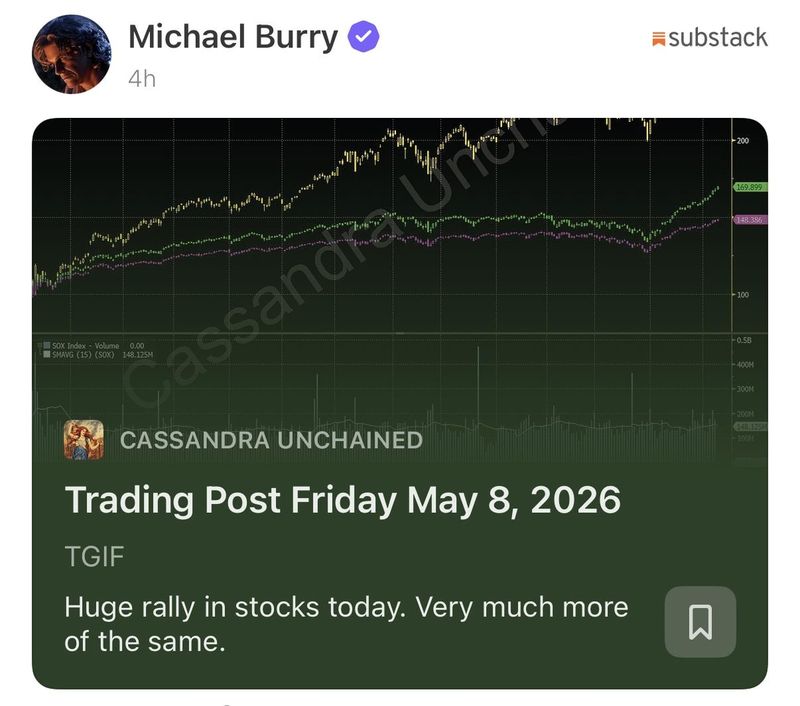
On the 29th (local time), Business Insider reported that Burry wrote in a post uploaded to Substack the previous day, "The AI bubble could burst sooner than expected," adding, "I am more certain than ever that my bearish outlook will become reality within the next year."
Burry initially set 2028 as his base-case scenario for the AI bubble's collapse, but moved that forecast up to 2027. He also changed the way he was betting against AI-related stocks. He closed his existing short positions and switched to put options, which generate profits when stock prices fall.
The targets of his put-option purchases included NVIDIA, Palantir Technologies, Micron Technology, Nebius, Oracle, and Caterpillar, as well as the iShares Semiconductor ETF and the Nasdaq-100 Index. The options expire from June through December next year.
The specific terms of the options Burry disclosed are highly aggressive. He said he purchased NVIDIA put options expiring next September with a strike price in the mid-$100s. That is less than half of NVIDIA's closing price of $229 the previous day.
Burry: "Data Center Investment Is Increasingly Reliant on Debt"
The key reason Burry has turned against the bullish view of AI is that massive data center investments are increasingly dependent on debt. He argued that AI companies are borrowing and spending at levels they can hardly afford to build technological infrastructure, saying, "If spending stops or slows, everything collapses."
In particular, he pointed out that the money being poured into AI infrastructure investment is "increasingly becoming debt, and that comes with strings attached."
He also identified the recent rise in interest rates as a factor increasing the risks. Large amounts of private-equity, private-credit, and insurance-company funding are flowing into the construction of AI infrastructure, including data centers. Burry said, "Rising interest rates put stress on every part of this chain."
In another recent post, Burry claimed that signs of pressure were already emerging among major hyperscalers. He said, "Signs of strain are appearing at each of the major hyperscalers," adding that their public statements and regulatory filings "contain clues about how much pressure each company is actually under." He continued, "I think these companies are beginning to fracture in several ways."
"They have propped up the AI investment boom by inflating short-term profits and using circular financing among AI companies," he criticized.
Burry has repeatedly argued that AI companies are masking slowing growth while overinvesting in semiconductors and data centers. He has also criticized accounting practices that inflate short-term profits, excessive stock-based compensation, and circular financing among AI companies as factors sustaining the AI investment boom.
Despite Burry's repeated warnings, AI-related stocks have driven the stock market to record highs this year. The AI investment fervor has not easily faded despite the war in the Middle East, rising interest rates, a sharp increase in Treasury yields, and concerns that inflation could accelerate again.
Burry became famous after anticipating the collapse of the U.S. mortgage market in the mid-2008s and making large bearish bets on subprime mortgages. His investment story became widely known through Michael Lewis's book and the film The Big Short.
[email protected] Lee Seok-woo, international affairs correspondent Reporter