Min Byeong-deok: "Establish a Regulatory Framework for Won-Based Stablecoins"; BOK: "Strengthen Financial Competitiveness Through Government Bond Tokenization" [KBW 2026]
- Input
- 2026-09-30 15:50:40
- Updated
- 2026-09-30 15:50:40
[Financial News] As dollar-backed stablecoins expand their influence as global payment infrastructure and the United States and Europe accelerate their competition to tokenize real-world assets (RWA), calls are growing for South Korea to urgently establish a regulatory framework for won-based digital assets and build tokenization infrastructure. Experts say the country should enhance the appeal of its financial market by improving regulations and market access.
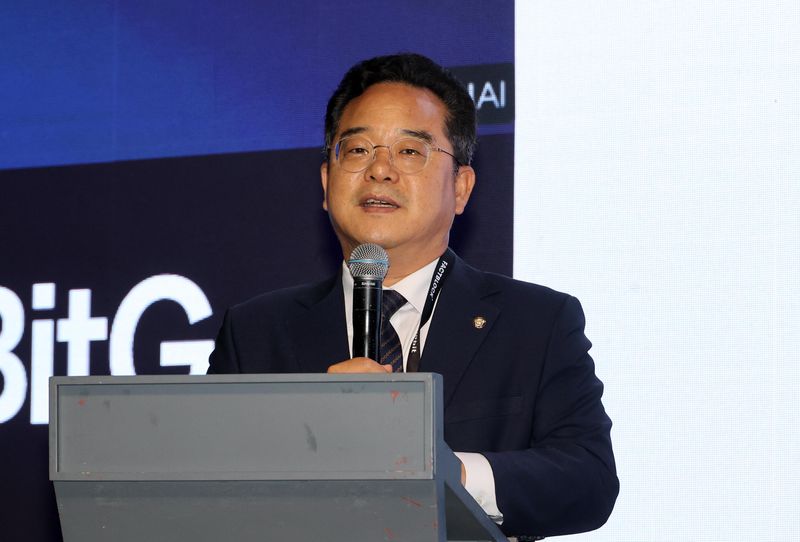
Speaking on "The Decisive Moment for South Korea's Digital Asset Policy" at Korea Blockchain Week 2026, held at Walkerhill Hotels & Resorts Seoul on the 30th, Min Byeong-deok, a lawmaker from the Democratic Party of Korea, said, "A 'dollar tsunami' is approaching as dollar stablecoins take control of the global payments infrastructure. Rather than building a seawall, we should ride that tsunami."
Min said the spread of AI is not merely an industrial shift but a factor that will reshape competition over financial infrastructure. As AI agents begin conducting transactions and making payments across borders, relying solely on cash or existing card networks will have limitations. South Korea therefore needs digital asset infrastructure capable of supporting real-time, automated payments.
Min highlighted the importance of gaining an early regulatory advantage, pointing to the United States' establishment in 2025 of rules governing the issuance of payment stablecoins and their reserve assets through the Guiding and Establishing National Innovation for U.S. Stablecoins Act (GENIUS Act). He described it as "more than simply institutionalizing virtual assets; it formally established the global expansion of the digital dollar as a national strategy."
He also cited moves by traditional financial institutions. JPMorgan Chase issued the dollar deposit token JPM Coin for institutional customers, while BlackRock launched the tokenized fund BlackRock USD Institutional Digital Liquidity Fund (BUIDL). Min stressed, "Digital assets are no longer merely a matter of speculative demand from a limited group of investors," urging policymakers to approach them as financial market infrastructure.
He identified a won-based stablecoin as the core of South Korea's domestic regulatory framework. Rather than focusing on the debate over the share of bank ownership in the issuing entity, he said priority should be given to establishing one-to-one redemption and guarantee and verification systems for reserve assets.
Min pledged, "We need to create a lighter, more convenient and useful won-based stablecoin system," adding, "I will pursue the institutionalization of won-based stablecoins, enactment of the Digital Asset Basic Act, and participation by institutional investors in the market." He continued, "South Korea has world-class information technology (IT) infrastructure and people who adapt quickly to change," emphasizing, "The AI world can change much faster, so we must make a choice now."
The Bank of Korea (BOK) also called for tokenization to ultimately serve as a means of improving access to South Korea's financial markets. The BOK is pursuing Project Han-gang, which converts bank deposits into deposit tokens, alongside Agora, an international payments project that shifts the cross-border foreign-exchange transaction system to a distributed ledger technology (DLT)-based platform. A government bond tokenization pilot project planned for next year is also intended to reduce inefficiencies in transaction procedures while improving access for domestic and international market participants.
Yoon Seong-gwan, head of the BOK's Digital Currency Office, said during a discussion titled "Digital Currencies and the Future Monetary System: South Korea's Next Financial Structure," "Not only the United States but also every country, including those in Europe, is jumping into real-world asset (RWA) tokenization." He added, "Even if the South Korean economy improves and government bonds become more attractive, the Korean market itself could lose its appeal if market access declines." He emphasized, "The fundamental value of government bond tokenization lies in improving access for market participants and strengthening the competitiveness of South Korea's financial markets."
[email protected] Lee Jeong-hwa Reporter