‘Defending Hangul’ Through Imprisonment and Suicide Laid the Foundation for a ‘Digital Powerhouse’ in the Smartphone Era
- Input
- 2026-09-30 15:59:05
- Updated
- 2026-09-30 15:59:05
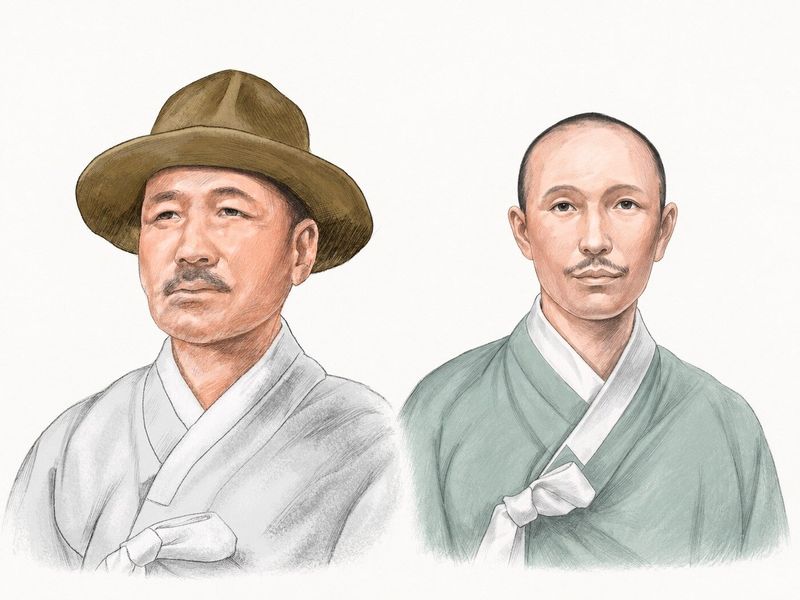
The Ministry of Patriots and Veterans Affairs (MPVA) said on the 30th that it had selected Garam Yi Byeong-gi and Minjae Sin Myeong-gyun, who protected the Korean language by refining its grammar and promoting its use despite Japan’s suppression of Hangul, as the ‘October 2026 Independence Activists.’ The Hangul movement of that period represented a quintessential cultural independence movement, defending Korea’s native common language and writing system against Japan’s attempts to take control even of Korean linguistic standards.
Yi Byeong-gi led the founding of the Korean Language Society and firmly established the foundations for promoting Hangul, standardizing orthography and compiling dictionaries. In particular, he personally secured the signatures of 78 literary figures, helping build broad public support for the Unified Hangul Orthography and demonstrating the qualities of an intellectual who took action. While directly teaching Korean grammar to the public, he was eventually imprisoned with his colleagues in the 1942 Korean Language Society Incident, fabricated by Japanese colonial authorities, and suffered severe hardship. He also left a distinct mark as a literary figure who led the sijo revival movement in the 1920s and captured the beauty of the Korean language in meticulously crafted sijo poems.
The life of Sin Myeong-gyun, selected alongside him, reflects the desperate resolve of a man who refused to compromise under Japanese colonial pressure. Sin participated in every stage of the Korean Language Society’s project to establish Hangul orthography, from its launch to its completion, and oversaw the practical work. After devoting his life to educating the public through publishing and education, he chose suicide in 1940 rather than comply when Japan’s policy of erasing Korean national identity reached its peak and demands for Shinto shrine worship and the adoption of Japanese-style names intensified. In doing so, he resisted with his death the humiliation imposed on him as a colonial intellectual.
After liberation, the orthographic rules and dictionary manuscripts prepared by the Korean Language Society at the risk of its members’ lives became firm standards for Korean language use and public education in South Korea, providing a solid foundation for building an independent nation.
The 24-consonant-and-vowel structure of Hangul that these scholars defended has become a decisive data point in South Korea’s rise as a global internet powerhouse in today’s digital information age. According to quantitative analyses by the linguistics and IT sectors, Hangul’s intuitive combination of consonants and vowels enables smartphone and computer keyboard input at speeds ranging from at least three times to more than seven times faster than Chinese input methods, which require individual conversion after entering Chinese characters, and Japanese methods, which require phonetic input using the Latin alphabet followed by conversion into kana. For mobile typing of 100 characters, Chinese and Japanese take about one minute because of conversion delays, while Hangul allows a complete sentence to be composed in 15 to 20 seconds. The standardization of linguistic rules achieved in opposition to Japan’s past repression ultimately became a structural advantage that has dramatically accelerated administrative and information-processing speeds across South Korea’s government ministries and private sector in today’s digital economy. The government posthumously awarded both scholars the Patriotic Medal of the Order of Merit for National Foundation in recognition of their contributions.
[email protected] Lee Jong-yoon Reporter