WebCash Expands to Customers with AX Validated Internally: "Leading Productivity Innovation" [AI World 2026]
- Input
- 2026-10-05 14:17:53
- Updated
- 2026-10-05 14:17:53
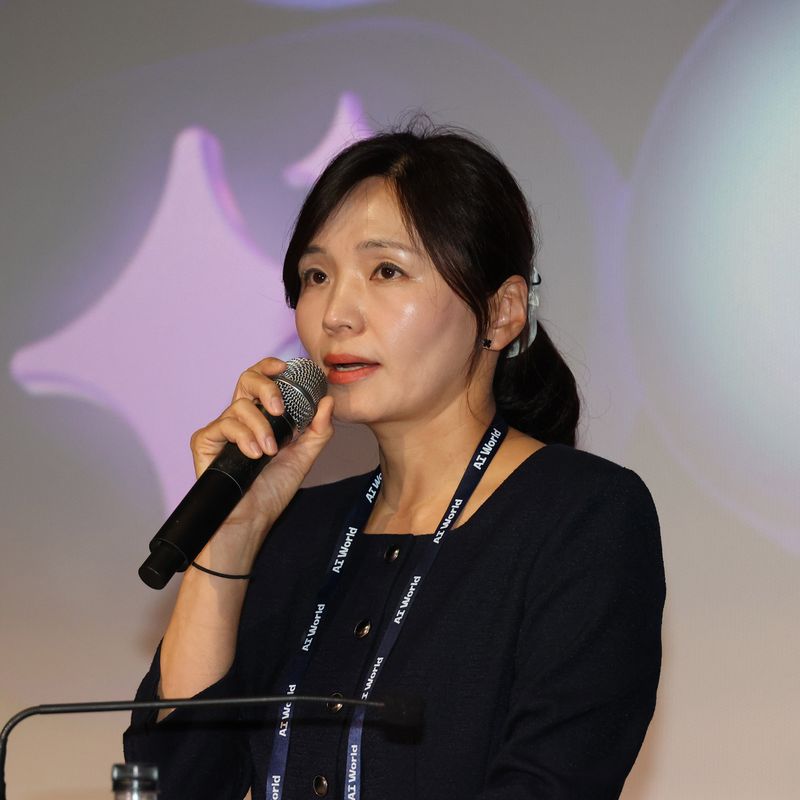
■ Evaluating AI capabilities instead of favoring developers At AI World 2026, jointly hosted by Financial News and the Ministry of Science and ICT at Lotte Cinema in Lotte World Tower in Songpa-gu, Seoul, on the 9th of last month, Jo introduced WebCash's AX transformation process. "Many companies are developing AI solutions or agents for customers, but we took a different approach," she said.
The first thing WebCash changed was its personnel system. It abolished a program that selected around 60 outstanding developers as "masters" and gave them preferential treatment. In its place, the company introduced the "AX Master" program, which selects employees who improve work productivity with AI regardless of their job category. Twenty people were selected this year.
“We selected 20 people this year, and there is only one criterion: ‘How much did they increase work productivity using AI?’” Jo said. “This means that we are no longer a company that favors developers, but one that favors people who use AI effectively.”
WebCash also shifted its work methods to center on AI. It established 'ASK AX FIRST (Ask AI first)' as a guiding principle, instructing employees to use AI before searching for materials or asking people when questions arose during their work. AI training was provided for executives, department heads, developers and general employees. Around 60 executives also received hands-on training in prompt design, web application development and short-form video production.
AI training previously centered on outside experts was also changed to a format in which employees shared examples of applying AI to their actual work. Examples included product planning with Claude and app development by nondevelopers. Attendance at the company's monthly internal presentation session grew from 80 people at the first session to 200 by the eighth.
■ Shortening work hours by automating repetitive tasks Changes in systems and training led to tangible innovations in the workplace. The management support division adopted the principle of "eliminating repetitive work done in Excel or by hand." This involved automating tasks repeatedly performed by employees in finance, accounting and human resources.
In accounting, processing about 200,000 accounting entries each quarter in Excel took more than 10 hours on average. Automation reduced the workload to six hours per week. The process of verifying 10,000 expense approvals and enterprise resource planning (ERP) data each month was cut from more than 10 hours on average to less than two hours. Settlement-balance verification was also reduced from an average of 10 hours per month to about 20 minutes.
Corporate card audits were changed from a process that required four employees to spend an average of 40 hours per month to one handled by a single employee in four hours. Reviewing contracts across all affiliates previously required an average of four people to spend 400 hours per month. After automation, two people handled the work in 167 hours, reducing the time required by about 60%.
These changes also affected workforce management. Last year, more than 40 employees in administrative support functions, including human resources, payroll, finance, accounting and treasury, regularly worked overtime. As of August this year, the workforce had fallen to 25, and the culture of working late had disappeared, Jo explained. Some employees were transferred to other departments.
The transformation process was not entirely smooth. "Some employees resigned, asking why they had to do AX when they were not developers, while others were reassigned to different departments," Jo said. "The satisfaction of the employees who remain is now higher." She added that the company plans to further apply AX to simple repetitive tasks while increasing staffing in human resources and employee welfare functions that involve direct interaction with employees.
WebCash also reorganized its structure and hiring policies around AI. The company halted new hiring in June last year and disbanded its design and publishing departments in August of the same year. It also established an AI Center and an in-house graphics processing unit (GPU) center during that period. This year, it created an AX business organization and established a context engineer position in July.
■ AI agents validated internally expanded into customer operations WebCash is extending the AX experience it accumulated internally to help improve customer productivity. The company's new business focuses on applying AI agents to its existing cash management system (CMS) products and providing them to customers, while also building AI agents directly for financial and public institutions.
AI agents have already been applied to Branch, a cash management service for mid-sized companies, and rERP, a research-fund management system for university-industry cooperation foundations. Branch provides real-time cash-flow management, while rERP supports research funding and research administration.
WebCash plans to complete development by the end of this year for In-house Bank (IHB), a product for public institutions and large enterprises, and GyeongriNara, a product for small and medium-sized businesses. Beginning next year, the services will be rolled out sequentially to 50,000 existing customers.
For financial institutions, WebCash will introduce agent banking, in which AI handles banking operations. The company won Nonghyup Bank's corporate agent banking project in June. It is first building a function that allows customers to ask questions in natural language and retrieve their balances, transaction histories and limits. The company is discussing plans to add transfers and various applications later.
Jo said, "We are aiming to transition corporate internet banking to an agent-based model in 2027. We are also discussing related projects with three other banks."
WebCash is also pursuing an AI management information system (MIS) that analyzes banks' management information. A user asks a question in an everyday sentence, and AI finds and analyzes the necessary data. WebCash has completed technology verification at several banks and is preparing to win the main project at one regional bank.
In the public sector, WebCash is pursuing a fiscal AX business that applies AI to treasury, budgeting and auditing. Gyoyuk Geumgo AX, being developed with Nonghyup Bank, is a representative example. The project applies AI agents to existing work systems to support the duties of employees in charge.
Jo said, "We will improve customers' work productivity by pursuing both the AI transformation of existing products and the construction of agents for financial and public institutions. We will grow into a company that supports AI transformation in the financial and public sectors."
[email protected] Yoon Hong-jip Reporter