"Measure Social Solidarity Economy Outcomes to Provide Growth Support Grants" — Ministry of the Interior and Safety Cooperates with SK Group's Center for Social Value Enhancement Studies
- Input
- 2026-09-30 15:18:22
- Updated
- 2026-09-30 15:18:22
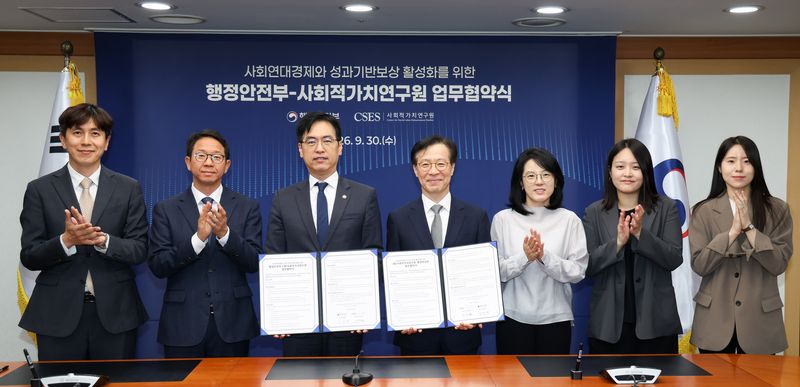
[Financial News] MOIS will measure how much social solidarity economy projects contribute to solving regional problems and provide growth support grants to high-performing projects.
The initiative applies the private-sector Social Performance Incentive (SPC) model—which has been used to measure and reward individual companies' social outcomes in monetary terms—to regional innovation models.
MOIS signed a memorandum of understanding with CSES, established by SK Group, at Government Complex Seoul on the 30th to promote the social solidarity economy.
Under the agreement, the two institutions will measure the outcomes of efforts to solve problems in regions selected for MOIS's project to identify and expand social solidarity economy innovation models. CSES will develop social performance metrics tailored to the characteristics of each project and measure and verify the actual outcomes.
Growth support grants will be provided to models that achieve outstanding results. CSES plans to cooperate on a total budget of 1.5 billion won over three years from 2027 to 2029.
The Social Performance Incentive is a system that measures in monetary terms the outcomes created by social solidarity economy enterprises as they address social problems and provides cash rewards in proportion to those outcomes. Until now, it has been used at the level of individual companies, but this agreement will expand its application to regional innovation models.
Through the initiative, MOIS plans to look beyond whether individual projects should receive support and assess what actual changes have taken place in each region. Models with verified outcomes will then be expanded to other regions. CSES will also broaden its measurement targets from individual companies to regional units, laying the foundation for eventually measuring social value at the city level.
Kim Min-jae, vice minister of MOIS, said, "The key to this agreement is measuring the social value created in local communities and linking those outcomes to growth support. Through cooperation with the private sector, we will actively support the expansion of outstanding social solidarity economy models to more regions and ensure that they lead to changes residents can feel."
[email protected] Lee Bo-mi Reporter