Special Prosecutors Seek 20-Year Prison Term for Choo Kyung-ho over "Obstructing the Vote to Lift Martial Law"; He Counters that "Involvement in an Insurrection" Was a "Forced Fit"
- Input
- 2026-09-30 17:18:14
- Updated
- 2026-09-30 17:18:14
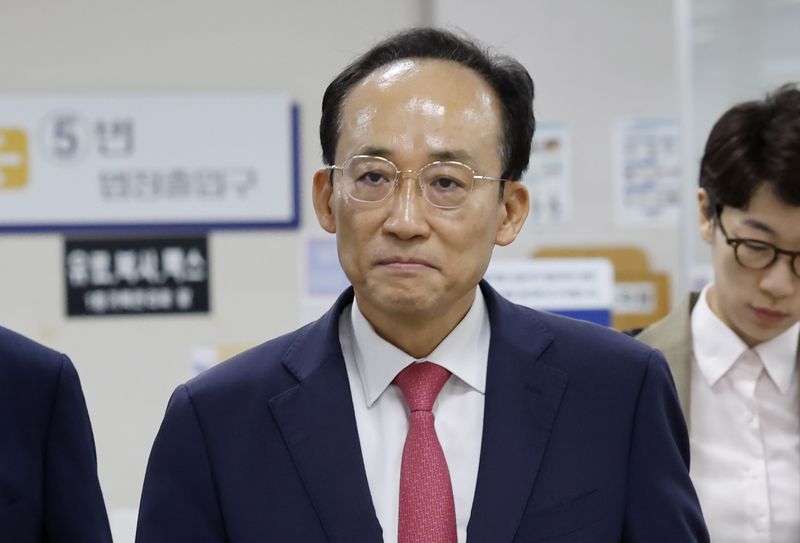
[Financial News] The special prosecutor sought a 20-year prison sentence in the first trial of Choo Kyung-ho, Mayor of Daegu and then floor leader of the People Power Party, who was indicted for allegedly obstructing the National Assembly vote to lift martial law declared on December 3. Choo's side denied all charges, arguing that the allegation of "involvement in an insurrection" was a leap in logic based on the premise that facts uncovered through years of investigation had already been known at the time.
The special prosecutor team made the request during the final hearing on Choo's charge of performing an important role in an insurrection, held on the 30th before Criminal Division 34 of the Seoul Central District Court, presided over by Judge Sung-Jin Han. "We hope to show the entire nation what punishment awaits those who betray the Constitution and deceive the people," the team said.
The special prosecutor team stated, "At a time when former President Yoon Suk Yeol was moving to blockade the National Assembly to ensure the success of martial law, the defendant volunteered for the key mission of preventing 108 ruling-party lawmakers from taking part in the vote."
The team particularly pointed to the fact that the defendant, who was the party's floor leader at the time, changed the gathering locations for People Power Party lawmakers several times. The allegation is that after speaking with former President Yoon Suk Yeol for two minutes and five seconds following the declaration of emergency martial law, Choo used messages and other communications to move the gathering location from the National Assembly to the Special Committee on Budget and Accounts of the National Assembly or the People Power Party headquarters instead of the main chamber, thereby hindering the lawmakers' effort to assemble.
Even after the National Assembly speaker announced that a plenary session would be convened, several People Power Party lawmakers, including the defendant, remained in the parliamentary floor leader's office. At that point, group text messages telling lawmakers to "gather at the party headquarters outside the National Assembly" were sent three times. The team also alleged that actions amounting to obstruction of the vote continued, including a request to National Assembly Speaker Woo Won-shik to delay the session.
The special prosecutor team explained its request for a severe sentence by saying, "The martial law troops deployed from outside and the defendant inside the National Assembly coordinated from inside and outside to keep a majority of ruling-party lawmakers from participating. After becoming floor leader, he grew frustrated with the opposition's offensive and the passage of budget-cutting bills, viewed martial law as a 'game changer,' and actively supported it. A harsh sentence is therefore unavoidable."
In contrast, Choo's attorneys categorically denied the charges, stating, "The defendant never conspired with the martial law leadership before or after the fact, and he did not even know that emergency martial law was unconstitutional or what specific plans the military and police had for carrying it out."
The attorneys countered, "Applying facts uncovered through a subsequent investigation retroactively to conduct at the time and linking it to involvement in an insurrection violates the principle of legality. Without direct evidence such as recorded phone calls or documents requesting cooperation, the special prosecutor is imposing serious insurrection charges based on the vague inference of an 'unspoken understanding.'"
Choo's side also viewed the change in gathering locations, which the special prosecutor presented as a key fact, as an unavoidable response to external circumstances. It explained that Choo initially ordered lawmakers to gather at the National Assembly while heading there immediately after martial law was declared. However, when the side of then-party leader Han Dong-hoon confirmed that the National Assembly was under control and moved the venue for the Supreme Council meeting to the party headquarters, the first change was made accordingly. The subsequent changes were also attributed to the external environment, as control of the National Assembly was briefly relaxed before security was tightened again.
The attorneys emphasized, "Immediately after his call with former President Yoon Suk Yeol, the defendant received a report that some restrictions at the National Assembly had been lifted, so he changed the location again—from the party headquarters to the National Assembly's budget committee meeting room—and went to the National Assembly himself. These actions cannot be seen as those of someone who intended to obstruct the lifting of martial law."
Regarding the allegation that he kept lawmakers confined in the floor leader's office, the defense pointed out that the floor leader's authority to convene lawmakers could not prevent individual lawmakers from acting on their own. It also argued that both the budget committee meeting room, where People Power Party lawmakers had been scattered, and the floor leader's office were not far from the main chamber, and that no one could have physically prevented lawmakers from leaving those locations.
If the special prosecutor's requested sentence is accepted and a sentence of imprisonment or a heavier punishment becomes final at the Supreme Court, Choo will lose his position as mayor.
[email protected] Lee Chang-hoon Reporter