3184 Additional Applications After Early-Admissions Disruption; Management System Under Scrutiny
- Input
- 2026-09-30 15:00:35
- Updated
- 2026-09-30 15:00:35
[Financial News] After the UWAYAPPLY system disruption on the 11th led to an extension of the early-admissions deadline, 3184 additional applications were submitted to 80 universities. Electronic records confirmed that 2329 of them involved applicants who had attempted to submit their applications during the disruption. Park Jung-hoon, a lawmaker from the People Power Party, pointed out that the budget for operating the college admissions application system had fallen by 34% in one year. He also noted that there had been no advance verification of UWAYAPPLY's system changes or audits and operational inspections led by the Ministry of Education over the past three years.
The Ministry of Education released data on additional applications resulting from the extension of the 2027 early-admissions deadline on the 30th. Of the 116 universities originally scheduled to close applications at 6 p.m. on Sept. 11, 100 extended the deadline because of UWAYAPPLY system errors. Additional applications were actually submitted to 80 of those universities.
Additional applications were submitted to 1781 admissions units at 80 universities. Of the 3184 applications, 2329, or 73.1%, left electronic records showing that applicants were in the process of submitting their applications when the system error occurred. The remaining 855 cases included instances in which applicants could not even log in because of the error, leaving no electronic records.
The additional applications did not significantly change the overall competition ratios. At the 80 universities where additional applications were submitted, the average ratio rose 0.22%, from 10.25-to-1 at 6 p.m. to a final 10.27-to-1. Across the 1781 admissions units, the average ratio increased 0.74%, from 13.66-to-1 to 13.76-to-1.
Most additional applications consisted of just one application per admissions unit. Of the 1781 units that received additional applications, 1244 received one each, accounting for 69.8% of the total. By contrast, 18 units received 10 or more additional applications, for a combined total of 535. The Ministry of Education explained that the units receiving 10 or more additional applications were concentrated in essay- and practical-skills-based admissions tracks that had initially recorded high competition ratios.
■ Admissions Application System Management Framework Also Under Scrutiny
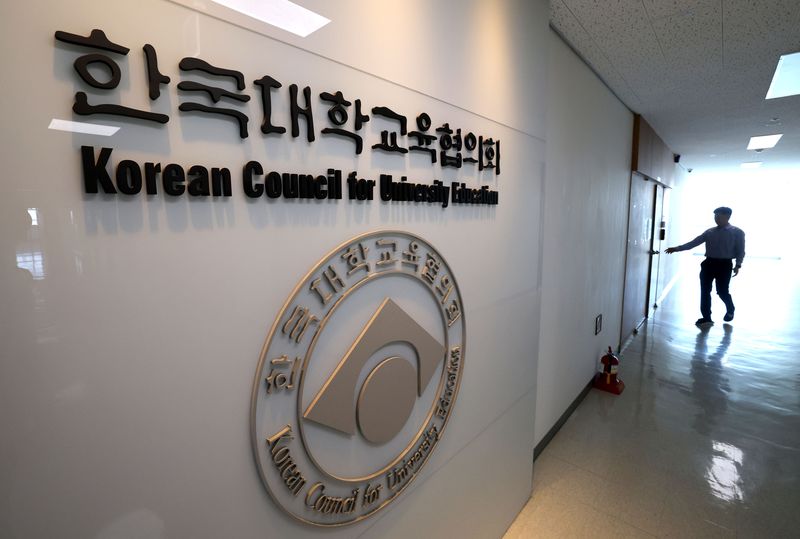
The disruption also brought the management framework surrounding the college admissions application system into focus. According to data that Park's office obtained from the Ministry of Education, the operating budget for KCUE's standardized common application system, supported by special grants from the Ministry, fell from KRW 974 million in 2025 to KRW 639 million in 2026. That represents a decrease of KRW 335 million, or 34%. Park's office said it asked about the reasons for the cut and the relevant ministries' assessments, but the Ministry of Education did not provide an answer.
There was also controversy over whether the Ministry of Education had been aware of UWAYAPPLY's system changes in advance. According to Park's office, UWAYAPPLY changed its operating system in June and July, before early-admissions applications opened, and also relocated its data center. In response to questions about whether it had received reports on these changes from KCUE and UWAYAPPLY, the Ministry said it faced limitations in directly managing and supervising systems operated by private agencies.
The Ministry gave the same response when asked whether it had conducted audits or operational inspections related to college admissions applications during the past three years. The revision history submitted by the Ministry also showed that, since the standard common application system's incident-response manual was introduced in 2016, it had been updated to reflect administrative matters such as updating operating schedules and personnel in charge, as well as deleting personal statements and teacher recommendation letters.
Park said, "The Ministry decided to extend the early-admissions deadline immediately after the incident, but it claims that it is constrained by private contracts when it comes to advance inspections and accountability. I will seek to hold it accountable through a parliamentary audit."
■ Ministry of Education Extends Special Investigation and Prepares for Regular Admissions
The Ministry of Education has decided to extend its special investigation to determine the cause of the disruption and where responsibility lies. In addition to investigating the cause of the UWAYAPPLY system failure, it will examine the overall operation of the application system, stability measures, and management procedures. Based on the findings, the Ministry plans to clarify the cause and responsibility and formulate comprehensive improvement measures.
The application system's operating framework will also be reviewed again ahead of regular admissions. Starting on the 30th, the Ministry of Education will operate a joint task force involving KCUE and private application agencies. Regular admissions for the 2027 academic year will begin on Jan. 4 next year.
The task force will reexamine private agencies' service-operation systems and prepare response manuals, communication channels, and drills for potential disruptions. It also plans to improve the way final competition ratios are disclosed and develop measures to reduce confusion during the application process.
[email protected] Kim Man-gi Reporter