"AI Must Also Be Given an Identity": RaonSecure Unveils Five Agentic AI Security Solutions
- Input
- 2026-09-30 15:23:57
- Updated
- 2026-09-30 15:23:57
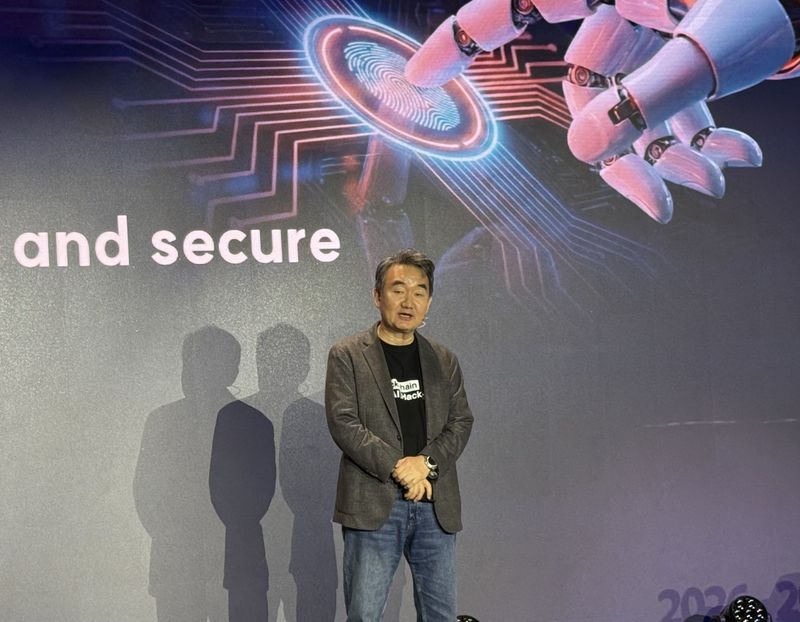
[Financial News] "No matter how smart AI becomes, it cannot create trust on its own. We can trust AI only when it has been demonstrated who it is, what it can do, and who is responsible for the results."
Lee Soon-hyung, chairman of RaonSecure, made the remarks at '2026 SecuUp' held at Fairmont Ambassador Seoul in Yeouido, Seoul, on the 30th, identifying trust as the key to the era of agentic artificial intelligence (AI).
As AI moves beyond simply answering questions to making its own decisions and carrying out actual tasks, a system is needed to verify whose instructions it is following, what authority it has, and how far it may act. Lee said, "The threat posed by AI is not merely that it could become a powerful hacking tool; it is also a matter of how to control and manage AI that acts autonomously. We must be able to identify who the AI is, verify what authority it has been delegated, determine what it is doing, and establish who is accountable."
"Trustworthy AI Must Have Security Built In"
As a solution, Lee proposed Web3-based AI identities. Just as people are issued identification cards, AI agents and robots would be given unique digital identities, with their authority and scope of delegation clearly defined so they can be controlled to act only within permitted limits. Lee emphasized, "Security that merely uses AI is not enough; security must be embedded in AI itself. In the future, competition will not be about who can build AI better, but who can use it more safely and effectively."
RaonSecure unveiled five agentic AI security solutions designed to implement this approach. The lineup includes OmniONe Access, which assigns identities to AI and manages its authority; OneShield, which analyzes AI requests and blocks risky activities; OneTag, which automatically classifies data by sensitivity; OneSOAR, which automates security operations using AI; and OneHacker, which verifies vulnerabilities and intrusion paths from an attacker's perspective. The key is not merely to offer each solution as a standalone product, but to manage the entire process—from AI receiving an identity and accessing data to performing tasks—as a single security framework.
"AX Must First Establish Standards for AI Autonomy"
Taejin Kim, chief technology officer (CTO) at RaonSecure, explained, "Rather than simply releasing individual AI security products, we designed the entire environment in which AI operates as a single pipeline. The key differentiator is that the technologies work together organically to protect everything from AI security to its use."
Kim, the CTO, assessed that companies' AI transformation (AX) remains largely at the stage of one-on-one conversations with AI or conducting limited proof-of-concept (PoC) projects. As companies adopt AI by department and then add security during the enterprise-wide rollout, they face the problem of having to redesign their security frameworks.
Kim said, "AX transformation is no longer about adopting functions or tools; it is about designing autonomy based on trust. Controls must be built into AI from the design stage, and organizations must determine how much autonomy to grant within the trust framework." He added, "There is no need to introduce all the solutions from the outset. Companies can start with the capabilities they need at their current stage."
Kim predicted that the importance of such trust frameworks will grow as AI becomes more autonomous. He stressed, "AI agents will handle tasks autonomously, while people will shift their focus to setting goals, judging exceptions, approving high-risk tasks, and taking responsibility for the results. The starting point for companies is not adopting a large AI model, but designing how much autonomy can safely be allowed to AI."
[email protected] Choi Hye-rim Reporter