Hair Transplantation: When Revision Surgery Is Needed and How to Address It [Kim Jin-oh's Escape from Hair Loss]
- Input
- 2026-09-30 15:19:20
- Updated
- 2026-09-30 15:19:20
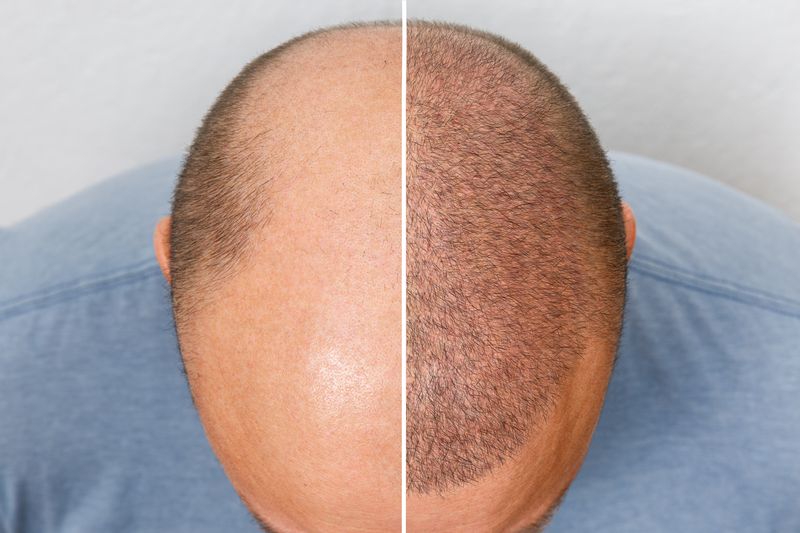
[Financial News] One year after hair transplantation, patients who have waited a long time often return to the clinic when the results fall short of expectations. Clinically, the problems from the initial surgery that lead patients to consider revision can be broadly classified into four categories: an unnatural hairline; transplanted hair that sticks out or grows in the wrong direction; gaps caused by an overall decline in graft survival; and depletion of the donor area at the back of the head due to excessive harvesting. An objective diagnosis must come first before revision surgery is considered.
The most noticeable problem occurs in the design of the frontal hairline. A natural human hairline does not descend in a perfectly straight line, as if drawn with a ruler. It has subtle irregularities, while extremely fine single hairs create a gradient with uneven density along the frontmost edge where the forehead meets the scalp. Ignoring this principle and implanting follicular units that produce two or three thick hairs in a dense, straight row at the very front can create an unnatural, doll-like appearance. If the hairline created during the initial surgery is not excessively low, one approach is to implant finer single-hair grafts in front of it in a scattered pattern to camouflage the thick line. However, if the hairline has been lowered too far, the thick-haired follicles must be individually removed with a punch without making an incision, then the hairline must be moved back—a highly challenging process.
Another common cause of failure is transplantation that does not match the hair's natural flow and angle. Each scalp hair grows at a different angle relative to the skin, which is why every person has a distinctive hair whorl. If this is ignored and follicles are implanted at an angle close to perpendicular, the growing hair will fail to blend with the existing hair and will stick outward like a hedgehog's spines. Severely misaligned follicles cannot be concealed simply by adding more hair around them to increase density. Ultimately, the incorrectly oriented follicles must be selectively extracted and reimplanted to match the flow of the surrounding hair. However, the tissue can sustain microscopic damage when follicles are reused, so the graft survival rate may inevitably decline.
Reduced density, with the scalp visible between transplanted hairs, is another common problem. It occurs when the grafts were implanted more sparsely than planned before surgery or when the transplanted follicles did not fully survive. Addressing it requires a precise density-enhancement procedure that fills the spaces between follicles that have already taken root and begun to grow. This demands much greater concentration than the initial surgery, which involves implanting follicles into an untouched scalp. The surgeon must accurately predict the direction of the roots of the existing follicles beneath the scalp—known as follicular units—and avoid them in order to protect the existing hair.
However, all of these corrections are effective only when enough usable follicles remain in the donor area at the back of the head. If too many follicles were harvested beyond the safe zone during the initial surgery, few resources may be left when it becomes necessary to correct the mistakes. The hair at the back of the head is not an inexhaustible resource. When the donor area is depleted, the scale of the surgery cannot be increased. In such cases, patients may have to accept a compromise: using body hair, such as beard hair, in a limited manner to add volume to the crown, while also undergoing scalp micropigmentation (SMP) to visually compensate for reduced density at the back of the head.
Many people want to undergo revision surgery as soon as possible, but an unsatisfactory result after the initial procedure does not mean correction can begin immediately. At least 10 months to one year is needed for microscopic scar tissue inside the scalp to soften and stabilize, and to assess the final density of hair that grows later after passing through the resting phase. In particular, a scalp with surgical scarring has less blood flow and is harder than normal tissue, making it less favorable for new follicles to survive. Before revision surgery, the scalp's flexibility and scar thickness must therefore be carefully evaluated, and the size and depth of the grafts must be precisely adjusted.
Many patients who visit a clinic want all of the unsatisfactory hair at the front removed so they can start over with a clean slate. They want to erase every trace of failure. But hair transplantation is not a sketch that can be erased and redrawn. The next step in correcting a failed procedure is not to rush into scheduling another surgery. Instead, patients should objectively count the follicles that remain safely available at the back of the head and set realistic goals for how much can be concealed and corrected with limited resources. The success of revision surgery does not lie in perfectly restoring everything that was lost. It begins with acknowledging the limits of the remaining resources and using them in the most effective way possible.

[email protected] Kim Hyun-sun Reporter