"Major shareholders already hold 44%, yet the tender offer covers only 50%+1 share"... Asset managers urgently push back [fn Market Watch]
- Input
- 2026-09-30 15:09:53
- Updated
- 2026-09-30 15:09:53
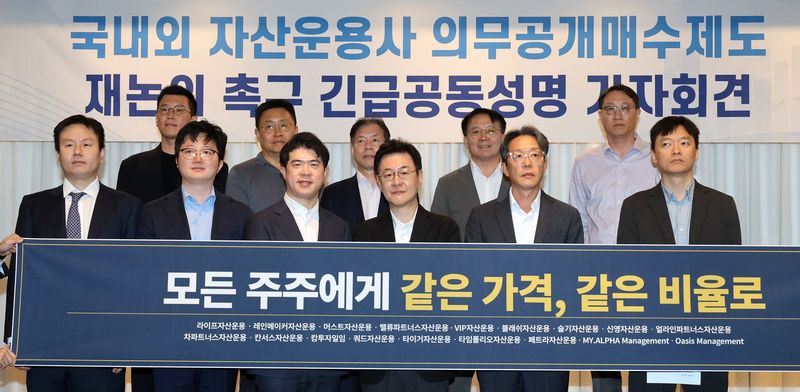
[Financial News]"Controlling shareholders already hold an average stake of 44%. If the mandatory tender offer extends only to 50%+1 share, how much would actually be left for general shareholders?"Changhwan Lee, CEO of Align Partners Asset Management, made the remark at a briefing on a joint statement by asset managers regarding the Political Affairs Committee bill on the mandatory tender offer system, held at Kensington Hotel Yeouido in Yeouido, Seoul, on the 30th. "An analysis of the average stake held by controlling shareholders in companies included in the KOSPI 200 Index shows that it stands at approximately 44%," he said.
Lee explained, "If an acquirer first purchases a controlling shareholder's 44% stake and then launches a tender offer up to 50%+1 share, it would need to purchase only about 6% more. General shareholders holding the remaining 56% would then have to divide that 6% tender offer allocation among themselves on a pro rata basis." He added, "Even if the tender offer is made at the same price, there can be a significant difference in the proportion that shareholders can actually sell."
Lee argued that the opportunity available to general shareholders may shrink as the controlling shareholder's existing stake increases. "If an acquirer first purchases the controlling shareholder's stake at a control premium and thereby exceeds 50%+1 share, it may no longer need to make an additional tender offer for shares held by general shareholders," he said. Even if the acquirer falls short of 50%, it would need to make a tender offer only for the shortfall, meaning that the stake general shareholders can actually sell may be limited.
Lee stressed that this issue cannot be viewed simply as a matter of how many shares are subject to a tender offer. His argument was that the value of the voting rights attached to the remaining shares held by general shareholders may also change once the acquirer secures 50%+1 share and obtains control.
He also presented differences in price-to-book ratios (PBRs) based on controlling shareholders' ownership stakes as supporting evidence. According to an analysis by asset managers, the average PBR was 1.31x among 756 listed companies where controlling shareholders held at least 50%, compared with 2.64x among 746 companies where they held less than 30%.
Lee said, "Because various factors affect corporate value, these figures alone cannot establish a causal relationship." However, he explained, "Once a controlling shareholder secures a majority, it becomes difficult for general shareholders to block a majority resolution at a shareholders' meeting even if they all unite. As a result, the value of governance rights may differ."
Kim Min-guk, CEO of VIP Asset Management, argued that the amendment could entrench the difference in share values between controlling shareholders and general shareholders in connection with what is known as "South Korea Is Becoming Uninvestable, Too."
Kim said, "When we examine South Korea Is Becoming Uninvestable, Too, the issue ultimately concerns the discount applied to listed shares, particularly those held by general shareholders. Controlling shareholders receive recognition for a control premium when they sell their shares, but general shareholders who hold the same common shares are unable to receive that premium even when control changes hands."
He continued, "Although one share held by a controlling shareholder and one share held by a general shareholder are the same common stock, a dual-pricing structure arises in control transactions, with different prices applied to them. If the bill passes as written, it could institutionally entrench the dual-pricing structure that has existed as a matter of practice."
Meanwhile, 18 domestic and overseas asset managers, including Life Asset Management, Align Partners Asset Management and VIP Asset Management, joined forces at the briefing and called for renewed deliberation on the proposed mandatory tender offer system.
[email protected] Kim Hyun-jung Reporter