Even Major Companies Were Not Spared... Nearly 100 Companies Designated as 'Unfaithful Disclosure Companies' Amid Stock Market Boom
- Input
- 2026-09-30 14:49:33
- Updated
- 2026-09-30 14:49:33
[Financial News] Poor disclosure management among domestic listed companies has shown little sign of improvement. As not only KOSDAQ-listed firms but also major corporations with high market recognition have been successively designated as unfaithful disclosure companies, concerns are growing over the transparency of information in the capital market. If disclosures intended to promptly inform investors of key corporate developments fail to serve their purpose, they can hinder rational investment decisions and undermine confidence in the market as a whole.
According to disclosure data from Korea Exchange (KRX) on the 30th, a total of 98 cases involving the final designation of companies as unfaithful disclosure companies had been recorded since the beginning of this year. Even after excluding cases in which sanctions were lifted following a preliminary designation and an explanation process, the figure was close to 100.
Analysts say disclosure violations are no longer isolated, one-off mistakes by individual companies but point to broader problems with disclosure management systems and internal controls across listed firms.
The issue is particularly noteworthy because unfaithful disclosures have repeatedly occurred at affiliates of major corporations and other prominent listed companies. Hanon Systems was designated as an unfaithful disclosure company last April for delaying the disclosure of confirmed embezzlement and breach-of-trust allegations, and was fined KRW 8 million. It was a case in which the company failed to promptly disclose important information that could affect its survival and investors' decisions.
Hanwha Solutions became subject to sanctions last June for failing to promptly disclose changes of 20% or more in the number of shares issued and the issue amount during the process of deciding on a paid-in capital increase. Jeju Bank was also designated as an unfaithful disclosure company last July for delaying the disclosure of its decision to issue contingent capital securities. Important information for investors, including funding plans and key management issues, was not delivered in a timely manner.
These cases show that a company's size or market recognition does not guarantee reliable disclosure management. When disclosures are delayed or altered in sensitive matters such as large-scale fundraising or embezzlement and breach of trust, investors may find it difficult to accurately assess a company's situation based solely on publicly available market information.
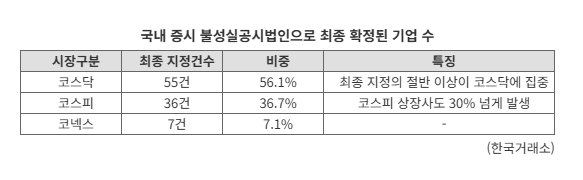
By market, the KOSDAQ Market Division accounted for 55 finalized designations, or 56% of the total. The Korea Exchange Main Board recorded 36 cases, while the KONEX Market recorded seven. The violations primarily involved disclosure changes and reversals, such as retracting disclosures concerning major contracts or earnings forecasts, as well as failures to make required disclosures, including delays in submitting reports and disclosing material facts.
The problem is that an unfaithful disclosure may not end with the payment of a simple fine. Repeated violations and accumulated penalty points can make a company subject to a substantive review of its listing eligibility, which could ultimately lead to delisting depending on the outcome. For companies, a cumulative record of disclosure violations may prove to be a greater burden than any short-term sanction.
The essence of disclosure is to reduce information asymmetry between investors and companies. If companies actively publicize favorable information while delaying the disclosure of unfavorable or sensitive matters, the market's price-discovery function will inevitably be distorted.
In a market environment like the current one, where stocks have remained range-bound without a clear leader, the fundamentals and information transparency of individual companies serve as important criteria for investment decisions.
A securities industry official said, "Unfaithful disclosures are more than a simple administrative sanction; they directly affect investor confidence and corporate value. Regardless of company size, it is becoming increasingly important for companies to review their internal control systems. Investors, meanwhile, should examine not only earnings and growth potential but also the consistency of disclosures and any history of past violations."
[email protected] Kang Jung-mo Reporter