"Wetland reclaimed to build a pet-friendly beach" ... 300 citizens seek an audit of Seogwipo City
- Input
- 2026-09-30 14:31:19
- Updated
- 2026-09-30 14:31:19
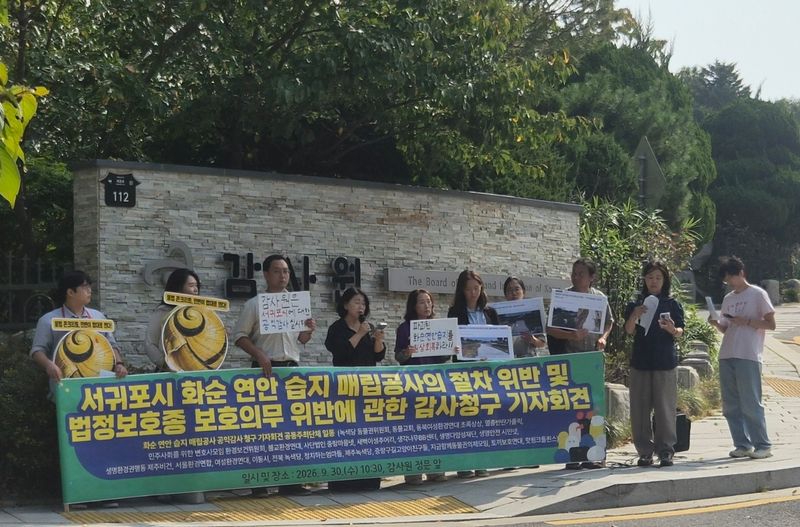
[Financial News] Civic groups have filed a public-interest audit request with the Board of Audit and Inspection over Seogwipo City's concrete reclamation of part of Hwasun coastal wetland, where legally protected species inhabit, for the development of a pet-friendly beach. They said Seogwipo City proceeded with the construction without completing the required prior consultation procedures and called for responsibility to be established and the damaged wetland to undergo ecological restoration.
On the 30th, the Environmental Health Committee of Lawyers for a Democratic Society and other civic groups held a press conference outside the main gate of the Board of Audit and Inspection in Jongno-gu, Seoul, and submitted an audit request signed by 300 citizens.
Kim Sori, a lawyer with Minbyun's Environmental Health Committee, said, "The BAI must thoroughly determine how the procedures were violated and establish the responsibility of the relevant public officials." Kim added, "It must independently investigate how much harm was caused to legally protected species and others, and lead corrective measures to restore the damaged wetland to its original condition and ecologically rehabilitate it."
The site at the center of the controversy is the coastal wetland around Hwasun Golden Sand Beach in Andeok-myeon, Seogwipo City, Jeju. The area is a brackish-water zone where freshwater flowing down from Hallasan meets seawater. It is known to provide habitat for Clithon retropictum, an endangered wildlife species and marine protected species.
Seogwipo City reclaimed part of the wetland with concrete in June while pursuing a project to develop a pet-friendly beach to attract tourists. According to civic groups, dozens of Clithon retropictum were found near the construction site, raising the possibility that the animals and their habitat were damaged during the work.
Civic groups alleged that Seogwipo City began construction before completing the required administrative procedures. Minbyun said that, after reviewing materials obtained through information-disclosure requests, it found that construction began on May 15 without the prior consultations and approvals required for public-water reclamation or the required marine-use consultation. The groups also said they found no documents showing that the presence of legally protected species or the potential ecological impact of the construction had been assessed in advance.
Civic groups stressed that measures were needed not only to remove the concrete but also to restore the damaged wetland's ecological functions. Kim Jeong-Duck, a full-time activist with Political Mamas, said, "Water is currently flowing over the concrete." Kim urged, "Since it is unclear whether removing the concrete alone would restore the former ecosystem as it was, a broader ecological restoration plan is necessary."
Some also pointed out that reclaiming the wetland could affect the surrounding ecosystem as a whole, not just individual species. Han Hye-won, secretary-general of Buddhist Environmental Solidarity, criticized the project, saying, "When concrete blocks a space where rivers and the sea are connected and countless living things make their homes, it does not damage just one part of nature; it severs the entire web of ecological relationships." Han added, "Damaging the habitats of other wildlife on the grounds of creating a space for companion animals cannot be justified."
The civic groups called on the BAI to address the following: determine whether procedures were violated during construction and establish responsibility; investigate damage to legally protected species and the ecosystem; ecologically restore the damaged coastal wetland; and improve local governments' preliminary review systems.
[email protected] Lee Dong-hyuk Reporter