Yoo Jae-hoon: "Insurance Must Change Its Risk Management Approach in the AI Transformation Era"
- Input
- 2026-09-30 14:48:09
- Updated
- 2026-09-30 14:48:09
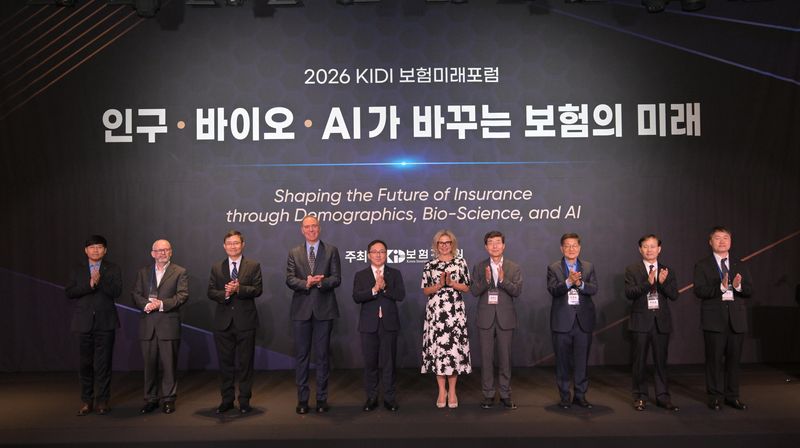
[Financial News] Yoo Jae-hoon, president of the Korea Insurance Development Institute, said on the 30th, "The future insurance industry must be redefined as an 'integrated risk manager' that protects customers throughout their lives." While insurance has traditionally calculated probabilities, underwritten risks, and paid claims after accidents, it must now shift toward controlling risks in advance and preventing crises through advances in artificial intelligence (AI) and biotechnology.
In his opening remarks at the 2026 KIDI Insurance Future Forum, held that day at FKI Tower in Yeouido, Seoul, Yoo said, "The era of AI transformation (AX), in which AI, biotechnology, and real-world data converge, is changing the very paradigm through which we understand and manage risk."
Yoo assessed that the insurance industry is facing three major changes: demographic shifts, advances in biotechnology, and the rapid evolution of AI.
He explained that with the emergence of generative AI and AI agents, AI is evolving into an independent decision-maker. It is also expanding into the realm of physical AI, such as robots, and developing into technology that acts alongside people in the real world.
At the same time, he pointed out that AI could create new risks. Yoo said, "It creates new risks that did not exist in the past, including algorithmic errors, system malfunctions, and emerging cyber threats," adding, "AI can be both a technology that reduces risks and one that creates new risks."
Accordingly, he stressed that it is important not only to adopt technology quickly but also to develop the capacity to control the risks it entails. New risks, including bias in AI algorithms, cybersecurity threats, and ambiguity over who is responsible, must be managed proactively.
Yoo said, "The highly advanced risk-management capabilities needed to pursue innovation while firmly upholding human-centered ethics and social trust are the true essence that the insurance industry must demonstrate in the era of the technological singularity."
He also identified demographic change and advances in biotechnology as factors reshaping the role of the insurance industry. As society enters a super-aged phase, insurance customers and their coverage needs are changing. Healthcare, meanwhile, is shifting from treating illnesses after they occur toward early prediction and prevention.
The Insurance Future Forum, now in its sixth year, was held under the theme "The Future of Insurance Shaped by Demographics, Biotechnology and AI." With experts from Korea and abroad in attendance, participants discussed the use of AI, biotechnology, and heterogeneous data in the insurance industry; the future of insurance amid population aging; automated retinal image analysis; physical AI; and changes to insurance business models driven by AI agents.
Boston Dynamics demonstrated the robots Spot and Spot Arm under the theme of physical AI, while the Korea Insurance Development Institute highlighted the need to strengthen AI governance and proactive AI risk-management capabilities.
[email protected] Hong Ye-ji Reporter