Wind Data from the Cheollian Satellite 2A to Be Compared with the United States, Europe and Japan
- Input
- 2026-09-30 11:01:37
- Updated
- 2026-09-30 11:01:37
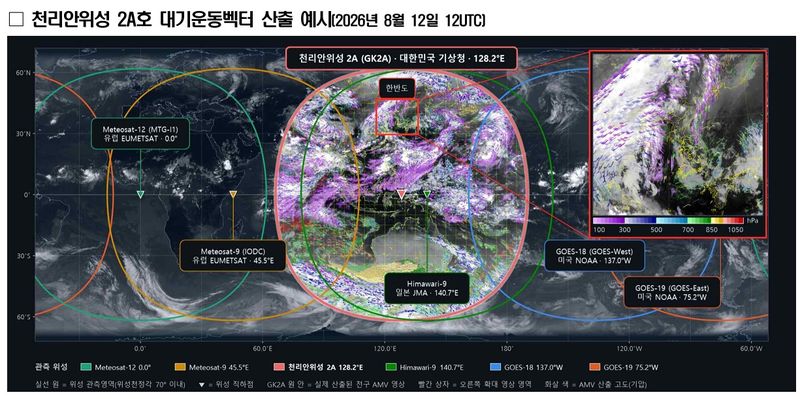
[Financial News] The Korea Meteorological Administration (KMA) will compare the performance of wind data retrieved from the Cheollian Satellite 2A with data produced by major satellite agencies in the United States, Europe and Japan.
The KMA announced on the 30th that it will participate in the Fifth International Intercomparison Study of Atmospheric Motion Vectors, organized by the International Winds Working Group (IWWG).
Atmospheric motion vectors are wind data calculated by tracking the direction and distance of cloud movements in images taken at 10-minute intervals by geostationary meteorological satellites observing the same area. They help fill observation gaps in areas such as oceans, deserts and polar regions, where installing ground-based observation equipment is difficult.
To produce wind data, clearly defined clouds are first selected in small areas of satellite images. Their temperatures are measured and their altitudes are calculated. The movement of the same clouds is then tracked twice across three consecutive images, and the displacement is averaged to determine wind direction and speed.
However, satellite-operating agencies around the world use different methods to select clouds and calculate their altitude and displacement. As a result, even when the same clouds are tracked, the retrieved wind direction, intensity and altitude may vary.
In this joint study, the KMA, the European Organisation for the Exploitation of Meteorological Satellites (EUMETSAT), the Japan Meteorological Agency (JMA) and the National Oceanic and Atmospheric Administration (NOAA) will compare each agency's wind retrieval results using the same observation data. Observation imagery from EUMETSAT's third-generation geostationary meteorological satellite MTG-I, along with cloud-detection imagery and cloud-top pressure imagery, will be used as common data.
The KMA submitted its wind retrieval results from the Cheollian Satellite 2A to the International Winds Working Group on the 16th. The participating agencies' analysis results will be shared at the 2027 International Winds Workshop.
The KMA plans to improve the wind retrieval technology of the Cheollian Satellite 2A based on the comparison results.
KMA chief Lee Mi-sun said, "This is an opportunity to analyze our technology using the same standards as major satellite agencies around the world." She added, "Based on our experience in the joint study, we will further advance the wind retrieval technology of the Cheollian Satellite 2A."
[email protected] Lee Bo-mi Reporter