Police Strengthen Patrols in Areas Densely Populated by Women Living Alone, Deploying Drones and Patrol Robots
- Input
- 2026-09-30 12:00:00
- Updated
- 2026-09-30 12:00:00
[Financial News] Police are strengthening patrols in areas densely populated by women living alone and deploying advanced equipment, including drones and patrol robots. They are also reinforcing a response system under which local police, women-and-youth units, and criminal investigation units respond together to reports of relationship-based crimes such as stalking and domestic violence.
The Korean National Police Agency said on the 30th that it would conduct comprehensive public safety activities for three months, from October 1 through December 31, to ease public anxiety heightened by violent crimes and accidents involving women and improve women’s perceived sense of safety.
First, flexible patrols will be strengthened in areas where many women living alone reside, such as neighborhoods with studio apartments, as well as around vacant or abandoned houses where residents feel particularly uneasy. Forty-five police drones equipped with thermal-imaging cameras and searchlights will be deployed in blind spots that are difficult to monitor from the ground.
Police units in Goyang, Gwangju Gwangsan, Bundang, and Jeonju are currently piloting patrol robots. They plan to deploy the robots in locations that can be linked to areas densely populated by women living alone and use them for patrols.
The response to relationship-based crimes such as stalking and domestic violence will also be strengthened. Police will avoid simply closing these cases and, in principle, assign a response level of Code 1 or higher when a 112 report is received, so that local police and women-and-youth and criminal investigation units respond simultaneously. They will also actively promote the 112 reporting app, which allows users to transmit their location and file reports through video, audio, and chat in emergencies.
Private security companies and volunteer patrol groups will also participate in public safety activities. In cooperation with major and mid-sized security firms, including S-1, SK Shieldus, and KT Telecop, police have reassigned 483 response vehicles to 619 vulnerable areas, including safe routes home for women. They also plan to expand nationwide the escort-home service currently operated by 147 volunteer patrol groups across the country for women and students.
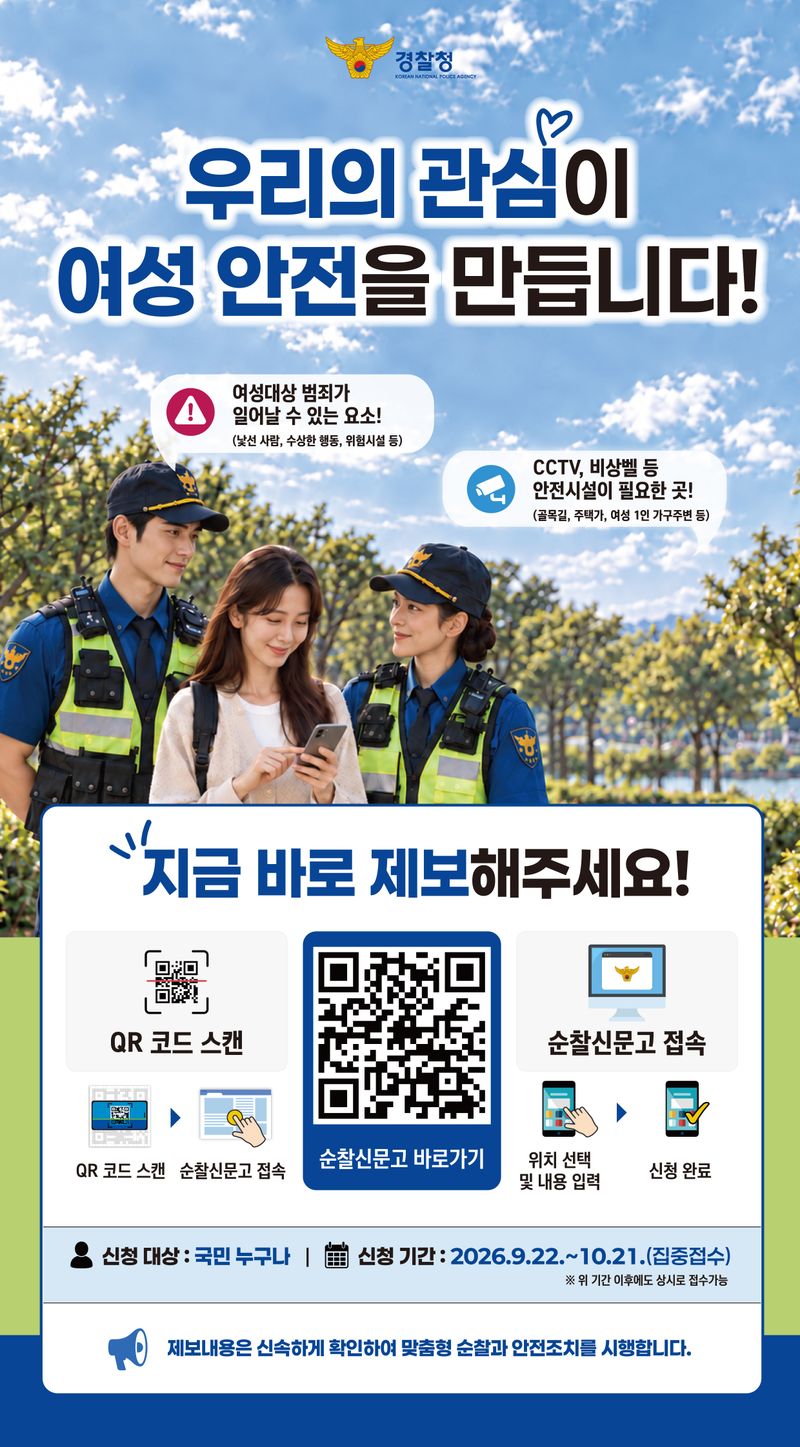
Citizens’ reports will be used to identify crime-vulnerable areas. From the 22nd through October 21, police have been accepting reports through Police Civil Service 24’s “Patrol Sinmungo” regarding places where crimes against women are feared or where safety facilities such as closed-circuit television (CCTV), emergency bells, and lighting are needed. The reports received will be reflected in patrols and local public safety policies, and will also be used to select future Crime Prevention Through Environmental Design (CPTED) projects and determine patrol areas for volunteer patrol groups and private security companies.
Crime-prevention facilities will also be expanded. Next year’s CPTED projects will focus on improving facilities such as CCTV and lighting along 1,230 safe routes home for women that were not covered by related projects this year. In consultation with local governments, police will also promote the expansion of intelligent CCTV systems, voice-recognition emergency bells, safe-return apps, and escort services. Portable CCTV systems will be added in areas with insufficient infrastructure for crime-prevention facilities or where flexible operation is needed.
A discount-support program for crime-prevention products, including home security cameras and emergency bells, has been available since last November for stores operated by women living alone. It will now be expanded to crime-vulnerable groups, including women living alone. A total of 5,000 recipients will be eligible for support.
Measures to protect foreign women will be carried out as well. In areas densely populated by foreign women and other crime-vulnerable areas, the country’s 71 foreign-national volunteer patrol groups and the foreign affairs units of 23 metropolitan crime-prevention patrol teams will conduct joint and coordinated patrols. Police will provide crime-prevention education in cooperation with multicultural support centers and similar organizations. They also plan to inform undocumented foreign nationals who have been victims of crimes about the “exemption from notification to immigration authorities” system, under which public officials may be exempted from their obligation to notify immigration authorities if certain conditions are met.
The Korean National Police Agency said, "Through these public safety activities, we will swiftly identify and proactively improve crime-vulnerable factors reported by the public. We will do our utmost to reduce the anxiety women feel in their daily lives by actively linking local public safety resources, including volunteer patrol groups and private security companies."
[email protected] Yeji Kim Reporter